Fundamentals Videos
Browse videos in the Fundamentals category.

Geriatric Nursing Essentials: Assessment, Safety, and Communication Strategies
Comprehensive review of essential geriatric nursing concepts including physiological changes of aging, differentiation between delirium and dementia, key safety assessments (falls, polypharmacy, elder abuse), ethical considerations in older adult care, and effective communication techniques. Includes practical strategies for supporting both patients and their caregivers in geriatric healthcare settings. Learning Objectives: - Identify normal aging changes and their clinical implications - Distinguish between delirium and dementia presentations - Implement evidence-based safety interventions for older adults - Navigate ethical dilemmas involving autonomy and beneficence - Apply age-appropriate communication techniques
Mastering Hyperthyroidism
If endocrine questions are wrecking your confidence, this hyperthyroidism deep-dive is your fix. In this NCLEX/Next Gen (NGN) walk-through, we mirror the Clinical Judgment Model from start to finish—recognize cues, analyze labs, set priorities, and manage worst-case scenarios—so you can answer confidently and practice safely.

Labor & Delivery: Assessment and Nursing Priorities
Practice organizing maternal and fetal assessment during labor and connecting your findings with nursing priorities. This focused lesson covers assessment after suspected membrane rupture, labor stages, introductory fetal heart-rate assessment, concerning changes, prompt team communication, and reassessment during supervised care. It also emphasizes listening to the patient's concerns and providing respectful support. Designed for nursing students preparing for maternity clinicals and NCLEX review. Based on OpenStax Maternal Newborn Nursing, ACOG's 2024 labor-management and 2025 fetal heart-rate monitoring guidelines, and CDC HEAR HER maternal warning signs. This AI-assisted explainer uses synthetic narration. Apply what you learn within your scope of practice, facility protocols, provider orders, and supervised clinical training.
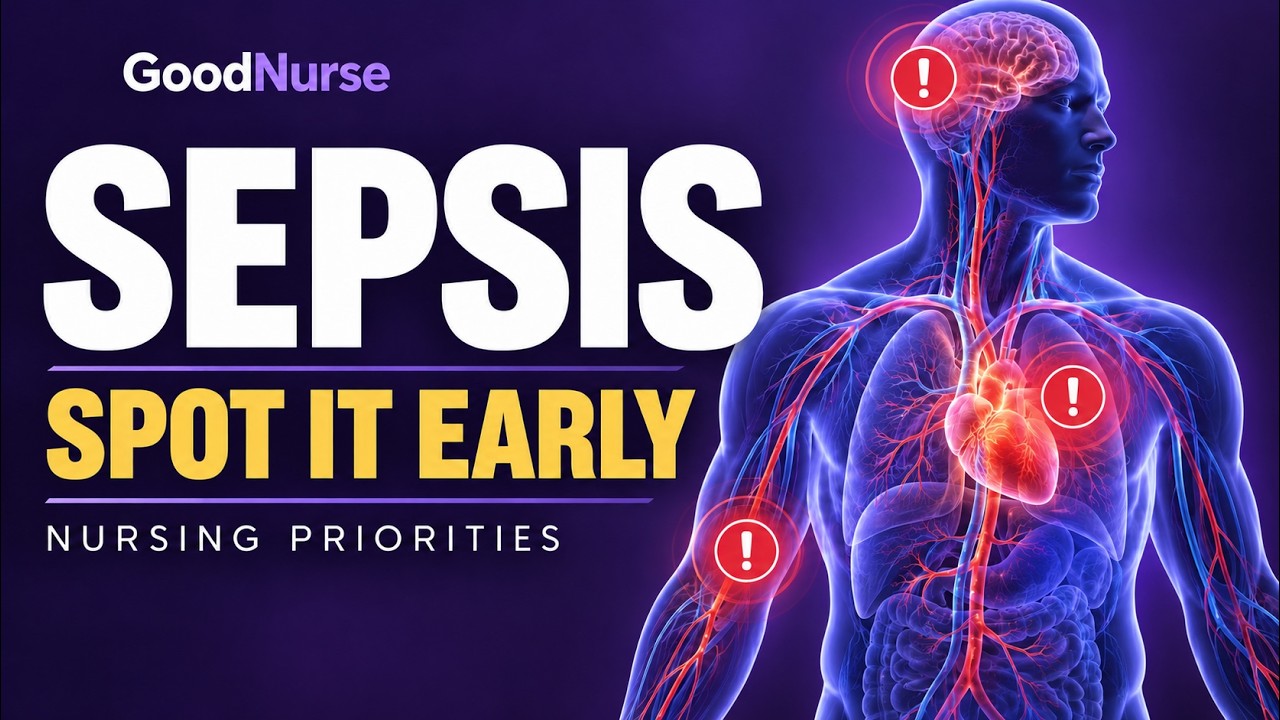
Adult Sepsis: Recognition, Escalation, and Nursing Priorities
Practice recognizing possible sepsis and organizing your response when an adult patient deteriorates. Clinical clarification (3:41–4:11): The three-hour window applies only to possible sepsis without shock; it is not a reason to delay indicated antibiotics. Perform rapid evaluation and give antimicrobials within three hours if infection concern persists. Shock or probable/definite sepsis calls for immediate treatment, ideally within one hour. The phrase “no exceptions” is too absolute: apply clinical judgment, patient-specific factors, and local protocols. In the recap case, the findings suggest possible shock and require immediate assessment; the brief scenario alone does not confirm shock. After watching, you should be able to identify concerning changes in mental status, breathing, circulation, and temperature; communicate findings promptly; explain the purpose and limitations of blood cultures and lactate; and describe nursing responsibilities during ordered antimicrobial therapy, fluid resuscitation, and reassessment. The lesson emphasizes clinical context, individualized care, and ongoing communication. Based on CDC resources and the 2026 Surviving Sepsis Campaign adult guidelines. This AI-assisted explainer uses synthetic narration. Apply what you learn within your scope of practice, facility protocols, provider orders, and supervised clinical training.

Receiving an Adult After Surgery: Handoff and Reassessment
Practice receiving a postoperative adult on an inpatient ward alongside the receiving RN. Connect the PACU handoff with the patient’s condition now, organize focused arrival checks within a complete assessment, and recognize changes that need prompt escalation. Use a fictional practice scenario, respectful patient communication and SBAR to report actual observations and request help. Urgent breathing or consciousness concerns interrupt a routine checklist; do not delay help to finish an assessment, score or handoff. Follow the individual orders, local monitoring and emergency pathways, and required supervision. This overview does not authorize independent transfer clearance, diagnosis, medication or equipment changes. AI-generated visuals and synthetic narration. Follow current clinician instructions and local policy.
Adult Pneumothorax: Recognition and Nursing Priorities
Build a focused approach to recognizing and reporting possible pneumothorax in an adult patient. Review pleural air and lung expansion, respiratory and circulatory changes, and why worsening physiology calls for prompt escalation. Practice prioritizing an urgent concern and organizing an SBAR request for bedside help. Learn how clinician-selected treatment and repeated assessment fit together, while keeping care within student scope, supervision, orders and local protocols. For nursing-student education. Includes a fictional scenario, AI-generated visuals and synthetic narration with source-based editorial review. This overview does not teach invasive procedures or replace supervised clinical skills training.

Adult Osteoarthritis: Pain, Function and Supported Activity
Connect established adult knee osteoarthritis with assessed pain, stiffness and meaningful daily function. Practice using PAIN / FUNCTION / CHANGE to compare current symptoms with baseline, support the individualized clinician/PT plan alongside the supervising RN, and communicate observations and response. Work through a fictional daily-activity goal, respectful teach-back and a changed-symptom scenario. Recognize a newly hot swollen joint, sudden severe pain or major loss of movement as concerns needing prompt assessment rather than an assumed OA flare; fever may be absent. Follow current local pathways, orders, assistance and RN/preceptor guidance. This original study organizer is not a validated or complete clinical protocol, exercise prescription or competency assessment.
Adult Shock: Recognize Poor Perfusion and Escalate
Compare hypovolemic, cardiogenic, obstructive and distributive shock. In a fictional adult case, practice recognizing a concerning change in perfusion, calling for immediate help and giving a focused SBAR. The lesson connects bedside assessment to action within supervised nursing-student scope and your facility’s escalation pathway.

Pharmacology Foundations: Medication Safety and Nursing Judgment
Practice a structured approach to medication safety before, during, and after administration. Connect the medication and indication with a focused assessment, verify the order and patient identifiers, recognize when to pause and clarify a concern, and reassess the response. This lesson includes a fictional patient scenario, high-alert medication concepts, respectful communication, documentation, and teach-back. The before/during/after organizer supports studying; assessment remains continuous and urgent deterioration needs immediate escalation. For nursing-student learning under RN/preceptor supervision. Use current orders, approved medication references, and local protocols. Created with AI-assisted visuals and synthetic narration; source comparison does not constitute qualified clinician sign-off.
Adult Cranial Nerve Assessment: Function, Findings, and Escalation
Connect adult cranial nerve function with focused bedside assessment. Review selected checks for smell and sight, eye movements and pupils, facial sensation and expression, hearing, voice and palate, shoulder strength, and tongue movement. Compare findings on both sides and with the patient's baseline, account for communication and sensory needs, and document what you actually assessed. Use a fictional case to practice recognizing a new facial or speech change and promptly escalating to your supervising nurse and the appropriate emergency response. Distinguish limited bedside observations from a formal swallowing screen, and avoid delaying urgent care to finish a routine sequence. This is an introductory study overview, not a complete neurological examination, stroke diagnostic test or competency validation. Follow current school and facility procedures and work within supervised student practice. Based on Open RN/WisTech Open Nursing Skills 2e (2023), Merck Manual Professional (updated February 2026), CDC stroke warning-sign guidance (2026), and Canadian Stroke Best Practices. Includes AI-generated visuals and synthetic narration; no qualified clinician review or source-organization endorsement is claimed.
Adult MDI Technique: Assessment, Spacer Use and Patient Teaching
Practice a focused nursing-student approach to adult metered-dose inhaler (MDI) teaching. This lesson follows a stable adult using a prescribed manually actuated MDI with a compatible mouthpiece valved holding chamber. Review breathing first, verify the actual medicine and device instructions, recognize common technique errors, and use a respectful return demonstration. Learn why one puff at a time, a slow inhalation and device-specific preparation matter, and when breathing difficulty calls for urgent escalation instead of routine teaching. An introductory educational overview for supervised study—not a competency assessment or individual treatment plan. Follow the prescription, manufacturer instructions and local protocols. AI-generated visuals and synthetic narration; reviewed against public NHLBI, American Thoracic Society and American Lung Association educational sources. No qualified clinician review is claimed.
After Discharge: Recognizing Urgent Maternal Warning Signs
Practice recognizing and reporting urgent concerns after pregnancy and birth. This focused nursing-student lesson follows a fictional patient who returns after discharge with concerning symptoms. Connect recent pregnancy history, respectful listening and selected maternal warning signs with prompt communication and the appropriate urgent or emergency response. Review a concise handoff and patient teaching about when and where to seek care. Some pregnancy-related complications can occur during the year after delivery; timing differs by condition. Warning examples are not an exhaustive checklist or a diagnosis. Work within student supervision and current orders and local protocols, and do not delay urgent care for a routine appointment or assessment checklist. AI-generated visuals and synthetic narration, reviewed against public CDC HEAR HER and Alliance for Innovation on Maternal Health educational resources. This is a study overview, not individual treatment advice or competency validation. No qualified clinician review or source-organization endorsement is claimed.