

You see the job listing:
- $155,000/year in San Francisco
- $88,000/year in Houston
Your instinct says the San Francisco job is the winner.
Your instinct is wrong.
In 2026, the gross number on your offer letter is arguably the least important metric in your career planning.
The travel nursing “gold rush” has stabilized. We have entered the era of Strategic Relocation.
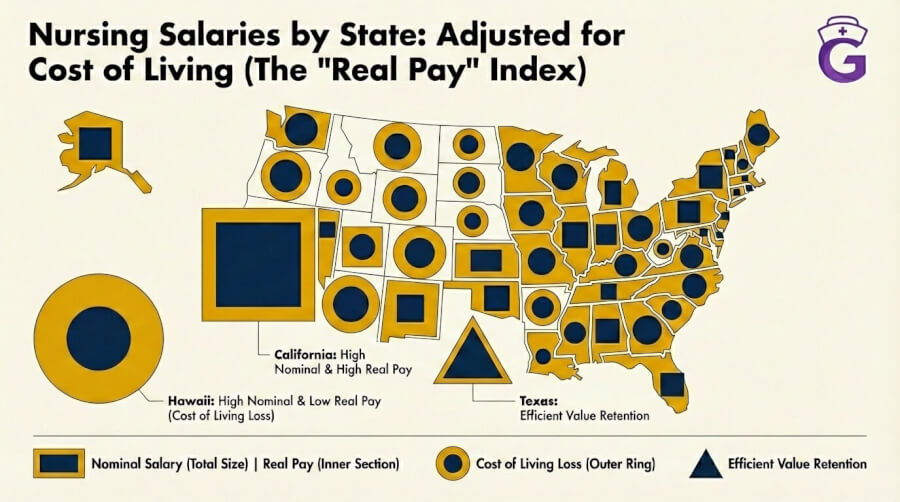
What matters now is Purchasing Power Parity (PPP) — how much house, groceries, savings, and lifestyle your income actually buys after taxes, rent, and cost of living are factored in.
While competitors publish static “highest salary” lists, GoodNurse provides Dynamic Career Intelligence — data interpreted through the lens of real-world financial strategy.
If you're planning your career beyond just passing the exam, start with our
Ultimate Guide to the 2026 NCLEX-RN and NCLEX-PN Test Plans
so you understand the licensing pathway before mapping relocation strategy.
The 2026 "Top 10" Real Value States
This table ranks by Paycheck Power, not just paycheck size.
- Gross Salary: Projected 2026 RN average (based on BLS trends)
- COLI: Cost of Living Index (National Average = 100; lower = better)
- Adjusted “Real” Salary: What that income actually feels like
| Rank | State | Mean Annual Salary (Gross) | COLI | Adjusted “Real” Salary |
|---|---|---|---|---|
| 1 | Texas | $88,400 | 92.5 | $95,567 |
| 2 | Nevada | $96,200 | 101.3 | $94,965 |
| 3 | Georgia | $84,500 | 89.2 | $94,730 |
| 4 | Tennessee | $81,300 | 88.7 | $91,657 |
| 5 | California | $136,000 | 149.9 | $90,727 |
| 6 | North Carolina | $82,100 | 91.0 | $90,219 |
| 7 | Michigan | $83,000 | 92.2 | $90,021 |
| 8 | Missouri | $79,500 | 88.4 | $89,932 |
| 9 | Arizona | $89,000 | 100.8 | $88,293 |
| 10 | Florida | $85,200 | 99.1 | $85,973 |
Notice something surprising:
California’s massive gross salary collapses once COLI is applied.
This is why financial literacy is becoming as important as clinical literacy in 2026.
🤖 AI Insight: The “Georgia Jump”
Why is Georgia climbing the rankings?
Our analysis of 2026 healthcare migration trends shows a supply deficit in the Atlanta metro region.
Major hospital systems such as Emory and Piedmont are competing aggressively for staff. Combine that with:
- COLI 11% below national average
- Moderate tax burden
- Strong suburban housing expansion
The result?
Georgia currently offers one of the highest Return on Investment (ROI) states for new graduate RNs.
If you're still in school and planning relocation after licensure, review
how to register and prepare for the NCLEX step-by-step
so your timeline aligns with hiring cycles in high-growth states.
The “Geo-Arbitrage” Strategy: Living in the Margins
Smart nurses in 2026 are using a strategy called Geo-Arbitrage.
Work in a high-paying zone.
Live in a lower-cost zone nearby.
Example: Sacramento vs. San Francisco
- San Francisco RN: $155k salary, $4,200/month rent
- Sacramento RN: $145k salary, $2,100/month rent
The Sacramento nurse effectively earns a $25,000 annual lifestyle bonus simply by living 90 miles inland.
Another classic example:
- Work in Oregon (higher pay)
- Live in Washington (no state income tax)
Strategic location selection now matters as much as specialty selection.
If you’re deciding between specialties before relocation, review
Best AI Apps for Nursing Students in 2025 (Career Planning Edition)
to understand which specialties are seeing wage acceleration.
Visual Mnemonics: Remembering the “Pay Zones”
Just like you use mnemonics for pharmacology or lab values, use memory hooks for economic patterns.
The “W.A.M.” States (High Gross / Lower Net)
- Washington
- Alaska
- Massachusetts
The Hook
These states pay large salaries — but your money gets hit by:
- Water (shipping costs to AK/HI regions)
- Air (higher travel expenses)
- Mortgages (housing inflation)
Verdict
Excellent for:
- Travel contracts (housing often subsidized)
More difficult for:
- Long-term staff nurses planning to buy property
If you're considering travel contracts post-licensure, make sure your clinical foundation is strong first. High-acuity assignments demand solid fundamentals, especially in areas like
NGN Med-Surg Physiological Adaptation case studies.
Strong clinical reasoning increases your mobility and negotiating power.
Career Intelligence Tip
Before relocating for salary alone, ask:
- What are housing trends?
- Is the hospital unionized?
- What are specialty demand projections?
- Is there a state income tax?
- What is malpractice climate and staffing ratio legislation?
Your RN license is an economic asset.
Understanding where it performs best is strategic.
The “S.U.N.” States (High Surplus)
- South Carolina
- Utah
- Nebraska
The Hook: Where Your Paycheck Stays “Sunny”
These are states where your cost structure is light and your purchasing power stretches further.
Verdict
These states offer what we call a Lifestyle Surplus.
After paying rent, utilities, groceries, and transportation, nurses in these states often have more discretionary income than nurses earning significantly higher gross salaries in New York or California.
High surplus states are particularly attractive for:
- New graduates building savings
- Nurses paying off student loans
- RNs planning early home ownership
If you're still preparing for licensure before relocating, review our
complete NCLEX registration guide with step-by-step instructions
so your timeline aligns with multi-state application strategies.
The “Bucket” Visual: Understanding Retention
Imagine your salary is a bucket of water.
The California Bucket
It is a massive bucket (highest gross pay).
But it has large holes labeled:
- State income tax (9–13%)
- High housing costs
- Elevated fuel and utility prices
By the time you get home, the bucket is half empty.
The Texas Bucket
It is a medium-sized bucket.
But it has:
- 0% state income tax
- Lower median housing costs
- Lower overall COLI
You carry more water home.
The Mississippi Bucket
It is a small bucket.
However, the water is “frozen.”
Costs are extremely low — but because your starting salary is also low, saving for nationally priced purchases (cars, travel, investment property) becomes slower.
Understanding how salary behaves relative to fixed national costs is critical for long-term wealth building.
Financial decision-making matters just as much as clinical skill development in 2026. If you’re mapping long-term career growth, explore how specialty demand affects income ceilings in our
Best AI tools and career-planning resources for nursing students.
The “Compact” Factor: Mobility Is Money
In 2026, the Nurse Licensure Compact (NLC) now covers over 40 jurisdictions.
This has created a two-tier wage ecosystem.
Compact States (TX, TN, FL, AZ)
- Easier interstate mobility
- Faster onboarding
- Less licensing friction
Because hospitals can recruit across state lines quickly, wage premiums tend to normalize.
However, mobility allows you to:
- Accept crisis contracts
- Pick up seasonal assignments
- Relocate without months of paperwork
If you are considering multi-state practice, understanding the licensure structure is critical. Review
the 2026 NCLEX-RN and PN test plan overview
to understand how compact licensure interacts with testing and endorsement pathways.
Non-Compact “Wage Fortresses” (CA, NY, HI)
These states operate like controlled labor markets.
Because it takes:
- Months to obtain licensure
- Hundreds of dollars in fees
- Additional documentation
Hospitals must offer higher gross salaries to attract external talent.
Career Strategy Tip
Holding:
- One Compact License
- One California License
creates a powerful 2026 income portfolio.
It gives you:
- Flexibility
- Premium market access
- Negotiation leverage
Mobility increases bargaining power — especially if your clinical foundation is strong in high-demand specialties such as ICU, ER, or Med-Surg.
If you want to strengthen high-acuity clinical reasoning before entering competitive markets, review
NGN Med-Surg Physiological Adaptation case studies.
Higher skill → higher leverage.
AI Deep Dive: The “Hidden Tax” of High-Pay States
Many nurses fall into what we call the Progressive Tax Trap.
Moving from:
- Florida (0% state income tax)
to - New York (state + city income tax)
does not just require a raise to offset cost of living.
It requires a raise to offset taxation layers.
The Math
To maintain the same lifestyle as a Florida RN earning $145,000, a New York RN may need to earn approximately $200,000+.
Why?
Because marginal tax brackets mean you may need to earn $1.40 to keep $1.00 at higher income tiers.
This is why gross salary comparisons alone are misleading.
Strategic relocation requires:
- Tax modeling
- COLI analysis
- Licensing flexibility
- Specialty leverage
Your RN license is not just a credential.
It is an economic instrument.
Understanding where it performs best is how you maximize its yield.
2026 Trend Watch: The Rise of “Internal Agency”
A major shift in 2026 is the decline of traditional external travel nursing and the rise of Internal Resource Pools.
Hospital systems realized they were losing millions to outside staffing agencies. In response, large networks such as HCA, Kaiser, and UPMC have launched their own internal “travel” or “float” teams.
The Trade-Off
Internal resource pool roles often:
- Pay significantly more than traditional staff positions (sometimes approaching $90–$100/hr)
- Offer local assignments
- Provide schedule flexibility
However, they may lack:
- Full benefit packages
- Seniority protections
- Pension or union leverage
The Strategy
For nurses in “Top 10 Real Value” states like Texas or Georgia, joining an internal float pool is often the fastest way to reach six figures without relocating.
If you're considering high-acuity float roles, strengthen your clinical readiness first with
NGN Med-Surg Physiological Adaptation case studies.
Higher skill = higher earning ceiling.
Regional Breakdown (2026 Trends)
The West Coast: The “Housing Squeeze”
Pros
- Strong unions
- Mandated nurse-to-patient ratios (CA, OR)
- Highest gross pay
Cons
- Severe housing affordability compression
- In coastal cities, the income required to buy a median home outpaces RN wages by nearly 2:1
Strategy
Best suited for:
- Younger nurses willing to rent or share housing
- Experienced nurses who already own property
California continues to lead in working conditions, but if you're evaluating financial trade-offs, revisit the cost-adjusted rankings above and compare them against your licensure options in the
2026 NCLEX-RN and PN Test Plan overview
to understand how relocation impacts endorsement timing.
The Midwest: The “Goldilocks Zone”
Pros
- Strong purchasing power
- Single-income home ownership is realistic in states like Ohio, Michigan, and Missouri
- Lower overall COLI
Cons
- Slower wage growth compared to coastal markets
The Midwest currently offers one of the best stability-to-income ratios for early-career nurses.
If you’re planning relocation directly after licensure, review
the complete NCLEX registration and licensure guide
so your timeline aligns with endorsement processing in these states.
The South: The “New Leader”
Pros
- Massive hospital system expansion (HCA, Ascension)
- Wage growth outpacing inflation in TN, GA, TX
- Strong hiring incentives
Cons
- Lower union density
- Higher average patient ratios
Southern states are emerging as high-ROI markets, particularly for nurses comfortable in fast-paced systems.
AI Relocation Logic: The “Nurse Move” Prompt
Do not guess your salary needs.
Instead of relying on generic calculators, use structured economic reasoning.
Inside GoodNurse, you can input:
“I am a Registered Nurse currently living in [Current City, State] making $[Current Salary]. I am considering moving to [Target City, State]. Based on projected cost of living differences, state income tax, and housing costs, what hourly rate do I need to negotiate to maintain my current standard of living?”
This approach integrates:
- COLI
- State tax burden
- Housing differentials
- Net purchasing power
Strategic salary negotiation now requires data interpretation — not instinct.
Frequently Asked Questions
Which state has the highest nursing salary after taxes?
In 2026, Texas and Nevada frequently rank near the top due to:
- High base wages
- 0% state income tax
- Moderate cost of living outside major metro cores
Is California still the best state for nurses in 2026?
If your priority is union protection and mandated ratios, yes.
If your priority is maximum purchasing power, California currently ranks lower once cost of living is applied.
What Is the “Golden Handcuff” Bonus Trap?
Many hospitals in lower-paying states offer large sign-on bonuses (sometimes $20,000–$30,000).
However:
- Bonuses are heavily taxed (often 35–40%)
- They require multi-year commitments
- The hourly base rate may still be below market
Always convert the bonus into an hourly equivalent over the contract term before signing.
Financial literacy is part of professional growth.
Ready to Maximize Your Earnings?
Do not just look for a job.
Look for a location strategy + specialty leverage + mobility advantage.
Before accepting relocation packages or residency contracts, make sure your clinical foundation is strong and your licensure plan is mapped.
Start with:
A stronger nurse negotiates from strength.
Your RN license is an asset.
Treat it like one.