
You spent months buried in NCLEX prep, survived clinicals, and now you're staring down the biggest decision of your nursing career: where do I actually want to work?
If your mental default is "med-surg floor at a hospital," you're not alone — but you might be overlooking one of the most rewarding (and fastest-growing) paths in nursing today. Home health nursing puts you in patients' homes, one-on-one, delivering skilled care that keeps people out of the hospital and recovering where they're most comfortable.
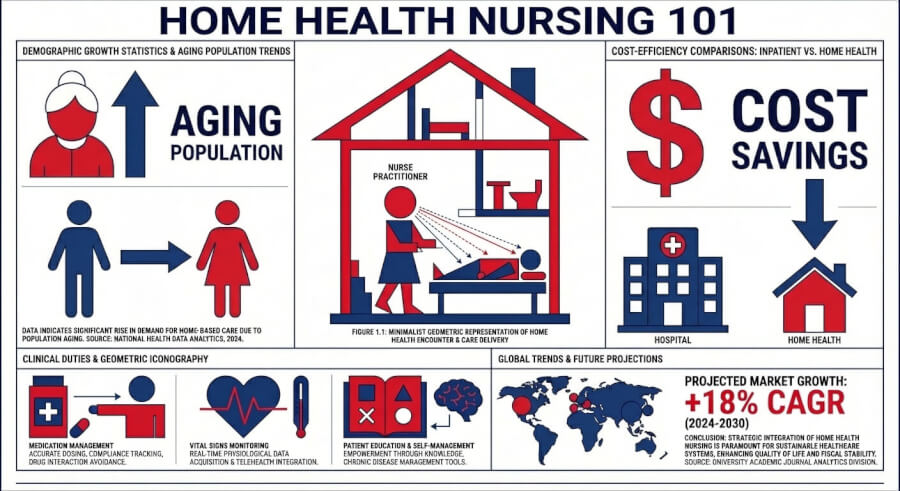
Surveys consistently rank home health among the top settings new nurses say they're interested in — and the numbers back it up. The Bureau of Labor Statistics projects home health aide and nursing roles will grow significantly faster than the national average through 2032, driven by an aging population that overwhelmingly prefers to receive care at home.
Here's everything you need to know about building a career in home health as a new grad.
What Home Health Nurses Actually Do
Forget the image of simply taking vitals in someone's living room. Home health nursing is clinically complex, autonomous work. On a typical day, you might:
- Perform comprehensive head-to-toe assessments and document changes in condition
- Manage wound care — including post-surgical sites, pressure injuries, and diabetic ulcers
- Administer IV medications, injections, and infusion therapy
- Educate patients and family caregivers on disease management, medication schedules, and warning signs
- Coordinate with physicians, physical therapists, occupational therapists, and social workers
- Complete OASIS assessments (the standardized tool used by Medicare to evaluate patient status and outcomes)
The scope is broad and the clinical thinking is real. You're not just following orders — you're often the eyes and ears for the entire care team, making judgment calls in real time without a charge nurse down the hall.
Understanding what separates home health from home care and hospice is essential before you commit to this path — the clinical expectations, payer models, and patient populations are fundamentally different across all three.
Why New Grads Are Choosing Home Health
Autonomy That Accelerates Your Growth
In a hospital, you have backup everywhere — which is great for learning, but can also become a crutch. In home health, you develop critical thinking faster because you're it. You assess, you decide, you act. That level of responsibility builds clinical confidence that many floor nurses don't develop until years into their career.
One-on-One Patient Relationships
This is the big one for a lot of nurses. Instead of juggling six or seven patients on a unit, you're spending 45 minutes to an hour with one person. You learn their story, their family, their goals. The continuity of seeing the same patients over weeks or months is something hospital nursing rarely offers.
Schedule Flexibility
Most home health positions don't involve 12-hour shifts or rotating nights. You'll typically work weekday hours with a caseload you manage yourself. There may be on-call rotations, but the day-to-day schedule is far more predictable than acute care. For nurses who value work-life balance — especially those with families — this is a major draw.
Lower Burnout Rates
Hospital nursing burnout is well-documented. The combination of understaffing, high acuity, and emotional toll drives many nurses out of bedside care within a few years. Home health isn't stress-free, but the pace is different. You're not responding to call lights from five rooms simultaneously. The work is demanding, but the environment is calmer.
The Post-Acute Care Landscape: Where Home Health Fits
Home health is one piece of a larger ecosystem called post-acute care — the network of services that support patients after a hospital stay, surgery, or acute health event. Understanding this landscape makes you a better home health nurse because your patients will frequently transition between these settings. NDPAP's complete guide to discharge planning and post-acute care breaks down every step of this transition in detail.
The main post-acute care settings include:
Skilled Nursing Facilities (SNFs) — Short-term rehab stays, often after hip replacements or strokes, where patients receive intensive therapy before going home. Understanding how Medicare covers skilled nursing facility care — including the 3-day rule and the 100-day cap — directly impacts the patients you'll receive in home health.
Inpatient Rehabilitation Facilities and LTACHs — For patients who need intensive therapy or have serious ongoing medical needs like ventilator weaning. NDPAP's guide to inpatient rehab vs. long-term acute care explains the clinical criteria that determine which patients end up in which setting — and eventually on your home health caseload.
Home Health — Skilled nursing and therapy services delivered in the patient's home, typically following a hospital or SNF discharge. If you want to understand exactly what Medicare covers for home health care — including the homebound requirement and eligibility rules — NDPAP's 2026 guide is the definitive breakdown.
Hospice — End-of-life care focused on comfort and quality of life, delivered at home or in a facility. Many home health nurses eventually work alongside hospice teams, so understanding the differences between hospice and palliative care will serve you throughout your career.
Many of your home health patients will have recently been discharged from a hospital or SNF. Knowing what happened upstream — what therapies they received, what medications were started, what their discharge goals were — directly impacts the care you provide. The National Directory of Post-Acute Providers (NDPAP) maintains a searchable database of over 77,900 providers across all these settings, and its library of over 130 post-acute care guides covers every Medicare rule, coverage question, and care transition scenario you'll encounter as a home health nurse.
What to Look for in Your First Home Health Job
Not all home health agencies are created equal, and as a new grad, the agency you choose will shape your early career. NDPAP's step-by-step guide to choosing a home health agency covers the evaluation framework in depth — here's the nurse-specific version of what matters most:
Structured Orientation and Preceptorship
This is non-negotiable. A good agency will pair you with an experienced home health nurse for ride-alongs — usually two to four weeks minimum. During this time, you'll shadow visits, learn documentation systems, and gradually take on your own caseload under supervision. If an agency tells you they'll "throw you right in," walk away.
Manageable Caseloads
Ask about average daily visit counts. New nurses should start with three to four visits per day and ramp up gradually. Agencies that expect six or seven visits from day one are prioritizing productivity over patient safety and your development.
Clinical Support Systems
Who do you call when you're in a patient's home and something doesn't look right? The best agencies have clinical managers or nurse supervisors available by phone throughout the day. Some have telehealth support built in. Make sure there's a clear escalation path before you accept an offer.
Documentation and Technology
Home health documentation is extensive — OASIS alone is a significant learning curve. Ask what electronic health record system the agency uses, whether they provide tablets or laptops for point-of-care documentation, and how much training they offer on the documentation platform.
Reputation and Accreditation
Check whether the agency is Medicare-certified and look at their Home Health Star Ratings on Medicare's Care Compare website. You can also use the NDPAP home health agency directory to search by city and state, compare CMS star ratings side-by-side, and see exactly which providers operate in your area — it covers over 12,000 Medicare-certified home health agencies nationally.
The Skills That Set Great Home Health Nurses Apart
Beyond your clinical foundation, certain skills will make you especially effective in this setting:
Assessment confidence. Without lab results coming back in 20 minutes or a physician walking the halls, your physical assessment skills are your most valuable tool. The clinical judgment skills you built studying for the NCLEX — prioritization, recognizing deterioration, knowing when to escalate — translate directly to home health. A big part of your assessment work will involve evaluating activities of daily living (ADLs) — the standardized framework used to measure patient independence and determine care needs.
Patient education. You'll spend a significant portion of every visit teaching. Medication management after hospital discharge, disease self-monitoring, fall prevention, nutrition — your ability to break down complex health information into language patients and families can actually use is what keeps people out of the hospital.
Cultural competency. You're entering people's homes — their most personal space. You'll work with families across every cultural background, socioeconomic status, and living situation. Respecting how people live while delivering evidence-based care requires flexibility and genuine cultural humility.
Time management. You're managing your own schedule, driving between visits, documenting in between, and coordinating with multiple providers. Nobody is building your assignment sheet for you. Strong organizational skills are essential from day one.
Communication. You're the link between the patient, the family, the physician, and the rest of the care team. Clear, concise communication — especially when reporting changes in condition — can be the difference between a timely intervention and an avoidable hospital readmission.
Understanding Medicare Coverage for Home Health
Since the vast majority of your patients will be Medicare beneficiaries, understanding how Medicare pays for home health is a practical career skill, not just administrative knowledge.
Medicare covers home health care when a patient is homebound, under a physician's plan of care, and needs skilled nursing or therapy services on an intermittent basis. But the details matter — the homebound definition is more nuanced than most new nurses realize, and misunderstanding it can lead to claim denials that affect both the agency and the patient.
You should also understand how home health intersects with other coverage pathways. Many of your patients will ask whether they can receive home health and hospice at the same time, how Medicare Advantage plans differ from Original Medicare for home health, and what happens when they need durable medical equipment like hospital beds, oxygen concentrators, or wound care supplies at home.
Knowing the answers — or knowing exactly where to find them — makes you an invaluable resource to your patients and sets you apart from nurses who treat coverage questions as "not my job."
Certifications and Career Growth
Home health is a launchpad, not a dead end. Here's how the career trajectory typically unfolds:
Year 1–2: Staff nurse, building your caseload and mastering OASIS documentation. Focus on getting comfortable with autonomous practice.
Year 2–4: Many nurses pursue the Home Health Nursing Certification (HCS-D or HCS-O) through OASIS credential programs, or the Certified Home Health Nurse (CHHN) credential. These boost your credibility and often come with pay increases.
Year 3–5+: Move into clinical supervisor, case manager, or director of nursing roles. Some nurses transition into quality assurance, compliance, or education within their agency. Understanding what case managers look for when choosing post-acute providers gives you a strategic edge if you're moving into these leadership positions.
Advanced practice: Home health experience is excellent preparation for Family Nurse Practitioner (FNP) or Adult-Gerontology NP programs. The autonomous decision-making and broad clinical exposure map directly to advanced practice competencies.
Common Concerns New Grads Have (Answered Honestly)
"Don't I need med-surg experience first?"
This is the most persistent myth in nursing. While hospital experience is valuable, it's not a prerequisite for home health. Many agencies actively recruit new grads and have orientation programs designed for nurses coming straight out of school. The key is finding an agency with a real preceptorship program — not one that hands you keys and a caseload on day three.
"Is it safe?"
You'll be entering unfamiliar environments, and safety is a legitimate consideration. Good agencies train you on personal safety protocols — parking strategies, environmental scanning, knowing when to leave a situation. Most home health nurses will tell you they feel safer than they expected. Trust your instincts, communicate with your team, and follow your agency's safety policies.
"Will I miss the adrenaline of acute care?"
Maybe, at first. But the clinical complexity in home health is real — you'll manage central lines, ventilators, complex wounds, and acute exacerbations. The difference is the pace. If you thrive on chaos, home health may feel slow initially. If you thrive on meaningful, sustained patient relationships and clinical problem-solving, you'll love it.
"How's the pay?"
Competitive and often underestimated. Home health nurses frequently earn comparable or higher salaries than their hospital counterparts, especially when you factor in per-visit pay models, mileage reimbursement, and the absence of night/weekend differentials eating into your quality of life. Pay varies significantly by region, so research your local market.
How to Find Home Health Agencies Hiring New Grads
Start by mapping out what's available in your area. The NDPAP home health agency directory lets you search over 12,000 Medicare-certified home health agencies by city and state, with CMS star ratings and patient experience scores displayed side-by-side so you can compare your options before you ever submit an application.
You can also:
- Check your state's home health association for member agency listings
- Ask your nursing school's career services office — many agencies recruit directly from programs
- Connect with home health nurses on LinkedIn and ask about their agency's culture and orientation
- Attend local nursing job fairs, where home health agencies increasingly have a presence
The Bottom Line
Home health nursing isn't just a viable career path for new grads — for the right person, it's the ideal one. You'll develop clinical autonomy faster, build genuine patient relationships, and enter a field with strong job security and upward mobility.
The post-acute care sector is growing, and home health agencies across the country are actively looking for nurses who want to do meaningful, independent work outside hospital walls.
You didn't become a nurse to chart in a windowless break room between call lights. If what drew you to this profession was the patient — the whole patient, in the context of their real life — home health might be exactly where you belong.
Exploring your career options in post-acute care? The National Directory of Post-Acute Providers (NDPAP) is the definitive directory of home health, hospice, skilled nursing, and rehabilitation providers in the U.S. — with over 77,900 searchable listings, CMS quality data, and 130+ in-depth care guides covering every Medicare rule and care transition scenario new nurses need to understand.