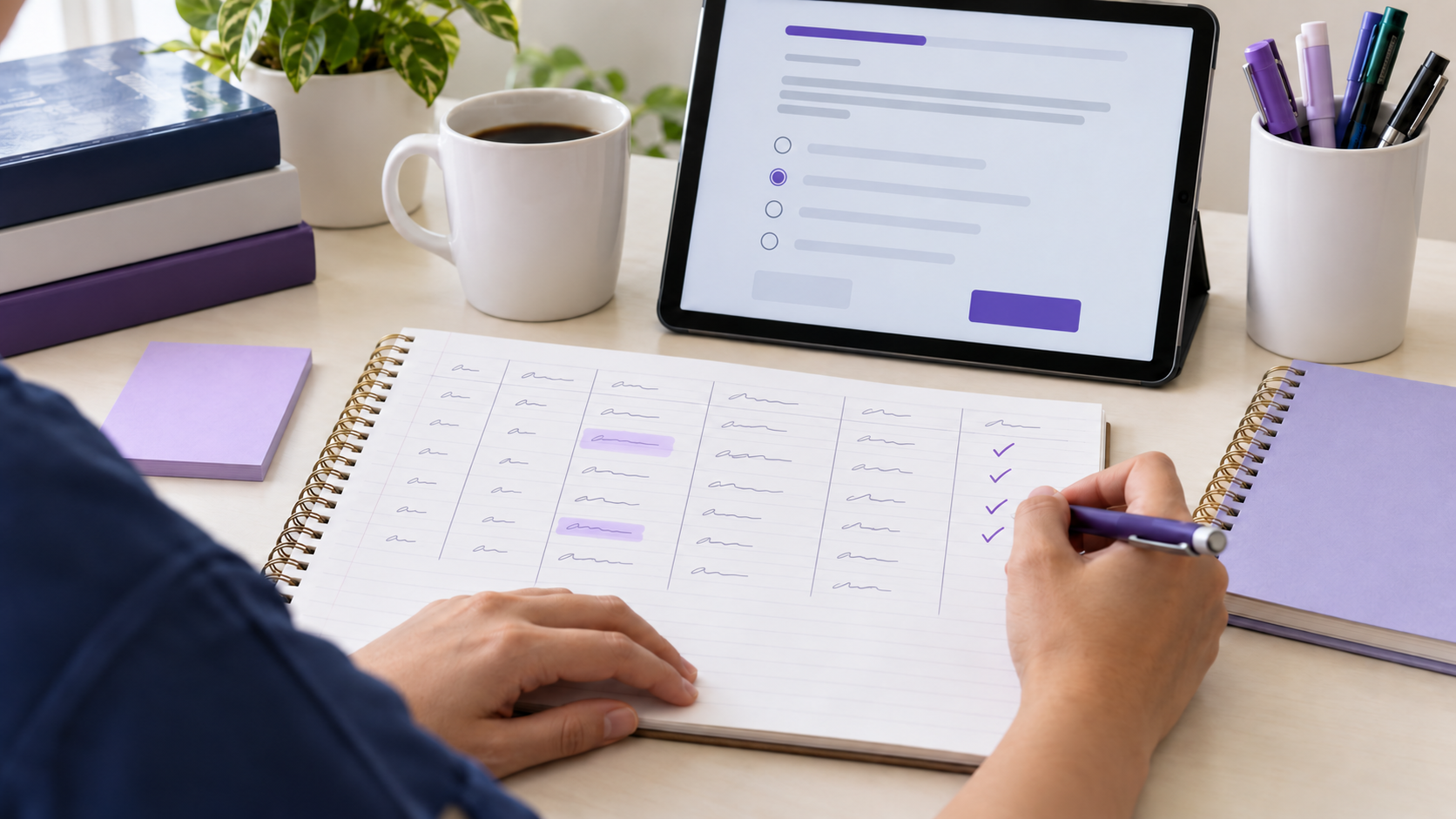


To review NCLEX practice questions, record what you misunderstood, the evidence that resolves it, and what you will try next. Then return to the idea without looking at the answer. An error log gives that process a home: a few useful lines per learning gap, rather than a second textbook of copied rationales.
Use the template below after a practice set. Include missed answers, correct guesses, and questions you answered correctly for a reason that did not match the explanation. The aim is to leave review with a specific next step.
What belongs in an NCLEX error log?
An error log is your own record of study problems and follow-up work. A notebook, notes app, or simple spreadsheet is enough. You do not need a special scoring system.
Keep two labels separate:
- Content: the subject you were studying, such as medication safety or mental health.
- Process: the difficulty you noticed, such as an unfamiliar term, a missed instruction, or an assumption that was not in the question.
For exam content categories, use the official plan for your exam. NCSBN provides separate RN and PN test plans with Client Needs categories, nursing activities, and clinical judgment information. The current plans apply from April 1, 2026, through March 31, 2029. See the official NCLEX test plans.
A personal label like “misread the task” is a study note, not an official NCLEX category or diagnosis of your ability.
A copyable error-log template
Copy these six fields for each idea worth revisiting. Use a question reference from your practice resource instead of copying its entire question and answer choices.
- Reference and topic: Where can I find this item again?
- My reasoning: What did I believe when I chose my answer? Was I sure, unsure, or guessing?
- Gap to address: What specific knowledge or reading problem needs work?
- Evidence and correction: Which detail and explanation resolve the problem? Where did I check a disputed fact?
- Next task: What small action will let me practice that gap?
- Recheck: When will I return, and could I explain the idea without seeing my notes?
Keep the correction in your own words. “Review pharmacology” is too broad to act on. “Explain the unfamiliar medication term, verify it in my course reference, and answer a fresh question using it” gives you a starting point.
Do not put patient information, clinical-placement records, or recalled questions from an actual licensing exam into this log or an AI tool. Use permitted practice materials and your own learning notes.
How to fill it in after a practice set
Capture your reasoning before reading the explanation
Write one short sentence about why you chose the answer. If you guessed, say so. This is easier to interpret later than reconstructing your thinking after the correct answer seems obvious.
Keep the note neutral: “I did not recognize the term” is actionable. “I am terrible at nursing” is not an explanation of what happened.
Compare the rationale with the actual question
Read the question again alongside the explanation. Mark the detail that supports the answer and the detail that makes your chosen option less appropriate. For questions with several response options, examine each relevant selection instead of recording only the total score.
If you still cannot connect the explanation to the question, label the entry unresolved. Check an appropriate course text or current authoritative reference, or bring the question to your instructor. An explanation that sounds confident is not enough reason to turn an uncertain clinical statement into a memorized rule.
Match the next task to the gap
Use this short menu to choose an action. These are suggested study categories, not a validated assessment tool.
| Gap you noticed | A useful next task |
|---|---|
| Unfamiliar term or fact | Check the concept, then explain it with notes closed. |
| Missed instruction | Restate what a fresh question asks before answering. |
| Added an unstated assumption | Separate the information given from information you imagined. |
| Calculation setup or units | Rework the setup and units before checking the result. |
| Unfamiliar item format | Explore the official sample items and tutorial. |
NCSBN's preparation page provides a sample pack, an exam preview, and a candidate tutorial. These serve different purposes: sample items show question formats, while the tutorial introduces the exam software. Open the official NCLEX preparation resources.
A filled example without copying a test question
Imagine you finish a practice item and realize you answered a different task from the one asked. This example illustrates the logging process; it is not an official NCLEX question.
- Reference and topic: Practice set A, item 4; patient education.
- My reasoning: I picked a statement that sounded familiar. I was unsure.
- Gap to address: The prompt asked which statement needed follow-up, but I looked for a statement that showed understanding.
- Evidence and correction: I reread the task wording. My next attempt should start by identifying whether the question asks for an appropriate response or a problem to address.
- Next task: Before answering a new item, summarize the requested task in one sentence without changing its meaning.
- Recheck: Tomorrow, use a different practice item. Record whether I identified the task and could explain my answer.
Notice what this entry does not contain: a copied paragraph, a claim that one trick solves every question, or a prediction about passing. It identifies one behavior to practice.
Recheck the idea without the answer in front of you
Close the explanation and try to state the correction from memory. At a later session, use a fresh question on the concept when one is available. If you repeat the original item, note that recognizing its answer may make the result easier to interpret too optimistically.
There is research behind testing your memory rather than only rereading. In two experiments using prose passages, Roediger and Karpicke found that prior recall tests produced better retention on delayed tests than repeated studying. The research was about learning from passages; it did not test this error-log template, GoodNurse, or NCLEX pass rates. Read the original study's abstract.
A practical starting point is to revisit an entry at your next study session and again later in the week. Adjust the timing to your workload and what you can explain. This is a suggested routine, not a proven optimal NCLEX schedule.
Keep the log small enough to use
After several study sessions, scan the entries for recurring gaps. Choose one manageable task for the next session. If the same topic keeps appearing, work through its underlying concept; if missed instructions appear across subjects, deliberately practice identifying the task wording.
Avoid treating the biggest pile of errors as a complete map of your needs. If you practiced mostly one subject, that subject had more chances to appear in the log. Continue covering your exam's full test plan.
You can use GoodNurse's free practice quizzes as one source of practice material. Keep your log separately and check uncertain clinical content against your course resources. For members reviewing a completed standard quiz, View Results → Question review opens the route back to an answer and its rationale. Sign in to your GoodNurse account to return to your quizzes.
Start with one entry you can actually follow up. At your next session, cover the correction, explain it, and record what still needs work. That gives your review a concrete output beyond another question count.
AI-assistance note: This article was drafted and source-checked with AI assistance. It has not received independent clinical review.