
If you can read a label and set up unit-canceling fractions, you can master every common nursing math task - IV drip rates, mL/hr pumps, mcg/kg/min titrations, pediatric mg/kg dosing, and insulin. This guide gives you a repeatable method, safety checks, and 25 practice problems with answers so you’re ready for clinicals and NGN items.
For skill-building with clinical judgment, pair this with NGN Med-Surg / Physiological Adaptation Case Studies (2026). If you’d like AI help scaffolding calculations step-by-step, see AI in Nursing Education (2026): Complete Guide and our AI Prompt Library for Nursing Students (2026).
🎯 Free NCLEX quiz!
Test your knowledge - new quizzes added weekly!
Table of Contents
- Core Method: Dimensional Analysis that Always Works
- Safety & Accuracy: Rounding, High-Alert Meds, and Double-Checks
- Quick Formulas: gtt/min, mL/hr, mcg/kg/min, mg/kg
- Practice Problems (25) with Answers
- FAQs: Common Pitfalls in Nursing Math
- Key Takeaways
- Further Reading
Dosage calc makes nursing students cry in their cars.
24 NCLEX-style problems with every step worked out. 6 formulas (not 47). Free PDF, in your inbox in 30 seconds.
- ✓ 24 problems
- ✓ 3 difficulty levels
- ✓ Full rationales
No spam. Unsubscribe anytime.
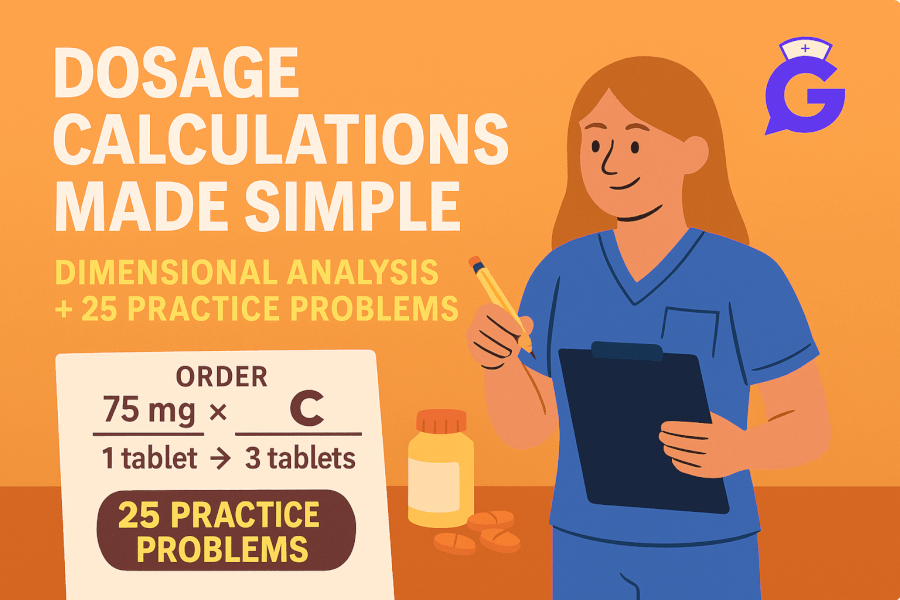
Core Method: Dimensional Analysis that Always Works
- Write the order and the available concentration.
- Build a fraction string so unwanted units cancel and the answer’s unit remains (e.g., mL, gtt/min, mL/hr).
- Multiply across, divide, then apply rounding rules (facility-specific).
- Sanity check: Does the answer make clinical sense for this med and route?
Bolded concepts to notice: order, supply concentration, unit cancellation, desired unit, rounding, sanity check.
Safety & Accuracy: Rounding, High-Alert Meds, and Double-Checks
- High-alert meds (e.g., insulin, heparin, vasoactives) often require a second RN check—follow policy.
- Rounding: Pumps typically accept whole mL/hr; gtt/min must be whole drops; insulin units per facility rule (whole or 0.5).
- Document the label, lot, and calculation when required.
- When in doubt, use GoodNurse to generate a step-by-step setup for your calculation flow (AI Prompt Library).
Quick Formulas: gtt/min, mL/hr, mcg/kg/min, mg/kg
- gtt/min = (\frac{\text{mL} \times \text{drop factor (gtt/mL)}}{\text{minutes}}) → round to whole gtt.
- mL/hr = (\frac{\text{mL}}{\text{hours}}) (or (\frac{\text{mL}}{\text{minutes}} \times 60)).
- mcg/kg/min infusions →
[ \text{mL/hr} = \frac{\text{ordered mcg/kg/min} \times \text{kg} \times 60}{\text{solution mcg/mL}} ] (Convert mg → mcg and know your bag’s mcg/mL.) - mg/kg (pediatrics) → (\text{Dose mg} = \text{mg/kg} \times \text{kg}), then convert to mL with the supply concentration.
Practice Problems (25) with Answers
Tip: Work them with dimensional analysis and check against the key. Where rounding differs by policy, we show a common choice.
A. Dose ↔ Volume & Tablets (5)
-
Acetaminophen 650 mg PO. Supply: 325 mg tablet.
Answer: 2 tablets.
Why: 650 ÷ 325 = 2. -
Morphine 2 mg IV. Supply: 4 mg/mL.
Answer: 0.5 mL.
Why: (2,\text{mg} \times \frac{1,\text{mL}}{4,\text{mg}} = 0.5,\text{mL}). -
Cefazolin 1 g IV. Supply: 2 g/100 mL premix.
Answer: 50 mL.
Why: (1,\text{g} \times \frac{100,\text{mL}}{2,\text{g}} = 50,\text{mL}). -
Furosemide 40 mg IV. Supply: 10 mg/mL.
Answer: 4 mL. -
Amoxicillin 500 mg PO. Supply: 250 mg capsule.
Answer: 2 capsules.
B. IV Drip Rate: gtt/min (5)
-
1,000 mL NS over 8 hr, drop factor 15 gtt/mL.
Answer: 31 gtt/min.
Math: (\frac{1000 \times 15}{480} = 31.25 \rightarrow 31). -
500 mL over 4 hr, 10 gtt/mL.
Answer: 21 gtt/min.
Math: (\frac{500 \times 10}{240} = 20.8 \rightarrow 21). -
250 mL over 2 hr, 20 gtt/mL.
Answer: 42 gtt/min.
Math: (\frac{250 \times 20}{120} = 41.7 \rightarrow 42). -
125 mL over 1 hr, 15 gtt/mL.
Answer: 31 gtt/min.
Math: (\frac{125 \times 15}{60} = 31.25 \rightarrow 31). -
75 mL over 30 min, 60 gtt/mL (microdrip).
Answer: 150 gtt/min.
Math: (\frac{75 \times 60}{30} = 150).
C. IV Pump: mL/hr (5)
- 100 mL over 30 min → 200 mL/hr.
- 1,000 mL over 10 hr → 100 mL/hr.
- 250 mL over 2.5 hr → 100 mL/hr.
- 400 mL over 3 hr → 133 mL/hr (pump whole number).
- 75 mL over 45 min (0.75 hr) → 100 mL/hr.
D. Weight-Based Titrations: mcg/kg/min (5)
Use mL/hr formula: (\frac{\text{mcg/kg/min} \times \text{kg} \times 60}{\text{mcg/mL}})
-
Dobutamine 5 mcg/kg/min for 80 kg. Bag: 400 mg/250 mL = 1600 mcg/mL.
Answer: 15 mL/hr.
Math: (\frac{5 \times 80 \times 60}{1600} = 15). -
Dopamine 7.5 mcg/kg/min for 60 kg. Same bag 1600 mcg/mL.
Answer: 17 mL/hr (16.9→17). -
Norepinephrine 0.05 mcg/kg/min for 70 kg. Bag: 4 mg/250 mL = 16 mcg/mL.
Answer: 13.1 mL/hr (≈ 13 mL/hr per policy).
Math: (\frac{0.05 \times 70 \times 60}{16} = 13.125). -
Epinephrine 0.02 mcg/kg/min for 50 kg. Bag: 1 mg/250 mL = 4 mcg/mL.
Answer: 15 mL/hr.
Math: (\frac{0.02 \times 50 \times 60}{4} = 15). -
Milrinone 0.375 mcg/kg/min for 80 kg. Bag: 20 mg/100 mL = 200 mcg/mL.
Answer: 9 mL/hr.
Math: (\frac{0.375 \times 80 \times 60}{200} = 9).
Cross-link for pharmacology context and monitoring: Therapeutic Drug Levels (2026).
E. Pediatrics: mg/kg/dose (5)
Convert mg/kg to total mg, then to mL using the supply strength.
-
Amoxicillin 25 mg/kg/dose for 18 kg. Liquid 250 mg/5 mL (50 mg/mL).
Answer: 9 mL.
Math: (25 \times 18=450,\text{mg};\ 450/50=9,\text{mL}). -
Acetaminophen 15 mg/kg/dose for 22 kg. Liquid 160 mg/5 mL (32 mg/mL).
Answer: 10.3 mL (per policy).
Math: (15 \times 22=330,\text{mg};\ 330/32=10.31,\text{mL}). -
Ibuprofen 10 mg/kg/dose for 30 kg. Suspension 100 mg/5 mL (20 mg/mL).
Answer: 15 mL.
Math: (10 \times 30=300,\text{mg};\ 300/20=15,\text{mL}). -
Cefdinir 14 mg/kg/day divided q12h for 20 kg → 7 mg/kg/dose. Suspension 250 mg/5 mL (50 mg/mL).
Answer: 2.8 mL per dose.
Math: (7 \times 20=140,\text{mg};\ 140/50=2.8,\text{mL}). -
Azithromycin 10 mg/kg (Day 1) for 25 kg. Suspension 200 mg/5 mL (40 mg/mL).
Answer: 6.25 mL.
Math: (10 \times 25=250,\text{mg};\ 250/40=6.25,\text{mL}).
F. Insulin: Carb Ratio + Correction (2)
-
Carb ratio 1:15; 60 g carbs eaten. Correction factor 1:50; BG 210 mg/dL, target 120.
Answer: 6 units total (4 meal + 2 correction*).
Math: Meal (60/15=4); Correction ((210-120)/50=1.8 \rightarrow 2) per policy.
*Follow your facility’s rounding rule for insulin. -
Correction only: Factor 1:40; BG 275, target 120.
Answer: 4 units.
Math: ((275-120)/40=3.875 \rightarrow 4).
For safe titration thinking and lab tie-ins, review Electrolytes (2026): Patterns & Nurse Actions.
FAQs: Common Pitfalls in Nursing Math
How do I avoid errors with mcg/kg/min infusions?
Convert the bag to mcg/mL first, then plug into the mL/hr formula. Write every unit and cancel visibly.
When do I round up vs down on gtt/min?
Drops must be whole numbers. Follow your hospital policy—many round to the nearest whole drop.
What should I document for high-alert meds?
Typically: calculation steps, second RN verification, label details, and parameters you’ll monitor (MAP, SpO₂, rhythm, UOP).
Is there a “best” method for all math?
Yes—dimensional analysis. It’s consistent, transparent, and reduces mistakes under stress.
Key Takeaways
- Use dimensional analysis to cancel units and land on mL, gtt/min, mL/hr, or mcg/kg/min reliably.
- Memorize just a few formulas and know your bag concentration (mcg/mL).
- Follow rounding rules: whole gtt/min, pump mL/hr to whole, insulin per policy.
- Treat insulin, heparin, vasoactives as high-alert—get the required double-check.
- Prove safety with parameters: SpO₂, MAP, rhythm, UOP, mentation—then adjust.
Further Reading
Download our free printable Pharmacology Mnemonics cheat sheet. Enter your email below and we'll send it right over.