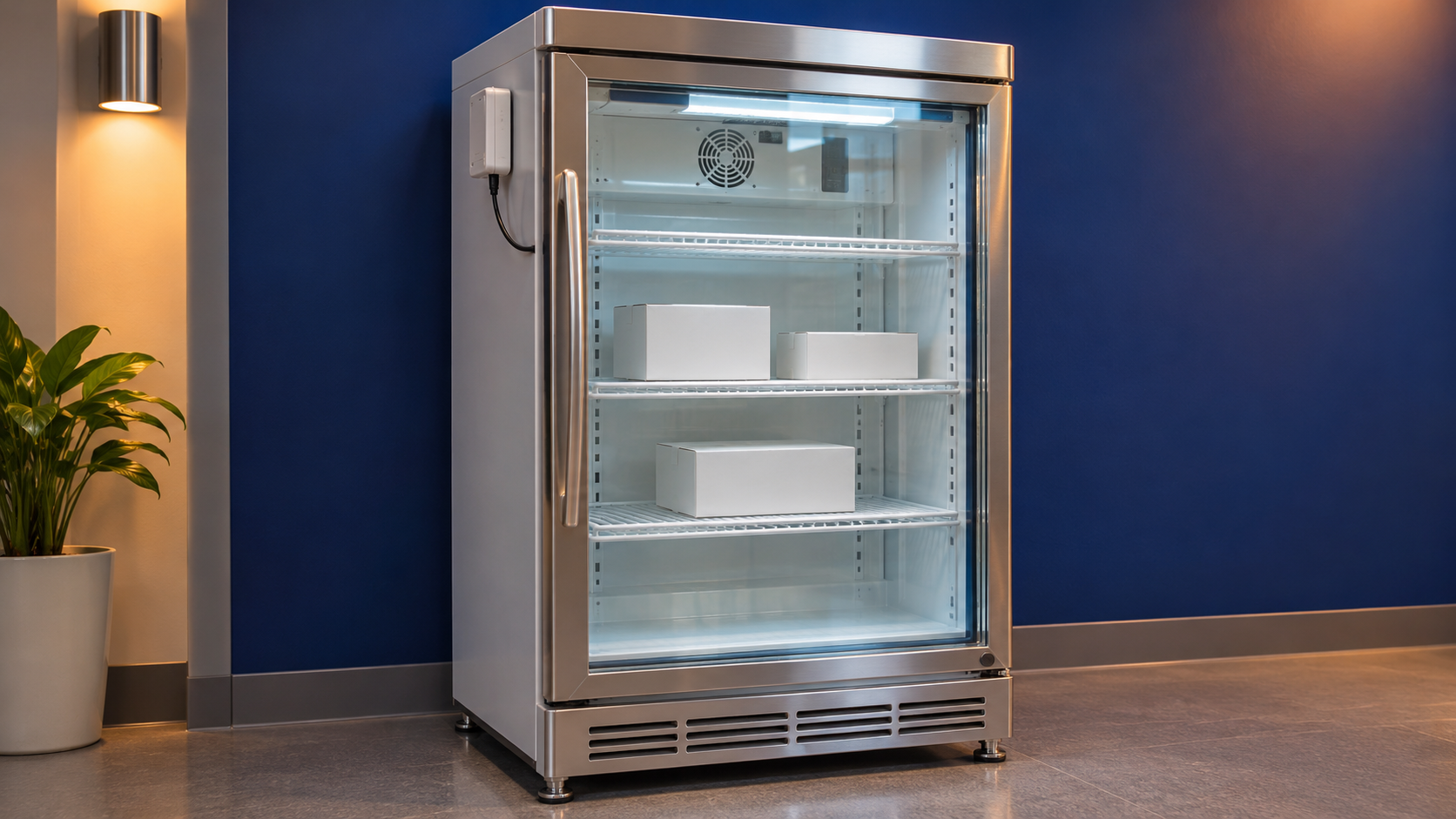


Vaccines need a cold chain because their biological components can lose potency when storage conditions are wrong. Refrigerating a damaged vaccine again does not restore its lost potency. The nursing lesson is to protect the product's temperature history, rather than judge it by whether the vial feels cold or looks normal. CDC: Vaccine Storage and Handling Toolkit.
For nursing students, three questions organize the topic: What conditions does this exact product require? What happened during storage and transport? Who must evaluate a suspected problem? This guide explains the concepts; use current product labeling, your clinical site's procedures and your instructor's supervision for actual handling.
What is the vaccine cold chain?
The cold chain is the temperature-controlled system connecting manufacture, distribution, delivery, storage and administration. It includes equipment, trained people and procedures. A refrigerator is one part of that system, not the whole chain. Responsibility is shared across everyone who handles the product. CDC Pink Book: Vaccine Storage and Handling.
Think of a relay: a careful final handoff cannot establish what happened during earlier stages. In a fictional teaching example, a shipment arrives with intact packaging. That observation answers a packaging question. It does not, by itself, answer the separate question of whether the shipment stayed within its required temperature conditions.
For the immune-system concepts behind vaccination, see our explanation of active and passive immunity. Here, the focus is preserving the product before it reaches the patient.
Why heat, freezing and light can matter
Vaccines are biological preparations with different formulations. Their proteins and other large molecules may be sensitive to environmental conditions or interactions within the container. Manufacturers determine stability through testing; a useful storage rule must therefore apply to the specific product, formulation and stage of use. WHO: Stability of Vaccines.
Colder is not automatically safer. CDC notes that freezing permanently reduces the potency of liquid vaccines containing an aluminum adjuvant. Vaccines licensed for refrigerated storage generally require 2°C–8°C (36°F–46°F); that range is not permission to refrigerate every vaccine or to freeze one for extra protection. CDC: Storage and Handling of Immunobiologics.
Light sensitivity also varies. CDC's July 2026 storage guidance identifies light exposure as a concern for certain vaccines. The safe learning habit is to check the current instructions, rather than generalize from a vaccine handled previously. CDC: Vaccine Storage and Handling.
A normal temperature now does not show the whole history
A temperature reading is a snapshot. A digital data logger records temperatures over time, helping staff understand whether an excursion occurred and how long it lasted. An excursion means a temperature outside the manufacturer's recommended range. A reassuring reading after an alarm does not erase the earlier event. CDC: Vaccine Storage and Handling Toolkit.
Consider this original classroom scenario: a refrigerator reads 5°C at the start of a shift, but its overnight record shows an out-of-range interval. Which statement is justified?
- Supported: The current reading is within the usual refrigerated range.
- Unsupported: Every product inside remained suitable throughout the night.
- Next learning question: What does the recorded history show, and who evaluates it under the site's procedure?
The important distinction is between detecting a concern and making a final product-use decision. A student should recognize the concern and involve the supervising nurse, rather than decide vaccine viability independently.
Four checks that answer different questions
| Check | What it helps establish | What it cannot establish alone |
|---|---|---|
| Product identity and current instructions | Which storage conditions apply | Whether those conditions were maintained |
| Temperature record | What the monitoring device recorded over time | Every other aspect of correct handling |
| Expiration or beyond-use information | Whether the applicable time limit has passed | Whether an earlier storage problem occurred |
| Visual inspection | Whether there is an observable concern | That potency is preserved |
These checks complement one another. CDC cautions that appearance cannot reliably establish appropriate storage. Its immunobiologics guidance also distinguishes the manufacturer's expiration date from time limits that can apply after a storage change. CDC toolkit, CDC expiration guidance.
In another fictional example, an unopened carton is still within its printed expiration date after a documented storage incident. The date answers one question; it does not cancel the incident. Conversely, an acceptable storage record does not extend a product's applicable use deadline.
What a student should recognize about an excursion
CDC's excursion job aid calls for immediate notification of the vaccine coordinator or supervisor, separating affected stock under correct storage conditions and marking it against use. It says to retain the products while the event is evaluated, rather than automatically discard them. Documentation and consultation with the manufacturer or immunization program follow the facility's procedure. CDC: Handling a Temperature Excursion.
For supervised learning, practice explaining:
- The observation: an alarm, a recorded interval or a concern during delivery.
- The uncertainty: what is known about time and temperature, and what is missing.
- The escalation: which supervising nurse or designated coordinator needs the information.
Avoid inventing a universal number of minutes that makes every vaccine safe or unusable. Product-specific assessment matters. A power failure, a warm shipment and a freezing event are different histories, even when all are called cold-chain problems.
Check your understanding
These are original learning prompts, not official exam questions:
- Why does returning a vaccine to its correct storage temperature fail to prove that earlier damage was reversed?
- Why can freezing be a problem even though this system is called a cold chain?
- What additional information would you want when a current reading is normal but an overnight alarm occurred?
- Why should a student report a suspected excursion without independently deciding to use or discard the stock?
A strong explanation connects product identity, storage history, time limits and escalation. Memorizing a temperature range is useful only when you also know which product it applies to and what that number cannot tell you.
AI-assistance note: This article was prepared with AI assistance, and its cover image is AI-generated. It has not received independent human or clinical review.