

Artificial intelligence is no longer a futuristic experiment in nursing education. It is becoming a structural advantage for students facing the most difficult licensure exam in nursing history.
For decades, NCLEX preparation followed a rigid, linear formula: purchase a 1,000-page comprehensive review book, subscribe to a static question bank, memorize thousands of isolated facts, and hope that your retention holds up under the pressure of exam day.
The introduction of the Next Generation NCLEX (NGN) changed that equation permanently.
Today, nursing students are not simply tested on what they know. They are tested on how they think. The NGN demands that candidates demonstrate complex clinical judgment in real-time, synthesizing data points to make life-or-death decisions.
That shift is precisely why AI for NCLEX preparation has exploded as a topic of interest. Adaptive tutoring systems promise to analyze reasoning patterns, detect subtle weaknesses in clinical judgment, and personalize reinforcement in ways that traditional textbooks and static Q-banks simply cannot.
But does it actually work? Is it safe? And how do you distinguish between a generic chatbot and a verified educational tool?
This comprehensive guide provides a complete academic and practical breakdown of:
- The Evolution of Prep: How we moved from flashcards to algorithmic intelligence.
- The Science: How "Item Response Theory" and adaptive learning map the human brain.
- The Evidence: A deep dive into independent University of Rochester research on learning outcomes.
- The Tools: A rigorous comparison between specialized nursing AI and general LLMs (like ChatGPT).
- The Strategy: A detailed 6-week blueprint for integrating AI into your study routine.
- The NGN Connection: Why AI is uniquely suited to master Bow-Tie and Matrix item types.
Want to test your clinical judgment in minutes? Use our free NCLEX practice questions—updated weekly with new quizzes and videos to help you spot weak areas fast.
Part 1: The NGN Shift: Why Memorization Is No Longer Enough
To understand why AI is necessary, we must first understand the problem it solves.
The "Old NCLEX" (prior to April 2023) was largely a test of knowledge retrieval. If you knew the normal range for Potassium (3.5–5.0 mEq/L), you could answer the question. It was binary.
The Next Generation NCLEX (NGN) is different. It is built around the NCSBN Clinical Judgment Measurement Model (NCJMM). This model acknowledges that a nurse can know the normal lab values and still be dangerous if they cannot interpret them in context.
The NCJMM measures six specific cognitive steps:
- Recognize Cues: Identifying relevant data (e.g., "The patient is restless and swallowing frequently").
- Analyze Cues: Connecting data to clinical meaning (e.g., "This could indicate post-tonsillectomy hemorrhage").
- Prioritize Hypotheses: Ranking potential issues (e.g., "Airway protection is a higher priority than pain control").
- Generate Solutions: Identifying interventions (e.g., "Prepare for suctioning, call the provider").
- Take Action: Implementing the solution.
- Evaluate Outcomes: Did it work?
The "Static Tool" Problem
Traditional study tools—textbooks and standard Q-banks—provide feedback that is too simple for this complex model. They generally offer a binary "Correct" or "Incorrect" result.
They rarely diagnose the root cause of the error.
Did you miss the question because you didn't know the Potassium range? (Recall Error)
Or did you miss it because you didn't realize that in a renal failure patient, a slightly high Potassium is expected, but chest pain makes it a priority? (Judgment Error)
Adaptive AI systems can make that distinction. By analyzing not just what you answered, but how you answered (distractor selection, time taken, previous performance on similar concepts), AI can pinpoint exactly which of the six cognitive steps is your weak point.
If you have not studied how NGN case stems are structured, it is vital to begin with the basics before applying AI tools:
👉 How to Read NGN Case Stems (Clinical Judgment Strategy Guide)
If you only read one section in this guide, read the independent University of Rochester outcomes data. Academic validation is rare in EdTech—this is one of the few examples with statistically significant findings (p = .0048).
Part 2: What "AI for NCLEX Preparation" Actually Means
The term "AI" is thrown around loosely in marketing. In the context of nursing education, we are discussing specific technologies: Adaptive Learning Algorithms and Large Language Models (LLMs).
The Mechanism: How an AI Tutor "Thinks"
Unlike a static Q-bank, which pulls questions from a bucket at random, a true AI nursing tutor utilizes a cycle of continuous assessment.
- Knowledge Tracing
The AI builds a digital map of your brain. It treats every topic (Pharmacology, Pediatrics, Critical Care) as a node in a network. As you answer questions, it assigns a probability score to each node.
Example: You answer three cardiac questions correctly. The AI raises your "Cardiac" probability score. However, you miss a question about Digoxin toxicity. The AI flags "Cardiac Pharmacology" as a specific sub-weakness, even though your general "Cardiac" score is high.
- Item Response Theory (IRT)
This is the same statistical framework used by the actual NCLEX CAT (Computer Adaptive Testing). It ranks questions not just by topic, but by difficulty and discrimination.
The AI knows that "Question A" is easy; 90% of students get it right.
It knows "Question B" is hard; only high-performers get it right.
If you get Question A wrong, the AI infers a fundamental gap. If you get Question B wrong, it infers a need for advanced refinement.
- The Feedback Loop
Instead of random exposure, the system creates a personalized curriculum:
Assessment → Gap Detection → Targeted Practice → Reassessment → Reinforcement
For a deeper technical breakdown of these systems, read:
👉 The Science of AI Tutoring: Boost Your NCLEX Score
Part 3: Independent Academic Validation: The University of Rochester Study
In the EdTech world, claims are easy to make. "Boosts scores by 50%!" is a common marketing slogan. However, very few platforms subject their algorithms to independent, peer-reviewed academic scrutiny.
GoodNurse is an exception.
In collaboration with the University of Rochester School of Nursing, GoodNurse’s AI algorithms were studied in a controlled academic environment to measure actual efficacy. This was not a user survey; it was a rigorous study comparing outcomes between students who used the AI tutor and those who did not.
The Study Design
The research focused on ECG Interpretation. This domain was chosen because it perfectly mirrors the cognitive demands of the NGN:
It requires Visual Pattern Recognition (Recognizing cues).
It requires Rule Application (Analyzing cues).
It requires Clinical Correlation (Taking action based on the rhythm).
Key Findings
The results, published for the academic community, were stark:
| Metric | GoodNurse AI Users | Non-Users (Control) | Interpretation |
|---|---|---|---|
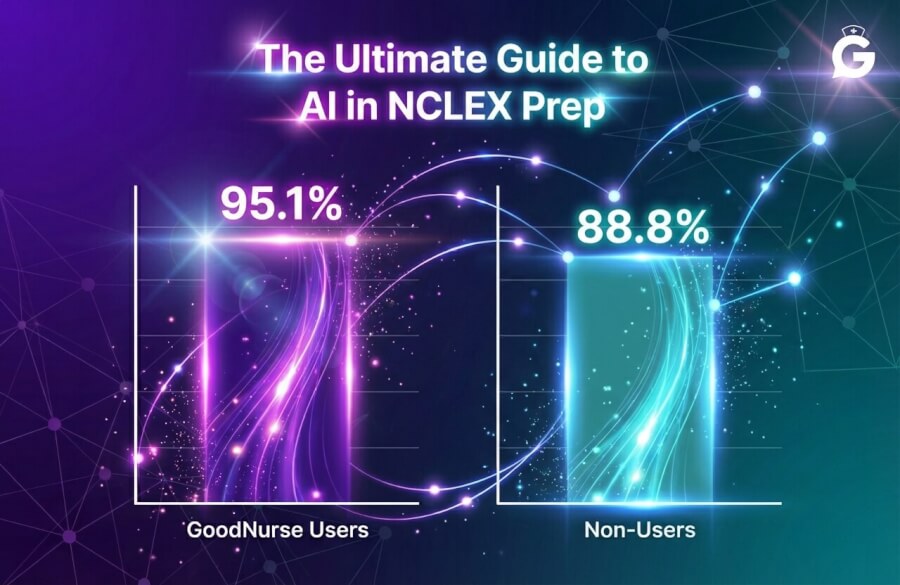
| Mean Course Grade | 95.1% | 88.8% | AI Users scored, on average, a full letter grade higher. |
| Statistical Significance | p = .0048 | — | The result is highly significant (p < 0.05), meaning it was not due to chance. |
| Cost Efficiency | $5.80 | — | The cost per 1% grade improvement was exceptionally low compared to human tutoring. |
| Engagement | 69.5 Prompts | — | High voluntary engagement suggests the tool reduces "study friction." |
Why This Matters for You
When choosing a study tool, you are investing your time—your most scarce resource. The University of Rochester research confirms that time spent with specialized AI yields a higher return on investment (ROI) in terms of grade improvement than traditional study methods alone.
You can review the full outcomes data here:
👉 Independent University Research: GoodNurse Improves Outcomes
If you’re comparing tools, bookmark the University of Rochester School of Nursing study summary and come back to it. When you see the 95.1% vs 88.8% gap and p = .0048, you’ll understand why “specialized” matters.
Part 4: Specialized Nursing AI vs. General Chatbots (ChatGPT)
A frequent question we receive is: "Why should I pay for an app when I can just use ChatGPT or Gemini for free?"
This is a dangerous misconception. While general Large Language Models (LLMs) are powerful, they are not designed for high-stakes medical licensure preparation. Using a general chatbot for NCLEX prep introduces three critical risks: Hallucination, Context Collapse, and Lack of Pedagogical Structure.
Risk 1: The Hallucination Problem
General AI is trained on the entire internet—medical journals, yes, but also Reddit threads, outdated blogs, and Wikipedia. It predicts the next likely word, not necessarily the factually correct word.
Scenario: You ask ChatGPT about "Digoxin toxicity levels."
ChatGPT Risk: It might confidently state an outdated therapeutic range from a 2010 forum post.
Specialized AI: GoodNurse is trained specifically on current NCSBN test plans and vetted nursing textbooks. It draws from a "walled garden" of verified data.
Risk 2: Missing the "Nursing" Context
The NCLEX tests nursing judgment, not medical diagnosis.
Scenario: A patient has chest pain.
ChatGPT (Medical Bias): Might suggest "Order a Troponin level" (A physician action).
Specialized AI (Nursing Bias): Will suggest "Assess vital signs and elevate the head of the bed" (A nursing action).
Why it matters: On the NCLEX, selecting the physician's action often results in a wrong answer, even if the action is medically correct.
Risk 3: No Educational Scaffolding
ChatGPT answers your question and stops. It does not track your progress.
Specialized AI remembers that you missed a similar question three days ago. It realizes you have a pattern of missing "Prioritization" questions. It actively remediates your weak spots over time.
For a detailed head-to-head comparison of specific apps, see our guide:
👉 Best AI Apps for Nursing Students: Honest Comparison
Part 5: The Psychological Advantage: AI and Test Anxiety
One of the most overlooked benefits of AI tutoring is psychological. Test anxiety affects nearly 40% of nursing students, often crippling performance even when knowledge is high.
Human tutors and professors, despite their best intentions, can induce anxiety. The fear of "looking stupid" prevents many students from asking basic questions.
The "Judgment-Free" Zone
An AI tutor never judges. You can ask the same question about fluid and electrolytes five times in a row. The AI will simply rephrase the explanation, perhaps offering a different analogy or visual aid, until you understand it. This psychological safety allows for Deep Learning—the freedom to explore concepts without fear of embarrassment.
Reducing Cognitive Load
Traditional studying involves managing many resources: a book, a notebook, a laptop, a timer. This creates "Cognitive Load"—your brain burns energy just managing the process of studying.
AI streamlines this. The interface serves the next optimal question automatically. Your brain focuses 100% on the clinical content, not on deciding what to study next.
Part 6: How AI Reinforces Specific NGN Item Types
The NGN introduced new item types that terrify students. AI is uniquely suited to help you master them because these items are algorithmic by nature.
- The Bow-Tie Item
This format requires you to identify the Condition, Actions to Take, and Parameters to Monitor. It is a "many-to-many" logic puzzle.
How AI Helps: The AI tracks your logic flow. If you get the Condition right but the Actions wrong, it knows you understand pathophysiology but lack knowledge of interventions. It will then serve you isolated intervention drills before giving you another full Bow-Tie.
- Matrix/Grid Items
These require you to evaluate multiple rows of data against columns (e.g., Indicated vs. Contraindicated).
How AI Helps: These items generate massive amounts of data points. The AI analyzes if you struggle with specific types of rows (e.g., you always miss rows related to medication side effects).
👉 NGN Matrix/Grid Strategy Guide
- Case Studies (Unfolding)
These track a patient over time (Admission -> Day 2 -> Discharge).
How AI Helps: The AI simulates the passage of time. If you make a mistake in "Scene 1," the AI can dynamically adjust "Scene 2" to show the consequences of that error, providing a powerful lesson in "Evaluate Outcomes" (Step 6 of the NCJMM).
👉 NGN Pharmacology Case Studies
Part 7: A Structured 6-Week AI-Integrated Study Plan
You cannot just "wing it" with AI. You need a structured plan that blends adaptive learning with content review. Here is a blueprint for the final 6 weeks before your NCLEX.
Weeks 1–2: The Diagnostic Phase (Gap Detection)
Goal: Identify what you don't know.
AI Action: Set your AI tutor to "Diagnostic Mode." Take 50-75 questions per day covering all domains (Physiological Integrity, Safe Care, Psychosocial).
Human Action: Do not study yet. Just test. Let the algorithm build your error profile.
Resource: If the AI flags math as a weakness, stop and use:
👉 Dosage Calculations Made Simple
Weeks 3–4: Targeted Remediation (The "Deep Work")
Goal: Fix the "Red Zones."
AI Action: Focus exclusively on your bottom 3 weakest categories. Use the AI's "Spaced Repetition" feature to drill rationales.
Human Action: Read the full rationales. If the AI explains why Hypocalcemia causes tetany, write it down. Connect the pathophysiology.
Resource: For lab weaknesses, use:
👉 Normal Lab Values & Interpretation
Weeks 5: NGN Format Fluency
Goal: Get comfortable with the weird question types.
AI Action: Switch settings to "NGN Only" or "High Difficulty." Force yourself to do Bow-Ties and Case Studies until the format feels boring, not scary.
Human Action: Focus on time management. Can you finish a 6-question case study in 8 minutes?
Weeks 6: Simulation & Stability
Goal: Build stamina.
AI Action: Take full-length CAT (Computer Adaptive Testing) simulations.
Human Action: Sleep. Hydrate. Trust the data. If the AI says your "Predictive Pass Rate" is High, believe it.
If you want a fast baseline before you begin Week 1, take a set of free NCLEX practice questions and note the topic areas that drain your time. That “time sink” is usually the first Red Zone to fix.
🔵 Callout: Preparing for HESI Too?
Many students take the HESI Exit Exam just weeks before the NCLEX. The good news is that clinical judgment is universal. The AI strategies you use for NCLEX apply directly to HESI.
👉 The Ultimate Guide to the HESI Exam (A2 & Exit)
Part 8: Addressing Specific Student Populations
AI is the "Great Equalizer." It benefits specific student groups in unique ways.
The ESL (English as a Second Language) Student
The NCLEX is often criticized for being a test of English, not just nursing. NGN questions are wordy and complex.
How AI Helps: AI tutors can simplify complex phrasing in rationales without losing the medical meaning. They can define difficult non-medical vocabulary in real-time, helping ESL students distinguish between a language barrier and a knowledge gap.
The Repeat Test-Taker
Failing the NCLEX is traumatic. Repeaters often suffer from "Pattern Exhaustion"—they have memorized the questions in their old book, so they get them right, but they don't know the concept.
How AI Helps: AI generates new questions or rephrases concepts constantly. You cannot memorize an AI. You must learn the logic. This forces repeaters out of their comfort zone and into active learning.
The "Visual Learner"
How AI Helps: Modern AI tools can generate dynamic diagrams (e.g., visualizing blood flow in Tetralogy of Fallot) on demand when a student struggles with a text description.
If you’re balancing both exams or your program requires it, pair this guide with the Ultimate Guide to the HESI Exam (A2 & Exit) to align your strategy across NCLEX + HESI without duplicating work.
Part 9: Frequently Asked Questions
Q: Is AI allowed for NCLEX studying?
A: Yes! AI is a study tool, just like a book or flashcards. However, strictly speaking, no electronic devices, watches, or papers are allowed during the actual exam at Pearson VUE centers.
Q: Can AI replace nursing professors?
A: Absolutely not. AI excels at knowledge reinforcement and error detection. It cannot teach empathy, therapeutic touch, or the nuance of human interaction. Professors provide the mentorship; AI provides the drill sergeant.
Q: Does GoodNurse guarantee I will pass?
A: No educational tool can guarantee a result. However, our predictive modeling is based on thousands of data points. If you consistently score in the "High Probability" range on our AI simulations, the statistical likelihood of passing is very strong.
Q: Is the University of Rochester study peer-reviewed?
A: The study was conducted by academic researchers within the School of Nursing. The data demonstrates statistically significant improvements (p < 0.05). It stands as one of the few rigorous academic validations in the nursing EdTech space.
Conclusion: Precision Over Volume
The era of "studying harder" is over. We are in the era of "studying smarter."
With the volume of information required for the NGN, it is mathematically impossible to memorize everything. You need a tool that tells you exactly what to study, when to study it, and how to apply it.
The independent University of Rochester research provides the proof: students who use specialized, adaptive AI perform better. They get higher grades. They understand the material deeper. And they do it more efficiently.
The NCLEX is evolving. Your study methods should too.
Ready to start your data-driven journey?
Access our free diagnostic tools and experience the difference of adaptive learning.
👉 Start with free NCLEX practice questions here: https://goodnurse.com/free-nclex-practice-questions