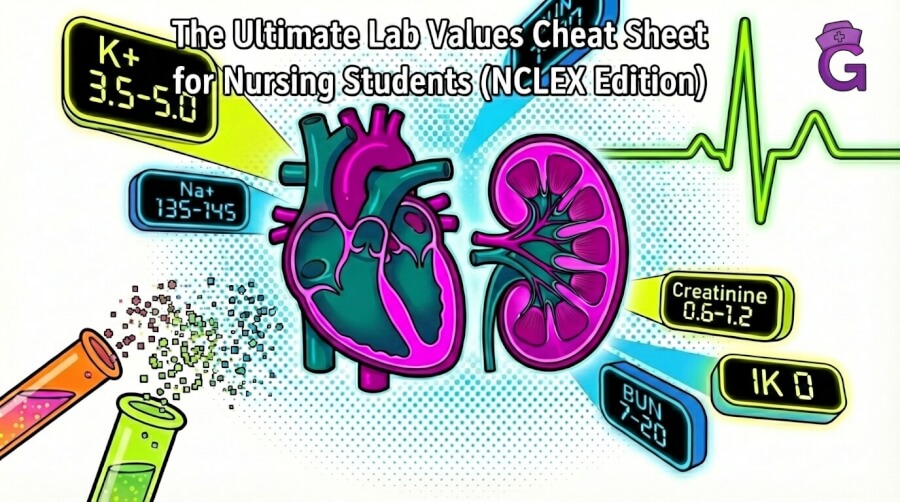

In nursing school, you are handed a list of numbers and told to memorize them. You make flashcards: Sodium 135–145. Potassium 3.5–5.0. You drill them until you can recite them in your sleep.
Then you get to the NCLEX (or your first shift), and you freeze.
Why? Because the NCLEX doesn't ask you to define the range. It gives you a patient with a potassium level of 6.2 and asks:
What kills this patient first?
To survive nursing school and dominate the NGN (Next Generation NCLEX), you need more than rote memorization. You need clinical judgment.
If you haven’t reviewed how NGN case stems are structured, read our guide on
how to read NGN case stems and think like the NCLEX.
This guide replaces static tables with Dynamic Learning:
- Visual Mnemonics – Lock the number into long-term memory
- AI Decoders – Simplified pathophysiology explanations (“The Why”)
- Priority Actions – What you actually do as the nurse
For a full master reference of normal lab ranges across systems, bookmark our
complete normal lab values guide for nursing students.
1. The Electrolyte Suite (The “Big Five”)
Electrolytes are the batteries of the human body. They control electricity (heart), fluid balance (brain), and muscle contraction.
The NCLEX loves electrolyte shifts because a small imbalance can be fatal — especially in Physiological Adaptation scenarios outlined in the
2026 NCLEX-RN and NCLEX-PN test plan breakdown.
If you want NGN-style practice where labs directly impact priority decisions, review these
NGN Med-Surg Physiological Adaptation case studies.
Sodium (Na⁺)
The Range
135–145 mEq/L
The Mnemonic: “The Saltwater Brain”
Imagine a brain floating in a saltwater tank.
- Too fresh (Low Na⁺) → Brain swells
- Too salty (High Na⁺) → Brain shrivels
🤖 AI Decoder (The Pathophysiology)
Think: “Water follows Salt.”
Sodium acts like a magnet that holds water in the bloodstream.
- Hyponatremia (<135): Water rushes into brain cells → cerebral edema → seizures
- Hypernatremia (>145): Water leaves cells → confusion and dehydration
These fluid-shift patterns are heavily tested under NGN cause-and-effect logic, especially in
Next Generation NCLEX matrix and grid item formats.
Priority Nursing Actions
- Low Sodium: Seizure precautions. Restrict fluids.
- High Sodium: Encourage oral fluids. Administer hypotonic IV fluids as ordered.
⚠️ NCLEX Trap
Lithium is closely tied to sodium balance.
If a patient taking lithium becomes hyponatremic, lithium levels rise — increasing toxicity risk.
Strengthen your pharmacology-based clinical reasoning with
NGN pharmacology case studies with full rationales.
Potassium (K⁺)
The Range
3.5–5.0 mEq/L
The Mnemonic: “Bananas in a Bunch”
You buy bananas in bunches of 3.5–5.0.
- Fewer than 3.5 → Weak and irritable
- More than 5.0 → Overexcited and dangerous
🤖 AI Decoder (The Pathophysiology)
Think: “Electrical Conduction.”
Potassium drives cardiac depolarization.
- Hypokalemia (<3.5): PVCs, U-waves
- Hyperkalemia (>5.0): Peaked T-waves, widened QRS, asystole
Electrolytes and cardiac rhythm interpretation go hand-in-hand. If EKG or acid-base connections feel weak, review
ABG interpretation made simple with 15 practice cases.
Priority Nursing Actions
- Low Potassium: Never give IV potassium IV push. Use an infusion pump.
- High Potassium: Cardiac monitor immediately. Prepare insulin/dextrose or Kayexalate protocol.
⚠️ NCLEX Trap
A potassium of 3.4 is not “close enough.”
On the NCLEX, even small deviations require intervention.
This type of precision commonly appears in
NGN bow-tie and priority-action questions.
Calcium (Ca²⁺)
The Range
9.0–10.5 mg/dL
The Mnemonic: “Call 9-1-1”
When calcium is unstable, muscles go wild — or completely floppy.
🤖 AI Decoder (The Pathophysiology)
Think: “Muscle Sedative.”
- Hypocalcemia (<9.0): Tetany, hyperreflexia
- Hypercalcemia (>10.5): Muscle weakness, constipation
Priority Nursing Actions
- Low Calcium: Assess Chvostek’s and Trousseau’s signs.
- High Calcium: Increase fluids. Encourage mobility.
Magnesium (Mg²⁺)
The Range
1.3–2.1 mEq/L
The Mnemonic: “The Sheriff’s Magnifying Glass”
Magnesium keeps the peace in the body.
🤖 AI Decoder (The Pathophysiology)
Magnesium is the “big sister” to calcium and potassium.
Low magnesium increases risk of torsades de pointes and worsens other electrolyte imbalances.
Priority Nursing Actions
- Low Magnesium: Seizure precautions. Cardiac monitoring.
- High Magnesium: Check deep tendon reflexes. Loss of reflexes → respiratory depression risk.
Chloride (Cl⁻)
The Range
98–106 mEq/L
The Mnemonic: “The Perfect Hot Tub”
Visual Hook: The perfect temperature to enjoy a saltwater (chloride) hot tub is 98–106 degrees.
While chloride is often overshadowed by sodium and potassium, it plays a key role in acid–base balance. Chloride shifts frequently mirror sodium shifts and are commonly tested in fluid volume and metabolic disorders.
If acid–base interpretation still feels shaky, review
ABG interpretation made simple with 15 nursing practice cases.
2. Complete Blood Count (CBC) & Oxygenation
The CBC panel tells you three critical things:
- The Army (White Blood Cells)
- The Supply Lines (Red Blood Cells / Hemoglobin)
- The Repair Crew (Platelets)
CBC interpretation is heavily tested under Physiological Integrity and frequently appears in NGN case studies requiring prioritization.
For NGN-style lab-to-action reasoning practice, review
NGN Med-Surg Physiological Adaptation case studies with full rationales.
White Blood Cells (WBCs)
The Range
5,000–10,000 /mm³
The Mnemonic: “Kids Get Sick”
Visual Hook: Kids aged 5 to 10 are always bringing home germs.
🤖 AI Decoder (The Pathophysiology)
Think: WBCs are the infantry.
-
Leukopenia (<5,000): The army is decimated (chemo, AIDS, bone marrow suppression).
→ Action: Neutropenic precautions (No fresh flowers, no raw fruits, private room). -
Leukocytosis (>10,000): The army is fighting a war.
→ Action: Assess for infection source (lungs, urine, wounds, lines).
In NGN case stems, elevated WBCs are often paired with fever, tachycardia, or hypotension — pushing you toward early sepsis recognition. Strengthen that thinking with
how to read NGN case stems and identify what the question is really testing.
Hemoglobin (Hgb)
The Range
- Females: 12–16 g/dL
- Males: 14–18 g/dL
The Mnemonic: “Puberty & Maturity”
Visual Hook: Females mature earlier (12–16). Males catch up later (14–18).
Hemoglobin carries oxygen. When it drops, tissues suffer first — especially the heart and brain.
Hematocrit (Hct)
The Range
37%–52% (Approximately 3× Hemoglobin)
The Mnemonic: “The 3× Rule”
Visual Hook: If Hemoglobin is 15, Hematocrit should be roughly 45.
🤖 AI Decoder (The Pathophysiology)
Hematocrit represents the percentage of blood that is solid (RBCs).
- High Hct: Dehydration (less plasma → blood looks thick).
- Low Hct: Bleeding, anemia, or fluid overload.
Dehydration vs. fluid overload differentials are commonly tied to electrolyte interpretation. If you need a quick refresher, revisit the
complete normal lab values reference guide for nursing students.
Platelets (Plt)
The Range
150,000–400,000 /mm³
The Mnemonic: “Fine China Plates”
Visual Hook: A fancy dinner set costs $150–$400. If you drop them, they shatter (bleeding).
Priority Nursing Action
-
<100,000: Thrombocytopenia
- No IM injections
- Soft-bristle toothbrush
- Electric razor
-
<50,000: CRITICAL
- Strict bleeding precautions
- Fall prevention (intracranial bleed risk)
Platelet thresholds frequently appear in NGN matrix-style prioritization questions. Practice applying cutoffs with
NGN matrix/grid item examples and strategy.
3. Coagulation (Clotting Times)
These labs measure how quickly blood transitions from liquid to solid.
On the NCLEX, the key is not memorizing the range — it’s knowing:
- Which drug it connects to
- Whether the patient is therapeutic
- Whether you hold the medication
Coagulation labs are heavily tested in pharmacology-focused NGN scenarios. Strengthen that area with
NGN pharmacology case studies with detailed rationales.
PT / INR (Prothrombin Time / International Normalized Ratio)
Linked Drug: Warfarin (Coumadin)
Normal Range (No Drug)
INR 0.8–1.1
Therapeutic Range (On Warfarin)
INR 2.0–3.0
The Mnemonic: “1 + 1 = 2”
Use your fingers. Warfarin’s standard target begins at 2… up to 3.
Priority Nursing Action
-
High (>3.5): Bleeding risk
- Hold dose
- Prepare Vitamin K (antidote)
-
Low (<2.0): Clot risk
- Drug not therapeutic
Warfarin safety questions often integrate dietary interactions and bleeding precautions — high-yield testable content under the
2026 NCLEX-RN and NCLEX-PN test plan breakdown.
aPTT (Activated Partial Thromboplastin Time)
Linked Drug: Heparin
Normal Range (No Drug)
30–40 seconds
Therapeutic Range (On Heparin)
60–80 seconds (1.5–2.5× normal)
The Mnemonic: “H-H”
Write the letter H. It looks like two Ts connected (TT = aPTT).
The “Heparin Spider”: A spider has 8 legs → therapeutic max ≈ 80.
Priority Nursing Action
-
High (>100):
- Turn off the drip immediately
- Prepare Protamine Sulfate (antidote)
-
Low (<60):
- Increase infusion per protocol
- Clot risk
Heparin titration frequently appears in NGN bow-tie style questions requiring cause → risk → intervention logic. Practice that structure with
NGN bow-tie item format strategy and examples.
4. Renal & Metabolic Markers
The kidneys are the body's filter. When they clog, waste builds up.
Renal markers frequently appear in NGN case studies involving dehydration, sepsis, medication toxicity, and contrast dye exposure. If you want structured NGN lab-to-priority practice, review
NGN Med-Surg Physiological Adaptation case studies with rationales.
BUN (Blood Urea Nitrogen)
The Range: 10–20 mg/dL
The Mnemonic: “Expensive Burgers”
Visual Hook: A fancy hamburger bun costs $10–$20.
BUN reflects protein breakdown and hydration status.
Creatinine (Cr)
The Range: 0.6–1.2 mg/dL
The Mnemonic: “The Same as Lithium”
Visual Hook: The “Creature” ranks 0.6–1.2 on the scale.
🤖 AI Decoder (The Pathophysiology)
Creatinine is the gold standard for kidney function.
- High BUN + Normal Creatinine: Dehydration (dry sponge).
- High BUN + High Creatinine: Renal failure (broken filter).
This dehydration vs. intrinsic kidney injury pattern is a classic NCLEX differentiation scenario and often appears in
Next Generation NCLEX matrix/grid item questions.
⚠️ NCLEX Trap
If a patient is scheduled for a CT scan with contrast dye, check creatinine first.
If Cr >1.2, contrast can worsen kidney injury.
Contrast-induced nephropathy questions are commonly integrated into pharmacology-based NGN scenarios. Strengthen that area with
NGN pharmacology case studies and priority interventions.
Hemoglobin A1C (Glucose Memory)
Normal (Non-Diabetic): 4%–6%
Diabetic Target: <7.0%
The Mnemonic: “Alice in Wonderland”
Visual Hook: A1C sounds like Alice. She wants to stay under 7 wonders. If she goes above 7, she gets lost (uncontrolled diabetes).
A1C reflects 3-month glucose control, not immediate blood sugar levels.
For deeper glucose prioritization logic and lab-to-intervention connections, review the
complete normal lab values guide for nursing students.
5. Arterial Blood Gases (ABGs)
Do not overcomplicate this.
Use the ROME Method:
- Respiratory Opposite
- Metabolic Equal
Core Values
- pH: 7.35–7.45 (The body’s ruler)
- PaCO₂ (Lungs / Acid): 35–45
- HCO₃ (Kidneys / Base): 22–26
🤖 AI Decoder (The Pathophysiology)
-
CO₂ = Acid
If you retain CO₂ (COPD, asthma), you become acidotic. -
HCO₃ = Base
If you vomit and lose stomach acid, you become alkalotic.
ABGs are one of the highest-yield NCLEX categories and heavily tested under Physiological Adaptation in the
2026 NCLEX-RN and NCLEX-PN test plan breakdown.
For step-by-step interpretation with 15 practice cases, read
ABG interpretation made simple for nursing students.
6. Therapeutic Drug Levels (The “Toxic” List)
The NCLEX loves questions about narrow therapeutic index drugs — where the difference between helping and harming is small.
These frequently appear in NGN bow-tie or case-study formats requiring lab recognition → symptom recognition → intervention.
Practice that cause-to-action logic in
NGN bow-tie item strategy and examples.
High-Yield Therapeutic Ranges
Digoxin
- Range: 0.8–2.0
- Toxic: >2.4
- Mnemonic: “Dig a hole 2 feet deep”
If you need a deeper pharmacology breakdown of digoxin toxicity and electrolyte interactions, review
cardiac glycosides and digoxin toxicity for NCLEX pharmacology.
Lithium
- Range: 0.6–1.2
- Toxic: >1.5
- Mnemonic: “Lithium Levels” (L-L = 1.2)
Lithium questions are frequently paired with sodium imbalance — reinforcing electrolyte cross-connections.
Theophylline
- Range: 10–20
- Toxic: >20
- Mnemonic: “10–20 Theo-Gods”
Phenytoin
- Range: 10–20
- Toxic: >20
- Mnemonic: “Pheny-Ten-To-Twenty”
Vancomycin
- Range: 10–20
- Toxic: >20
- Mnemonic: “Van-Twenty”
Therapeutic drug monitoring questions are core pharmacology content tested repeatedly under the NGN framework.
7. Critical “Panic” Values Table
If you see these numbers on a test (or in real life), you do not “assess” or “document.”
You act.
Immediate Action Thresholds
-
Potassium <2.5 or >6.0
→ Cardiac monitor / Call provider -
Sodium <120
→ Seizure precautions -
Hemoglobin <7.0
→ Prepare blood transfusion -
Platelets <50,000
→ Bleeding precautions (intracranial hemorrhage risk) -
WBC <2,000
→ Neutropenic precautions (sepsis risk) -
pH <7.25 or >7.60
→ Prepare for airway support / crash cart -
Blood Glucose <40 or >400
→ IV dextrose (low) or insulin (high)
These critical-value scenarios are commonly tested in
“Who do you see first?” prioritization formats, which are explained in
how to break down NGN case stems strategically.
Conclusion: How to Use This Cheat Sheet
You cannot memorize all of this in one night.
Use the System-a-Day Method:
- Monday: Electrolytes (Bananas & Saltwater)
- Tuesday: CBC (The Army)
- Wednesday: Coagulation (The Spider)
- Thursday: Renal & Metabolic
- Friday: ABGs
Spaced repetition and system-based learning improve retention and clinical judgment.
Test Your Knowledge
Want to apply these numbers immediately?
Practice lab-to-intervention reasoning inside
NGN Med-Surg case studies with full rationales.
Frequently Asked Questions (FAQ)
Q: Do I use the textbook range or the hospital range?
For the NCLEX, use standardized textbook ranges (based on NCSBN testing parameters). Hospital lab ranges vary slightly by equipment.
Reference the official breakdown in the
2026 NCLEX-RN and PN test plan overview.
Q: Which lab is most important for the NCLEX?
Potassium.
Because it directly affects cardiac conduction. Hyperkalemia frequently appears in “Who do you see first?” priority questions.
Q: How do I remember them all?
Do not obsess over decimals.
Remember the whole number patterns:
- Calcium ≈ 9–10
- Potassium ≈ 3–5
- Sodium ≈ 135–145
Close enough allows you to identify pathology quickly — which is exactly what the NCLEX is testing.
Download our free printable Lab Values cheat sheet. Enter your email below and we'll send it right over.