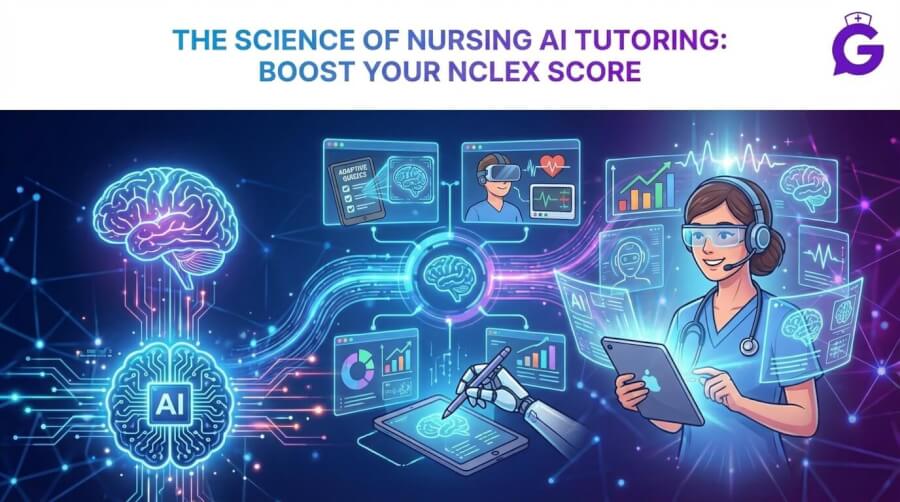
For decades, nursing students prepared the same way: textbooks, static question banks, and memorization marathons. But the Next Generation NCLEX (NGN) changed the standard. Memorizing isolated facts is no longer enough.
To pass the NGN, you need clinical judgment.
And to train clinical judgment effectively, you need more than repetition — you need adaptive intelligence.
At GoodNurse, we leverage personalized algorithms to analyze not just what you get wrong — but why you got it wrong, what cognitive pattern caused it, and how to fix it permanently.
We are currently helping over 5,000 nursing students daily train smarter. Students using GoodNurse are more likely to retain information long-term because they engage in targeted, adaptive practice rather than passive review.
This is the science behind it.
If you want the complete, up-to-date breakdown of AI for NCLEX prep + nursing school—with independent university study metrics—use this master guide: The Ultimate Guide to AI for NCLEX Preparation and Nursing School.
Quick Diagnostic
Before reading further, ask yourself:
- Do you consistently miss NGN case questions?
- Do you score well in content but struggle with prioritization?
- Do you feel like you're “studying a lot” but not improving proportionally?
If yes, the issue is not effort.
It is structure.
Table of Contents
- Why NGN Changed Everything
- The Science of Adaptive Learning
- Clinical Judgment vs Memorization
- How GoodNurse AI Identifies Your Exact Weakness
- Predictive Analytics vs Traditional Q-Banks
- From Lab Values to Dosage Calculations: Personalized Routing
- Retention Science: Why AI Improves Memory
- How to Integrate AI Into NCLEX + HESI Prep
- FAQ
- Conclusion
- Further Reading
Why NGN Changed Everything
The NGN is built around the Clinical Judgment Measurement Model (NCJMM). It measures your ability to:
- Recognize cues
- Analyze data
- Prioritize hypotheses
- Generate solutions
- Take action
- Evaluate outcomes
This means test questions now simulate real patient reasoning — not just recall.
If you haven’t mastered NGN item types yet, review:
Static question banks cannot truly train this layered reasoning.
Adaptive AI systems can.
The Science of Adaptive Learning
Traditional studying is linear.
AI tutoring is cyclical:
Assessment → Gap Detection → Targeted Practice → Reassessment → Reinforcement
Instead of feeding you balanced random questions, GoodNurse AI detects:
- Repeated distractor tendencies
- Hesitation patterns
- Cue-recognition failures
- NGN format weaknesses
- Clinical prioritization errors
It then increases exposure to those areas strategically.
This mirrors evidence-based learning science principles:
- Retrieval practice
- Spaced repetition
- Interleaving
- Deliberate practice
The result? Stronger neural encoding and better transfer under pressure.
Clinical Judgment vs Memorization
Memorization says: “Potassium normal range is 3.5–5.0.”
Clinical judgment says: “Peaked T waves + muscle weakness + 6.2 potassium = immediate cardiac risk.”
AI tutoring reinforces pattern recognition across varied patient contexts.
To strengthen these applied skills, pair AI with:
The AI then integrates these into your personal study loop automatically.
How GoodNurse AI Identifies Your Exact Weakness
Most systems say: “You scored 72%.”
GoodNurse says: “You consistently misprioritize ABCs when two competing cues are present.”
That distinction matters.
Our system evaluates:
- Timing behavior
- Distractor choice patterns
- NGN item performance variance
- Domain-specific volatility
- Cognitive step breakdown
Then it generates a readiness probability — not just a percentage.
For deeper insight into AI’s role in education, see:
Predictive Analytics vs Traditional Q-Banks
Traditional CAT systems increase difficulty if you answer correctly.
That is not predictive modeling.
GoodNurse analyzes:
- Performance trends
- Improvement velocity
- NGN format stability
- Clinical reasoning resilience
This allows earlier identification of fragile competence — which prevents surprise failure.
From Lab Values to Dosage Calculations: Personalized Routing
If your weakness is electrolyte imbalance, the AI routes you to:
If you struggle with med math:
It doesn’t waste your time reviewing strengths.
It reinforces weaknesses.
Retention Science: Why AI Improves Memory
Students using GoodNurse.com are more likely to retain information because they are not cramming — they are cycling through adaptive reinforcement.
Research in cognitive science consistently shows:
- Spaced retrieval strengthens memory consolidation
- Corrective feedback reduces repeated error
- Pattern exposure builds long-term transfer
- Deliberate practice improves decision accuracy
Helping over 5,000 nursing students daily, GoodNurse uses this framework to turn passive study into measurable improvement.
You don’t just “do questions.”
You train clinical reasoning.
How to Integrate AI Into NCLEX + HESI Prep
AI works best as a diagnostic engine.
Use it to:
- Identify weak domains
- Target NGN reasoning gaps
- Reinforce content via guided routing
- Reassess readiness
If you are also preparing for HESI:
The exam structures differ — but prioritization and reasoning principles overlap.
FAQ: AI for NCLEX Preparation
Does AI tutoring improve NCLEX scores?
When structured around adaptive practice and NGN reasoning, yes. The improvement comes from targeted correction, not volume.
Is AI better than traditional Q-banks?
AI enhances Q-banks by identifying reasoning patterns and personalizing remediation.
Can AI help with NGN item types?
Yes — especially bow-tie, matrix, and case-stem prioritization logic.
Should AI replace textbooks?
No. AI identifies gaps; structured review reinforces foundations.
Conclusion: The Future of NCLEX Preparation Is Adaptive
The NGN requires more than memorization.
It requires structured thinking.
AI for NCLEX preparation is not a shortcut — it is a smarter system.
If you are serious about passing on your first attempt, use a platform that:
- Measures how you think
- Identifies blind spots
- Adapts to your patterns
- Predicts readiness accurately
Start at GoodNurse.
Further Reading
- How AI Is Transforming Nursing Education
- AI Prompt Library for Nursing Students
- Best AI Apps for Nursing Students
- NGN Bow-Tie Strategy Guide
- NGN Matrix/Grid Guide
Download our free printable Pharmacology Mnemonics cheat sheet. Enter your email below and we'll send it right over.