Neurological Disorders Videos
Browse videos in the Neurological Disorders category.
Adult Cranial Nerve Assessment: Function, Findings, and Escalation
Connect adult cranial nerve function with focused bedside assessment. Review selected checks for smell and sight, eye movements and pupils, facial sensation and expression, hearing, voice and palate, shoulder strength, and tongue movement. Compare findings on both sides and with the patient's baseline, account for communication and sensory needs, and document what you actually assessed. Use a fictional case to practice recognizing a new facial or speech change and promptly escalating to your supervising nurse and the appropriate emergency response. Distinguish limited bedside observations from a formal swallowing screen, and avoid delaying urgent care to finish a routine sequence. This is an introductory study overview, not a complete neurological examination, stroke diagnostic test or competency validation. Follow current school and facility procedures and work within supervised student practice. Based on Open RN/WisTech Open Nursing Skills 2e (2023), Merck Manual Professional (updated February 2026), CDC stroke warning-sign guidance (2026), and Canadian Stroke Best Practices. Includes AI-generated visuals and synthetic narration; no qualified clinician review or source-organization endorsement is claimed.
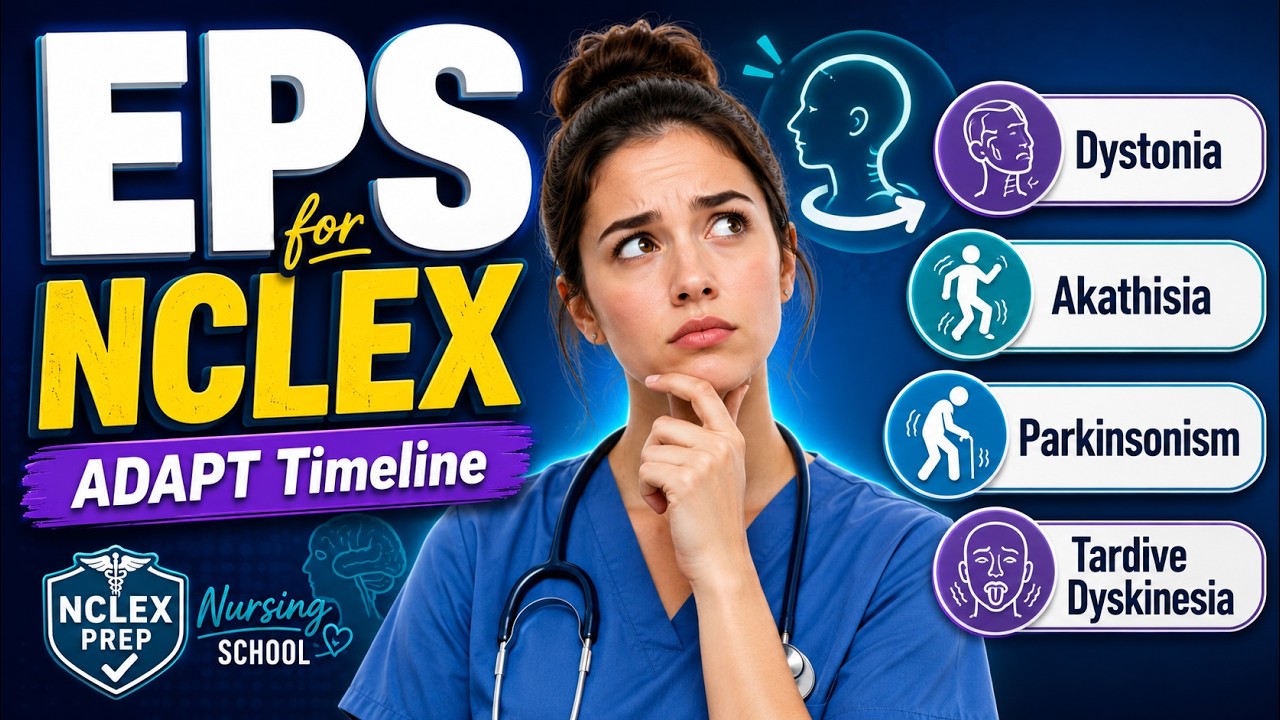
Extrapyramidal Symptoms: EPS Timeline, Assessment, and NCLEX Traps
Learn how to recognize and manage extrapyramidal symptoms caused by dopamine-blocking medications, including antipsychotics and antiemetics. This lesson covers the ADAPT timeline for acute dystonia, akathisia, pseudoparkinsonism, and tardive dyskinesia, along with AIMS assessment steps, anticholinergic treatment, and key NCLEX comparisons such as EPS vs neuroleptic malignant syndrome, malignant hyperthermia, and serotonin syndrome.
Multiple Sclerosis (MS) — High-Yield NCLEX Review
## 1. YouTube Title & Description **Title:** Multiple Sclerosis (MS) NCLEX Review | Pathophysiology, Signs & Symptoms, Nursing Interventions & Pharmacology --- **Description:** Struggling with the neuro section of the NCLEX? This high-yield Multiple Sclerosis review covers everything nursing students need to know to confidently answer MS questions on the boards — from pathophysiology to pharmacology, all broken down in a clear, memorable way. In this video, you'll master: - The core pathophysiology of MS and how demyelination disrupts nerve transmission - How to instantly tell MS apart from Myasthenia Gravis (a classic NCLEX trick!) - Must-know signs and symptoms: Charcot's triad, Uhthoff's sign, Lhermitte's sign, optic neuritis, and Romberg's sign - Priority nursing interventions and how to teach patients to avoid exacerbation triggers - Bowel and bladder management strategies, including the step-by-step constipation algorithm - Key MS medications mapped to the symptoms they treat — exactly how the NCLEX tests pharmacology Whether you're in nursing school, deep in NCLEX prep, or brushing up on neurological nursing, this structured breakdown will help you retain the concepts that matter most on test day. 🔍 Topics Covered: MS Pathophysiology | Myelin Sheath | MS vs Myasthenia Gravis | Charcot's Triad | Uhthoff's Sign | Lhermitte's Sign | Romberg Sign | Optic Neuritis | Nursing Interventions | Urinary Incontinence vs Retention | Clean Intermittent Catheterization | Beta Interferon | Corticosteroids | Baclofen | Oxybutynin | Bethanechol | Modafinil | NCLEX Neuro Review #NCLEX #NursingSchool #MultipleSclerosis #NCLEXReview #NursingStudy #NeuroNursing #NCLEXPrep #NursingExam #MSNursing #HighYieldNursing --- ## 2. Members-Only Library Title & Description **Title:** Multiple Sclerosis (MS) — High-Yield NCLEX Review --- **Description:** This video provides a comprehensive, board-focused breakdown of Multiple Sclerosis for NCLEX preparation. Topics include the autoimmune pathophysiology of CNS demyelination, key distinguishing features between MS and Myasthenia Gravis, and high-yield clinical findings such as Charcot's triad, Uhthoff's sign, Lhermitte's sign, and optic neuritis. Also covered: priority nursing interventions, environmental trigger education, bowel and bladder management protocols, and essential pharmacology including immunomodulators, corticosteroids, muscle relaxants, and bladder medications.

Glasgow Coma Scale (GCS): Scoring, Assessment & NCLEX Traps
A complete walkthrough of the Glasgow Coma Scale covering all three components (Eye, Verbal, Motor), how to perform the assessment from least to most invasive, and the clinical thresholds you need to know. Includes memory tricks like EVM 4-5-6, key rules such as "less than 8, intubate" and documenting non-testable components as NT, plus a breakdown of the Pediatric GCS and when a score drop signals a neurological emergency. Ends with a practice question calculating and classifying a GCS of 12.

Anxiety Disorders & Panic Attacks: Clinical Assessment and Nursing Interventions
Comprehensive review of anxiety disorder nursing care covering assessment techniques, immediate crisis interventions, therapeutic communication, and long-term treatment approaches. Includes NCLEX-style prioritization scenarios and delegation guidelines essential for safe clinical practice. Learning Objectives: - Differentiate between anxiety levels and their impact on patient cognition - Implement immediate nursing interventions for panic attacks - Apply therapeutic communication techniques for anxious patients - Prioritize patient care using ABC framework - Understand safe delegation principles for anxiety disorder patients - Compare treatment modalities including SSRIs, benzodiazepines, and CBT

Schizophrenia Assessment & Nursing Interventions - NCLEX Essentials
Comprehensive overview of schizophrenia for NCLEX preparation covering the distinction between positive and negative symptoms, mental status examination techniques, and priority nursing interventions. Key Learning Objectives: - Differentiate between positive symptoms (hallucinations, delusions) and negative symptoms (the 6 A's) - Conduct systematic mental status examinations - Implement therapeutic communication strategies - Assess command hallucinations for safety risks - Apply evidence-based nursing interventions for optimal patient outcomes

Neurovascular Assessment: Circulation, Sensation, and Compartment Syndrome
If your casted patient has severe pain unrelieved by opioids but still has a pulse—🚨 think Acute Compartment Syndrome (ACS). In this NCLEX-focused lesson, we turn a classic clinical scenario into a clear, step-by-step approach you can use on exams and in clinicals. You’ll learn the 6 P’s, which signs show up early vs. late, and the exact first nursing actions to take to protect perfusion and save tissue.