Pharmacology Videos
Browse videos in the Pharmacology category.
Insulin Pen Safety: Patient Assignment and Uncertain Devices
Explain why a fresh needle does not make a used insulin pen safe for another person. Practice checking patient assignment, recognizing an unclear label or use history, and promptly involving the supervising RN and pharmacist to obtain verified equipment for timely prescribed care. Work through fictional near-miss and suspected-sharing cases, with respectful patient explanation and appropriate qualified-team follow-up. This focused lesson supports supervised nursing-student learning and does not replace the complete medication-administration process.
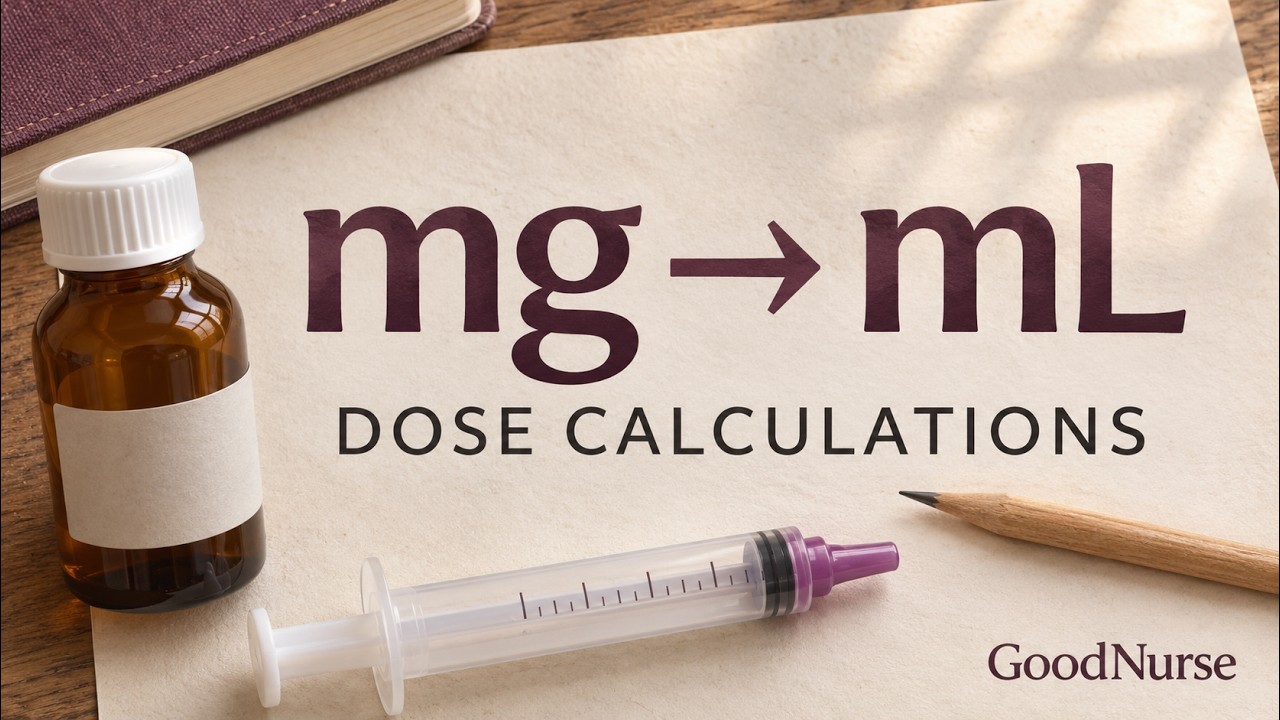
Oral-Liquid Dose Calculations: Label, Units and Volume
Practice reading a complete oral-liquid concentration, arranging mg and mL so units cancel, and verifying the calculated volume with ratio reasoning or a reverse calculation. Compare two hypothetical concentrations, solve an answered practice problem and recognize when missing label information requires RN/pharmacist clarification. Includes clear decimal notation and appropriate oral-device principles. These fictional exercises do not establish patient-specific dose appropriateness or authorize administration; students follow supervision, orders and local policy.
Furosemide and Spironolactone: Compare Monitoring Cues
Follow a fictional adult case involving new dizziness while furosemide and spironolactone are prescribed. Compare potassium risks and connect symptoms with current blood pressure, fluid balance, weight, renal function and ordered laboratory results. Practice a concise report to the supervising RN and teach-back about the individual medication, supplement and salt-substitute plan. Follow your assigned role, supervision, orders and facility protocols.

TB Treatment: Plan Understanding, Support and Warning Symptoms
Learn how nursing students can support an adult with an established TB treatment plan. Distinguish inactive infection from active disease at a teaching level, explain why feeling better does not prove treatment is complete, and check the actual medicine schedule, monitoring and contact instructions. Practise respectful barrier assessment, teach-back and TB-team support, then recognize warning symptoms that need immediate medical attention. The lesson does not select a regimen or replace the supervising RN, treating clinician or local protocols.
Reported Penicillin Reaction: History, Uncertainty and Team Review
Practice gathering a focused adult penicillin-reaction history using what happened, when, and what followed. Ask about actual symptoms, timing relative to doses, treatment and outcome, and later antibiotic exposure. Preserve unknowns and distinguish the patient report from verified details in a clear handoff to the supervising RN for clinician/pharmacist review. Apply the history questions to a fictional stable-patient scenario, then contrast a new emergency concern. Current airway, breathing or circulation compromise takes priority over an interview or documentation and may occur without a rash. Follow RN/preceptor guidance and current local protocols. These original study cues are not a validated risk score; the lesson does not authorize independent allergy classification, label removal, drug clearance, challenge testing or medication changes.

Vitamins and Supplements: Ask, Verify and Share the Medication History
Practice gathering a complete adult medication history that includes vitamins, minerals, herbs and other supplements. Use the ASK / VERIFY / SHARE study organizer to distinguish product identity, amount actually used and frequency; check available labels; and communicate uncertainty honestly to the supervising RN for clinician/pharmacist review. Work through a fictional case and a focused handoff, connect supplement use with medication-safety concerns, and support the patient with respectful questions and teach-back. Follow local policies and RN/preceptor supervision. This lesson does not recommend supplement doses or authorize independent treatment changes.
Adult Eye-Drop Technique: Verification, Tip Protection and Patient Teaching
Practice a focused approach to routine prescribed eye drops for a stable adult. Connect medication and order verification with assessment, protection of the dropper tip, the lower-lid conjunctival pocket and respectful patient teaching. Use a fictional scenario to identify contamination concerns, clarify the exact product instructions with the supervising RN/preceptor, and check understanding through teach-back and return demonstration. Reassess tolerance, document actual care and report concerns. New pain, discharge or vision changes while using drops needs prompt clinical advice. This study overview supports supervised skills learning. Follow individual orders, product instructions and local policy; it does not certify competency or authorize independent medication decisions. AI-generated visuals and synthetic narration.
Adult MDI Technique: Assessment, Spacer Use and Patient Teaching
Practice a focused nursing-student approach to adult metered-dose inhaler (MDI) teaching. This lesson follows a stable adult using a prescribed manually actuated MDI with a compatible mouthpiece valved holding chamber. Review breathing first, verify the actual medicine and device instructions, recognize common technique errors, and use a respectful return demonstration. Learn why one puff at a time, a slow inhalation and device-specific preparation matter, and when breathing difficulty calls for urgent escalation instead of routine teaching. An introductory educational overview for supervised study—not a competency assessment or individual treatment plan. Follow the prescription, manufacturer instructions and local protocols. AI-generated visuals and synthetic narration; reviewed against public NHLBI, American Thoracic Society and American Lung Association educational sources. No qualified clinician review is claimed.

Pharmacology Foundations: Medication Safety and Nursing Judgment
Practice a structured approach to medication safety before, during, and after administration. Connect the medication and indication with a focused assessment, verify the order and patient identifiers, recognize when to pause and clarify a concern, and reassess the response. This lesson includes a fictional patient scenario, high-alert medication concepts, respectful communication, documentation, and teach-back. The before/during/after organizer supports studying; assessment remains continuous and urgent deterioration needs immediate escalation. For nursing-student learning under RN/preceptor supervision. Use current orders, approved medication references, and local protocols. Created with AI-assisted visuals and synthetic narration; source comparison does not constitute qualified clinician sign-off.
Extrapyramidal Symptoms: EPS Timeline, Assessment, and NCLEX Traps
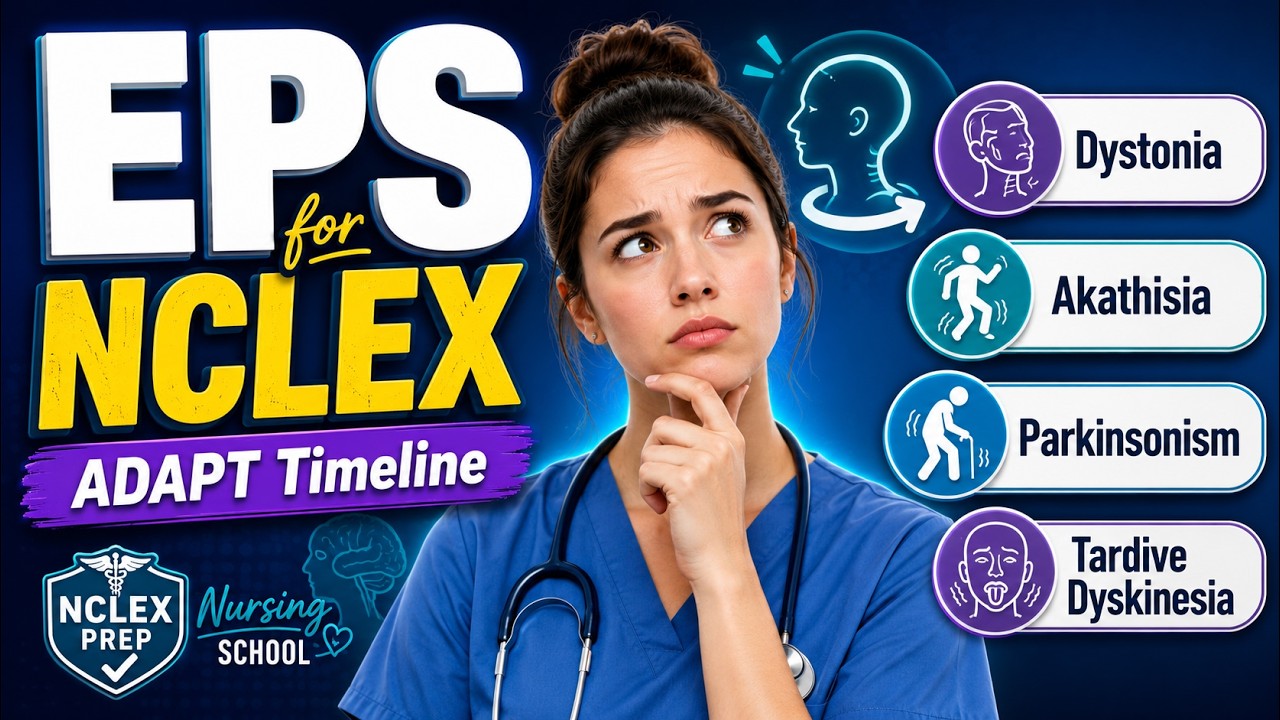
Learn how to recognize and manage extrapyramidal symptoms caused by dopamine-blocking medications, including antipsychotics and antiemetics. This lesson covers the ADAPT timeline for acute dystonia, akathisia, pseudoparkinsonism, and tardive dyskinesia, along with AIMS assessment steps, anticholinergic treatment, and key NCLEX comparisons such as EPS vs neuroleptic malignant syndrome, malignant hyperthermia, and serotonin syndrome.

Cardiac Assessment NCLEX Review: Auscultation, JVD, Troponin, Angina & Nitro Protocol
This lesson reviews high-yield cardiac assessment concepts for NCLEX prep, including heart auscultation landmarks, normal and abnormal heart sounds, jugular vein distension assessment, troponin interpretation, stable vs. unstable angina, and the step-by-step nitroglycerin protocol. Designed to help nursing students connect memorized facts with safe clinical decision-making.

Pediatric NCLEX Review: Prioritization, Emergencies, Milestones & Med Safety
This pediatric NCLEX review covers the key concepts nursing students need to recognize high-priority pediatric patients and answer safety-based exam questions. Topics include NCLEX prioritization rules, pediatric vital sign trends, developmental milestones and regression, croup vs. epiglottitis, signs of abuse and neglect, mandated reporting, and high-yield pediatric pharmacology. Students will review essential medication safety points including kilogram-based dosing, ibuprofen and aspirin precautions, IM injection site selection, digoxin toxicity signs, amoxicillin teaching, and pancreatic enzyme administration for cystic fibrosis.