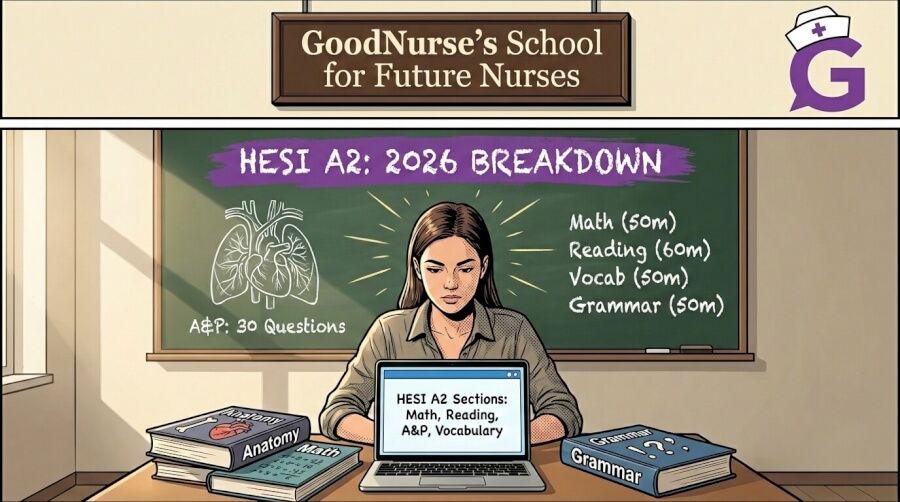


Preparing for the HESI A2 can feel overwhelming, especially if you’re applying to competitive nursing programs where admissions scores truly matter. Unlike the NCLEX, the HESI A2 is not testing clinical judgment yet. It is testing whether you have the academic foundation to succeed in nursing school: math, reading, vocabulary, grammar, and often anatomy and physiology.
If you are beginning your preparation and want structured guidance with adaptive practice, you can explore focused tools here: https://goodnurse.com/hesi-exam-prep
This guide breaks down every HESI A2 section, explains what schools are actually evaluating, and gives you a practical strategy for scoring competitively.
Preparing for the HESI A2 Exam?
Join 5,000+ nursing and pre-nursing students using GoodNurse for AI-powered HESI A2 prep, step-by-step math walkthroughs, anatomy reviews, and personalized study plans designed to strengthen weak areas before test day.
What Is the HESI A2?
The HESI Admission Assessment (HESI A2) is an entrance exam used by many nursing programs to evaluate academic readiness. It is commonly required for:
- Associate Degree in Nursing (ADN) programs
- Bachelor of Science in Nursing (BSN) programs
- Practical or Vocational nursing pathways
The HESI A2 is modular. Each nursing program selects which sections it wants applicants to complete. Always verify your program’s required sections before studying.
HESI A2 Test Structure Overview
Possible HESI A2 sections include:
- Math
- Reading Comprehension
- Vocabulary and General Knowledge
- Grammar
- Anatomy and Physiology
- Biology
- Chemistry
- Physics
Most nursing programs require the core five:
- Math
- Reading
- Vocabulary
- Grammar
- Anatomy and Physiology
Because scoring requirements vary, always confirm:
- Minimum section scores
- Composite score expectations
- Retake policy
Math
What It Tests
The HESI A2 Math section typically includes:
- Whole number operations
- Fractions and decimals
- Ratios and proportions
- Percentages
- Conversions (metric and household)
- Word problems
While it is not full medication math, it prepares you for dosage reasoning used later in nursing practice.
The U.S. Food & Drug Administration notes that medication errors contribute significantly to preventable adverse events in healthcare (FDA.gov). Calculation precision matters.
Study Strategy
- Practice conversions daily
- Write units clearly in every step
- Use dimensional analysis
- Build accuracy before speed
If you want to strengthen broader nursing exam math skills beyond admissions testing, you may also find this helpful: https://goodnurse.com/article/134/best-ai-apps-for-nursing-students-2026-honest-comparison-for-classes-nclex
Reading Comprehension
What It Tests
This section evaluates:
- Main idea
- Supporting details
- Logical inference
- Author’s tone
- Drawing conclusions
Strong reading skills are foundational for evidence-based nursing practice. The National Institutes of Health emphasizes accurate interpretation of research in clinical decision-making (NIH.gov).
Study Strategy
- Read questions first
- Identify key phrases
- Avoid assumptions not supported by the passage
- Eliminate extreme answer choices
Vocabulary and General Knowledge
What It Tests
- Word meaning
- Context clues
- Academic vocabulary
- Basic healthcare terminology
Clear communication reduces medical error. The Joint Commission identifies communication breakdown as a major contributor to sentinel events (jointcommission.org).
Study Strategy
- Learn medical prefixes and suffixes
- Practice contextual vocabulary
- Focus on academic test-style wording
Grammar
What It Tests
- Subject-verb agreement
- Verb tense consistency
- Pronoun usage
- Sentence structure
- Word choice
Clear written communication is essential in nursing documentation and academic success.
Study Strategy
- Review major grammar rules
- Practice error identification
- Choose the simplest grammatically correct answer
Anatomy and Physiology
This is often the most challenging HESI A2 section.
What It Tests
- Organ systems
- Structure and function
- Homeostasis
- Basic cause-and-effect relationships
The National Council of State Boards of Nursing emphasizes physiological integrity as foundational to nursing competence (ncsbn.org).
High-Yield Systems
Focus on:
- Cardiovascular
- Respiratory
- Renal
- Endocrine
- Nervous system
If you want to strengthen your understanding of respiratory physiology and acid-base balance, review: https://goodnurse.com/article/201/abg-interpretation-made-simple-2026-15-practice-cases-with-answers-nursing-rationale
System-based understanding improves both HESI performance and later NCLEX success.
How the HESI A2 Is Scored
Each section receives a percentage score. Programs may require:
- Minimum section scores
- Minimum composite score
- Weighted scoring
A competitive score often falls in these ranges:
- 90% or higher: highly competitive
- 85 to 89%: strong
- 80 to 84%: competitive for many programs
Always confirm specific requirements with your admissions department.
How Long Should You Study?
Most students benefit from:
- 4 to 6 weeks of preparation
- 30 to 60 minutes daily
- Weekly timed practice
If you are preparing for both admissions exams and eventual licensure testing, structured preparation becomes even more important. You can begin organized HESI-focused practice here: https://goodnurse.com/hesi-exam-prep
Common HESI A2 Preparation Mistakes
- Not verifying required sections
- Ignoring Math until the final week
- Memorizing Anatomy without understanding systems
- Skipping timed practice
- Underestimining vocabulary complexity
Frequently Asked Questions
Is the HESI A2 harder than the TEAS?
It depends on strengths. Many students find HESI A2 slightly more detailed in Anatomy and Physiology, while TEAS includes broader science categories.
Can you retake the HESI A2?
Most programs allow retakes, but waiting periods and limits vary.
Where can I begin structured HESI prep?
Explore guided tools and AI-supported practice here: https://goodnurse.com/hesi-exam-prep
Final Thoughts
The HESI A2 measures readiness.
If you focus on:
- Consistent math practice
- System-based Anatomy and Physiology understanding
- Timed reading drills
- Vocabulary and grammar fundamentals
You position yourself competitively for nursing school admission.
For structured, adaptive support designed for nursing students, visit: https://goodnurse.com/hesi-exam-prep