
Math is one of the most heavily tested sections on the HESI A2 - and one of the easiest areas to improve quickly with structured practice.
If you’ve already reviewed the overall structure of the exam in our HESI A2 breakdown guide: https://goodnurse.com/article/241/hesi-a2-breakdown-every-section-explained-2026-complete-guide
This article will go deeper into the math section specifically, with step-by-step explanations and real problem walkthroughs.
The goal is simple: accuracy first, speed second.
Preparing for the HESI Math Section?
Join 5,000+ nursing and pre-nursing students using GoodNurse for AI-powered HESI math practice, step-by-step breakdowns, and targeted drills designed to improve accuracy before test day.
What the HESI Math Section Actually Tests
You can expect questions involving:
- Fractions and decimals
- Ratios and proportions
- Percentages
- Conversions (metric & household)
- Time and military time
- Word problems
The key difference between average scorers and high scorers?
Unit awareness and structured setup.
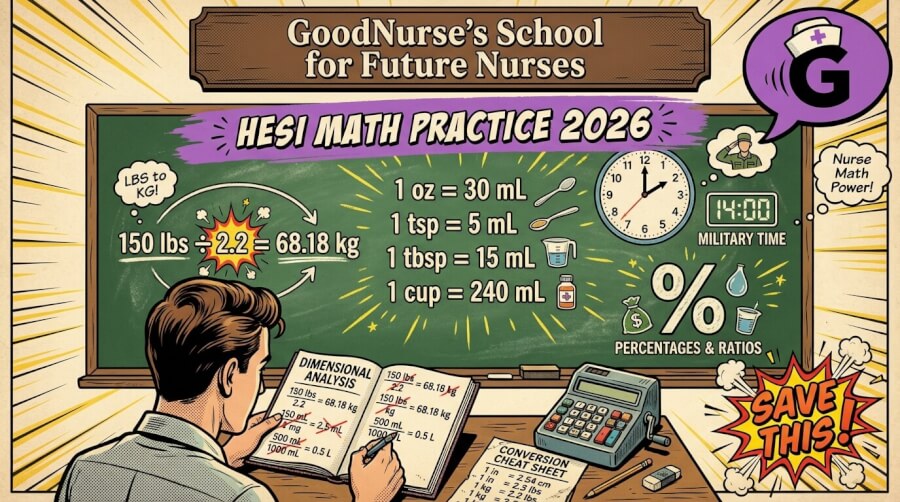
Printable HESI Conversion Table (Keep This Handy)
Metric Conversions
- 1 kg = 1000 g
- 1 g = 1000 mg
- 1 mg = 1000 mcg
- 1 L = 1000 mL
Household Conversions
- 1 tsp = 5 mL
- 1 tbsp = 15 mL
- 1 oz = 30 mL
- 1 cup = 240 mL
Time
- 60 seconds = 1 minute
- 60 minutes = 1 hour
- 24 hours = 1 day
Military Time Quick Guide
- 1300 = 1:00 PM
- 1400 = 2:00 PM
- 1800 = 6:00 PM
- 2300 = 11:00 PM
Dimensional Analysis (The Safest Method)
Dimensional analysis prevents most mistakes because units cancel.
Example setup:
Desired unit × (conversion factor)
Always write units. If they cancel properly, you are likely correct.
Worked Practice Problems
Problem 1 (Multiple Choice)
Convert 2.5 grams to milligrams.
A. 25 mg
B. 250 mg
C. 2500 mg
D. 25,000 mg
Step-by-Step
1 g = 1000 mg
2.5 g × 1000 mg = 2500 mg
Correct Answer: C
Problem 2 (Open Response)
Convert 0.75 L to mL.
Solution
1 L = 1000 mL
0.75 × 1000 = 750 mL
Final Answer: 750 mL
Problem 3 (Multiple Choice)
What is 30% of 250?
A. 50
B. 60
C. 75
D. 90
Solution
30% = 0.30
0.30 × 250 = 75
Correct Answer: C
Problem 4 (Ratio)
A ratio of 3:5 is equivalent to which fraction?
3 ÷ 5 = 0.6
Answer: 3/5 or 0.6
Problem 5 (Word Problem)
A student studies 45 minutes per day. How many hours is that in one week?
45 minutes × 7 days = 315 minutes
315 ÷ 60 = 5.25 hours
Final Answer: 5.25 hours
Problem 6 (Multiple Choice)
Convert 3 tablespoons to milliliters.
A. 30 mL
B. 45 mL
C. 60 mL
D. 90 mL
Solution
1 tbsp = 15 mL
3 × 15 = 45 mL
Correct Answer: B
Problem 7 (Fraction to Decimal)
Convert 3/4 to a decimal.
3 ÷ 4 = 0.75
Answer: 0.75
Problem 8 (Military Time)
What time is 1630 in standard format?
1600 = 4:00 PM
1630 = 4:30 PM
Answer: 4:30 PM
Problem 9 (Multi-Step)
A container holds 2.5 L. Convert to mL.
2.5 × 1000 = 2500 mL
Answer: 2500 mL
Problem 10 (Percent Increase)
A score increases from 70 to 84. What is the percent increase?
Increase = 14
14 ÷ 70 = 0.2
0.2 × 100 = 20%
Answer: 20%
Most math errors occur during unit conversion. If units cancel cleanly using dimensional analysis, your setup is usually correct.
Rushing simple percentage or conversion questions. Slow down on easy problems—those are the ones that cost points.
How to Practice Efficiently
- Practice daily for 20–30 minutes
- Mix conversions with percentages
- Review mistakes immediately
- Time yourself during the final week
If you want structured math drills with adaptive feedback, explore: https://goodnurse.com/hesi-exam-prep
Final Takeaway
HESI math is not advanced calculus.
It is precision, structure, and unit awareness.
Master conversions. Use dimensional analysis. Practice consistently.
Accuracy builds confidence. Confidence improves scores.
Download our free printable Fluids & Electrolytes cheat sheet. Enter your email below and we'll send it right over.