

Type "best time to take the NCLEX" into any nursing forum and you'll get folklore: "The exam is easier in spring." "Never test in December." "Summer testers get the new grads' curve."
The official NCSBN data for 2025 shows there really is a seasonal pattern — a big one:
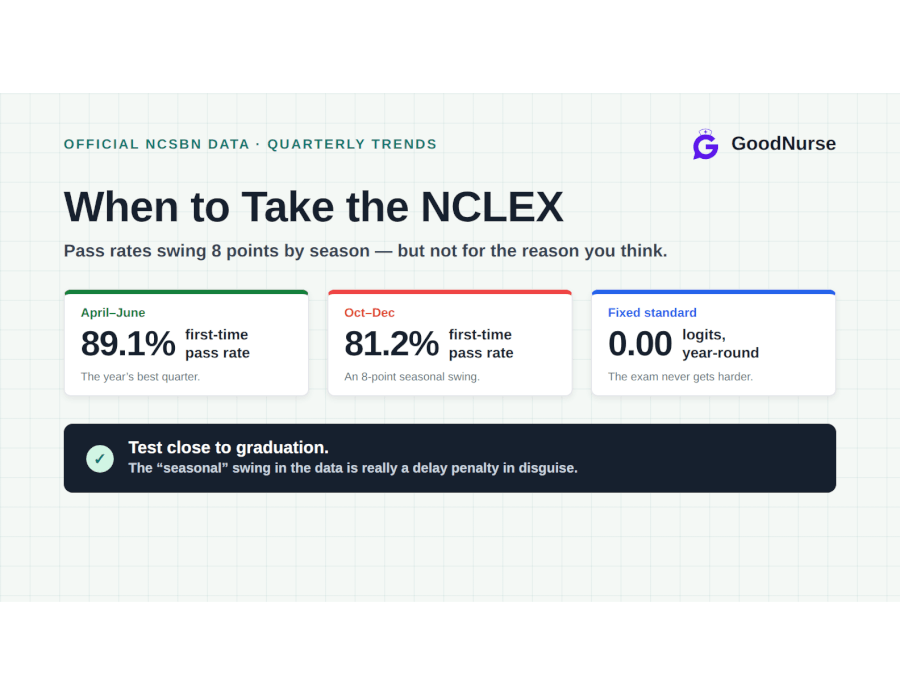
First-time U.S.-educated candidates passed at 89.1% in April–June, but only 81.2% in October–December.
An 8-point swing is enormous for a single variable. But the reason behind it isn't what the forums think — and understanding the real mechanism tells you exactly how to schedule your own exam.
📊 Whenever you test, walk in ready.
GoodNurse's AI builds a prep plan around your exam date and drills your weak areas with NGN-format questions. Start free — no card needed.
Try GoodNurse Free →The Official Quarterly Numbers (2025, NCLEX-RN)
| Quarter | First-Time US-Educated | Repeat US-Educated | All Candidates |
|---|---|---|---|
| Jan–March | 88.4% | 51.5% | 71.6% |
| April–June | 89.1% | 47.5% | 73.7% |
| July–Sept | 84.0% | 58.0% | 68.7% |
| Oct–Dec | 81.2% | 51.4% | 57.6% |
And for the NCLEX-PN (first-time, U.S.-educated): Q1 86.3%, Q2 86.5%, Q3 88.8%, Q4 83.5%.
Look closely and the plot thickens: RN first-timers peak in spring, PN first-timers peak in summer, and repeat candidates peak in summer too. If the exam itself were "easier" in certain months, every group would peak together. They don't.
The Exam Doesn't Get Easier. The Cohort Changes.
Here's the part the folklore misses: the NCLEX passing standard is fixed all year (0.00 logits for the RN exam in 2025 — the same standard in January as in December). The adaptive algorithm doesn't loosen up in spring.
What changes is who is testing:
Spring testers are freshly graduated
Most U.S. nursing programs graduate in May (and December). The huge Q2 wave — 68,091 first-time candidates, the year's biggest — is dominated by new grads testing within weeks of graduation, with content fresh and momentum high. They pass at 89.1%.
Fall testers include more delayed testers
By Q4, first-time volume collapses to 20,128 — a third of Q2's. Who's left? A higher share of candidates who graduated in May but postponed — often because life intervened or because they didn't feel ready. Their 81.2% pass rate reflects months of content decay, not a harsher exam.
The delay penalty is the real story
Read the quarterly pattern as a proxy for time since graduation, and it aligns with what educators have long observed: the further you get from graduation, the lower your first-attempt odds. The drop from 89.1% to 81.2% across the year is the cost of delay, measured at population scale.
Why repeaters peak in Q3
Repeat candidates hit 58.0% in July–September — their best quarter by far. The likely mechanism: spring first-attempt failers who rebuilt for 6–10 weeks and returned promptly, exactly the retake strategy the second-attempt data supports. Repeaters testing in Q2 (47.5%) skew toward longer-delayed retakes.
So When Should You Take the NCLEX?
The data supports three practical rules:
1. Test as soon as you're consistently ready — ideally within 6–8 weeks of graduation. Not because spring is magic, but because recent graduates pass more. If you graduate in December, your "Q2" is January–February. The right study timeline matters more than the calendar.
2. Don't confuse "soon" with "rushed." Ready means consistently scoring 65–70%+ on new NGN-style practice questions, not just feeling done with school. A 3-week panic prep in June is worse than a structured 7-week prep ending in August.
3. If you've delayed, don't despair — compensate. Testing 6+ months after graduation? You're fighting content decay, so build a longer runway: diagnostic first, then targeted review of decayed areas (pharm values and maternal/peds go first), then full-length timed simulations to rebuild stamina.
One more scheduling note: appointment availability tightens in the May–July crush. Booking early gets you your preferred date and test center — and once you test, here's how long results actually take.
🧠 Your graduation-to-test-date window is your biggest lever
GoodNurse turns it into a plan: adaptive daily practice, NGN formats, and AI rationales that keep content fresh from graduation to test day.
Start Practicing Free →What About Test-Center Seasonality Myths?
"December exams are curved harder." False. The passing standard is identical year-round; NCSBN re-evaluates it only every three years. The Q4 dip is cohort composition, not difficulty. (Full statistics breakdown here.)
"Testing with lots of other new grads helps you." The NCLEX isn't graded on a curve. Your result depends only on your ability estimate versus the fixed standard — other candidates' performance is irrelevant. (How the adaptive algorithm actually works.)
"Summer is the worst time because pass rates drop." The Q3 first-timer dip (84.0%) mostly reflects late-spring grads who delayed a few months. For repeat candidates, Q3 is actually the best quarter in the data.
FAQs
What month has the highest NCLEX pass rate? By quarter, April–June had the highest first-time pass rate in 2025 (89.1% for U.S.-educated RN candidates). But the driver is freshness of graduation, not the month itself.
Is it bad to take the NCLEX in December? The exam is identical. Q4's lower pass rate (81.2% first-time) reflects who tests then — mostly candidates months removed from graduation. A December-graduating student testing in January carries the same advantage as a May grad testing in June.
How long after graduation should I take the NCLEX? The data favors testing within 6–8 weeks of graduation, once you're consistently hitting 65–70%+ on new practice questions. See our complete study timeline guide.
Does the NCLEX get harder at certain times of the year? No. The passing standard (0.00 logits for RN) is fixed year-round, and questions come from the same calibrated item pools. Seasonal pass-rate differences come entirely from who is testing.
The Bottom Line
There's no magic month — but there is a clear, data-backed rule: the best time to take the NCLEX is as close to graduation as genuine readiness allows. The 8-point quarterly swing in the 2025 data is really a delay penalty in disguise. Protect your window: build your study plan the week you graduate, book your seat early, and test while your knowledge is at its peak.
Related Resources
- How Long Should You Study for the NCLEX? A Complete Guide
- How Long Does It Take to Get NCLEX Results?
- NCLEX Pass Rates 2026: Every Official NCSBN Statistic (RN & PN)
- NCLEX Second Attempt Pass Rate (2026): The Real Numbers & How to Beat Them
Graduating soon? Start your countdown plan today.
GoodNurse builds an adaptive prep plan around your target test date — 2,500+ NGN questions, AI rationales, and weak-area targeting for $9.99/mo.
Try GoodNurse Free — No Card Needed →Source: NCSBN, 2025 NCLEX Examination Statistics (Research Brief Vol. 96, June 2026), Tables 1 & 12.