

If you failed the NCLEX and you're searching for your real odds on the second attempt, here's the honest number, straight from NCSBN's official 2025 statistics:
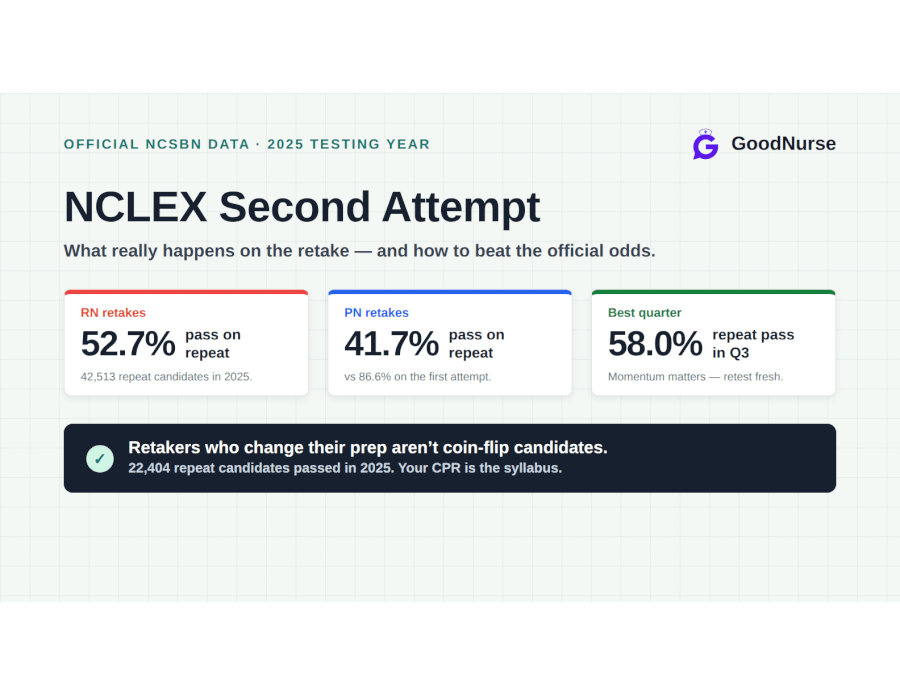
52.7% of repeat, U.S.-educated NCLEX-RN candidates passed in 2025.
That's a coin flip — compared to the 86.7% pass rate for first-time candidates. For the NCLEX-PN, the repeat pass rate is even lower: 41.7%.
Here's what almost nobody tells you, though: that 52.7% is an average across everyone who retakes — including people who changed nothing about how they prepared. Repeat candidates who diagnose why they failed and retrain specifically against it are not coin-flip candidates. This article shows you the full data, why retakes really fail, and the evidence-based way to land on the right side of that statistic.
📊 Retaking the NCLEX? Don't repeat the same prep.
GoodNurse's AI finds your actual weak areas and drills them with NGN-format questions — so your second attempt is nothing like your first. Start free, no card needed.
Try GoodNurse Free →The Official Repeat Pass Rates (2025 NCSBN Data)
| Group | Tested | Passed | Pass Rate |
|---|---|---|---|
| First-time, U.S.-educated (RN) | 192,916 | 167,272 | 86.7% |
| Repeat, U.S.-educated (RN) | 42,513 | 22,404 | 52.7% |
| First-time, U.S.-educated (PN) | 54,818 | 47,470 | 86.6% |
| Repeat, U.S.-educated (PN) | 13,342 | 5,558 | 41.7% |
| Repeat, internationally educated (RN) | 40,187 | 12,271 | 30.5% |
Two important context points:
You are not alone. 42,513 U.S.-educated candidates retook the NCLEX-RN in 2025 — that's more than 1 in 6 of all U.S.-educated test-takers. Failing the first attempt is common enough that NCSBN publishes an entire statistical category for it.
More than 22,000 repeat candidates passed last year. The retake is not a lost cause — it's a different exam experience that requires a different preparation strategy.
Why the Repeat Pass Rate Is So Much Lower
The 34-point gap between first-time and repeat pass rates isn't because repeat candidates are less capable. Four factors do most of the damage:
1. Most retakers repeat the same preparation
The single biggest mistake: doing the same question bank, the same review course, the same study schedule — just "more of it." If your prep didn't build the clinical judgment the Next Gen NCLEX tests, doubling the hours doesn't fix the method.
2. They ignore their Candidate Performance Report (CPR)
Every failing candidate receives a CPR showing performance in each content area: "below," "near," or "above" the passing standard. It's a personalized diagnosis of exactly why you failed — and most candidates barely look at it. Your retake plan should be built directly from your CPR: below-standard areas first, near-standard areas second, above-standard areas almost never.
3. The knowledge decay window
The 45-day minimum wait between attempts creates a trap: wait too long and content decays; rush back unprepared and you become part of the 47% who fail again. The data suggests neither extreme works — what matters is that the time between attempts is structured. (Retake waiting periods and attempt limits also vary by state.)
4. Test anxiety compounds
Walking back into Pearson VUE carrying a previous failure is psychologically heavier. Candidates who don't rehearse under realistic, timed conditions often experience the same anxiety spiral that hurt them the first time.
The Interesting Quarterly Pattern
Repeat pass rates in 2025 weren't flat across the year:
| Quarter | Repeat RN Pass Rate |
|---|---|
| Jan–March | 51.5% |
| April–June | 47.5% |
| July–Sept | 58.0% |
| Oct–Dec | 51.4% |
Repeat candidates did meaningfully better in Q3 than in Q2 — a 10.5-point swing. A likely contributor: many Q3 retakers are recent grads who failed in spring, rebuilt over 6–10 weeks, and came back while their knowledge base was still fresh. Q2's low number likely includes more candidates retaking after long delays. The pattern is a useful reminder that momentum matters — a structured, prompt rebuild beats a long drift toward "someday."
Your Second-Attempt Battle Plan (Condensed)
We have a complete step-by-step guide in Failed the NCLEX? Your Comeback Plan — here's the short version the data supports:
1. Decode your CPR the day it arrives. List every "below standard" category. That list is your syllabus.
2. Change your prep method, not just your prep volume. If you failed on content, you need structured review with rationales. If you failed on NGN formats (bow-ties, matrix, cloze), you need format-specific practice. If you ran out of stamina, you need full-length timed simulations.
3. Rebuild in 6–8 focused weeks. Long enough to fix real gaps, short enough to avoid decay. Use the 45-day minimum wait as your floor, not your ceiling.
4. Prove readiness before you rebook. Consistent 65–70%+ on new NGN-style questions in your former weak areas — not re-answering questions you've seen.
5. Know your state's rules. Attempt limits and waiting periods differ by state, and there's a lifetime-attempts question worth understanding before you plan attempt #3.
🧠 Your CPR tells you what went wrong. GoodNurse fixes it.
Feed your weak areas into GoodNurse and get unlimited NGN-format practice targeted exactly where you're below standard — with AI rationales that build the clinical judgment the exam is actually testing.
Start Your Retake Prep Free →FAQs
What percentage of people pass the NCLEX on the second try? NCSBN doesn't separate second attempts from third-plus attempts, but all repeat U.S.-educated RN candidates passed at 52.7% in 2025 (41.7% for PN). Second attempts likely run somewhat higher than that average, since the pool includes multi-time repeaters.
How soon can I retake the NCLEX? The NCSBN minimum is 45 days between attempts, though some states impose longer waits.
Is the NCLEX harder the second time? No — the exam draws from the same item pools and uses the same passing standard (0.00 logits for RN in 2025). What changes is you: preparation, mindset, and strategy determine the different outcome.
Why do internationally educated repeat candidates pass at only 30.5%? They face compounding challenges — second-language cognitive load, unfamiliar NGN question formats, and often long gaps since nursing school. Each is fixable, but only with a plan that targets it specifically.
How many people fail the NCLEX every year? In 2025, 101,497 NCLEX-RN candidates did not pass (328,443 tested, 226,946 passed). See the complete statistics breakdown.
The Bottom Line
The 52.7% repeat pass rate is the average of two very different groups: candidates who changed their preparation, and candidates who didn't. You can't control which statistic gets quoted at you — but you have full control over which group you join.
Diagnose with your CPR. Rebuild with NGN-format practice. Retest with momentum.
Related Resources
- Failed the NCLEX? Your Step-by-Step Comeback Plan
- NCLEX Retake Rules by State (2026): Wait Times & Attempt Limits
- NCSBN's NCLEX Retake Policy Email: What the 45-Day Rule Actually Means
- NCLEX Pass Rates 2026: Every Official NCSBN Statistic (RN & PN)
22,404 repeat candidates passed last year. Join them.
GoodNurse costs $9.99/mo — not another $400 review course — and its AI tutor adapts to exactly what your CPR says you need.
Try GoodNurse Free — No Card Needed →Source: NCSBN, 2025 NCLEX Examination Statistics (Research Brief Vol. 96, June 2026).