

Every year, NCSBN publishes the complete official statistics for the NCLEX — and the newest report (covering the full 2025 testing year) is the single best source of truth about who passes, who doesn't, and why.
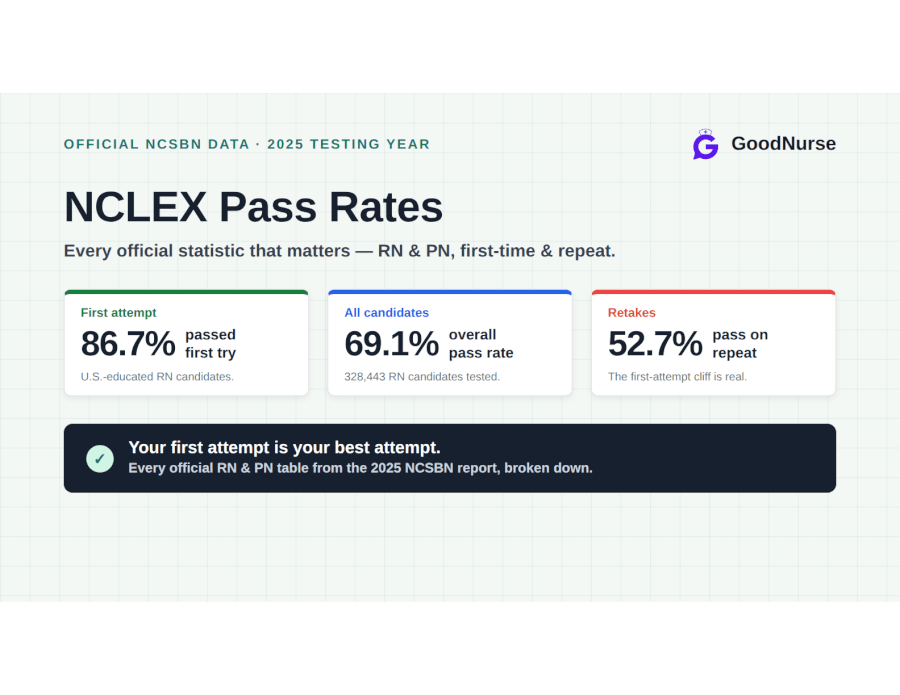
Here's the number most students never hear: 328,443 people took the NCLEX-RN for U.S. licensure in 2025, and only 69.1% passed.
That's not a typo. The "86% pass rate" you've probably heard only applies to one group — first-time, U.S.-educated candidates. Everyone else faces much steeper odds.
This article breaks down every official statistic from NCSBN's 2025 examination report: RN and PN, first-time and repeat, U.S.-educated and internationally educated, by degree type and by quarter — so you know exactly where you stand and what actually moves your odds.
📊 Want to be on the right side of these statistics?
GoodNurse AI was built specifically for the Next Gen NCLEX — with 2,500+ questions, clinical judgment practice, and AI rationales that explain the reasoning behind every answer. Start free today.
Try GoodNurse Free — No Card Needed →The Headline Numbers: NCLEX-RN Pass Rates (2025)
Here is the complete breakdown for the NCLEX-RN (U.S. licensure), straight from NCSBN's official 2025 statistics:
| Candidate Type | Tested | Passed | Pass Rate |
|---|---|---|---|
| First-time, U.S.-educated | 192,916 | 167,272 | 86.7% |
| Repeat, U.S.-educated | 42,513 | 22,404 | 52.7% |
| First-time, internationally educated | 52,827 | 24,999 | 47.3% |
| Repeat, internationally educated | 40,187 | 12,271 | 30.5% |
| All candidates | 328,443 | 226,946 | 69.1% |
Three things jump out of this table:
1. Your first attempt is by far your best attempt. First-time U.S.-educated candidates pass at 86.7%. On a repeat attempt, that drops to 52.7% — a 34-point cliff. If that's you, start with our step-by-step comeback plan. For the complete repeat-taker data, see our second-attempt pass rate breakdown.
2. Nearly 1 in 3 test-takers is now internationally educated. 93,014 of the 328,443 RN candidates (28%) were educated outside the U.S. Their pass rates vary dramatically by country of education — from above 77% (Spain) to below 26% (Cameroon). See the full country-by-country breakdown.
3. The overall pass rate hides huge variation. 69.1% is the blended average of four very different groups. Your real odds depend on which row you're in — and what you do about it.
NCLEX-PN Pass Rates (2025)
The PN exam shows the same pattern — strong first-time rates, much weaker repeat rates:
| Candidate Type | Tested | Passed | Pass Rate |
|---|---|---|---|
| First-time, U.S.-educated | 54,818 | 47,470 | 86.6% |
| Repeat, U.S.-educated | 13,342 | 5,558 | 41.7% |
| First-time, internationally educated | 397 | 213 | 53.7% |
| Repeat, internationally educated | 439 | 121 | 27.6% |
| All candidates | 68,996 | 53,362 | 77.3% |
Notice that first-time U.S.-educated PN candidates (86.6%) pass at virtually the same rate as their RN counterparts (86.7%). The idea that the PN exam is "much easier" isn't supported by the data — it tests a different scope of practice, but first-attempt success rates are nearly identical.
Where PN candidates struggle more is the retake: repeat PN test-takers pass just 41.7% of the time, notably lower than the RN repeat rate of 52.7%.
BSN vs. ADN vs. Diploma: Does Your Degree Change Your Odds?
One of the most-asked questions in nursing forums, answered with official 2025 data (first-time, U.S.-educated RN candidates):
| Degree Type | Tested | Passed | Pass Rate |
|---|---|---|---|
| Baccalaureate (BSN) | 100,258 | 87,814 | 87.6% |
| Associate (ADN) | 89,549 | 77,061 | 86.1% |
| Diploma | 2,671 | 2,226 | 83.3% |
The BSN advantage is real but small: 1.5 percentage points over ADN. Your program's quality and your personal preparation matter far more than the letters on your degree. An ADN grad who practices clinical judgment questions daily will outperform a BSN grad who doesn't.
What the "Average" NCLEX Actually Looks Like
NCSBN also publishes summary statistics that tell you what to expect on test day (first-time, U.S.-educated candidates, 2025):
| Statistic | NCLEX-RN | NCLEX-PN |
|---|---|---|
| Average test length | 103 items | 100 items |
| Candidates getting minimum-length exam | 59.1% | 64.6% |
| Candidates getting maximum-length exam | 20.5% | 17.7% |
| Average testing time | 2 hr 14 min | 2 hr 18 min |
| Candidates using maximum time | 0.5% | 0.7% |
Two takeaways worth internalizing:
Most exams end early. Nearly 6 in 10 RN candidates get the minimum number of questions — the computer adaptive algorithm was confident about their result (in either direction) quickly. About 1 in 5 rides the exam to the maximum length, which says nothing about passing or failing — it just means you're near the standard. Our guide to how many questions are on the NCLEX explains exactly how the algorithm decides.
Time is almost never the problem. Only 0.5% of RN candidates used the full time allowed. Pacing anxiety is common; actual time-outs are rare.
Pass Rates by Quarter: When You Test Matters More Than You Think
The 2025 data shows a striking seasonal pattern for first-time, U.S.-educated RN candidates:
| Quarter | Pass Rate |
|---|---|
| Jan–March | 88.4% |
| April–June | 89.1% |
| July–Sept | 84.0% |
| Oct–Dec | 81.2% |
An 8-point swing between the best and worst quarters — but it's not because the exam gets harder in the fall. The passing standard is fixed all year. The driver is who is testing: the April–June wave is dominated by fresh May graduates testing at their knowledge peak, while the fall quarters include far more candidates who are months removed from graduation. The practical takeaway: test as close to graduation as genuine readiness allows. We unpack the whole seasonal pattern in when to take the NCLEX.
By State: Where Pass Rates Are Highest and Lowest
State-level first-time pass rates in 2025 ranged from the low 70s to above 92%. North Dakota (92.9%), Vermont (92.6%), and South Carolina (91.6%) led the states, while Alaska (77.8%), Utah (79.1%), and Oklahoma (80.5%) trailed. Among high-volume states, California posted 89.0% while Florida — the single largest testing state at 17,403 candidates — came in at just 81.8%.
We cover what drives those gaps, and what to do if you're in a low-performing state, in NCLEX pass rates by state.
How 2025 Compares to 2024: The Decline Is Real
If these numbers look lower than what you saw a year ago, you're right. The first-time U.S.-educated RN pass rate fell from 91.2% in 2024 to 86.7% in 2025 — the largest single-year drop of the Next Gen NCLEX era. We analyzed the four root causes in NCLEX pass rates are falling, and the short version is: clinical judgment gaps, NGN format adaptation, and cohort effects — all things you can prepare against.
Also remember that the 2026 test plan took effect April 1, so make sure your prep materials reflect the current exam.
🧠 The exam is adaptive. Your prep should be too.
GoodNurse's AI identifies your weak content areas and drills them with NGN-format questions — the same clinical judgment items driving the pass-rate decline. Ask 5 questions free, no card needed.
Start Practicing Free →FAQs
How many people pass the NCLEX each year? In 2025, 226,946 of 328,443 NCLEX-RN candidates passed (69.1%), and 53,362 of 68,996 NCLEX-PN candidates passed (77.3%) — roughly 280,000 new nurses licensed across both exams for U.S. licensure.
What percentage of people pass the NCLEX on the first try? 86.7% of first-time, U.S.-educated RN candidates passed in 2025. For PN candidates, it was 86.6%. Internationally educated first-timers passed at 47.3% (RN).
Is the NCLEX-PN easier to pass than the NCLEX-RN? First-time pass rates are nearly identical (86.6% PN vs. 86.7% RN for U.S.-educated candidates). The PN exam covers a different scope of practice, not an "easier" version of the same test.
What are the odds of passing the NCLEX on the second attempt? 52.7% for U.S.-educated RN repeat candidates, and 41.7% for PN. If you're retaking, don't repeat the same prep — start with our step-by-step comeback plan.
Does a BSN give you a better chance of passing than an ADN? Slightly: 87.6% vs. 86.1% in 2025. The 1.5-point gap is far smaller than the gap between students who practice NGN-style questions and those who don't.
The Bottom Line
The 2025 NCSBN data tells one consistent story: the NCLEX strongly rewards being ready the first time. First-time candidates pass at 86%+; repeat candidates at 53% or worse. Every other variable — degree type, state, even test quarter — moves the needle by single digits. Preparation quality moves it by tens of points.
Bookmark this page — we update it every year when NCSBN releases new data.
Related Resources
- NCLEX Pass Rates Are Falling in 2026: What the Data Means for You
- NCLEX Pass Rates by State (2026): Where Students Struggle Most
- How Many Questions Are on the NCLEX?
- Failed the NCLEX? Your Step-by-Step Comeback Plan
- NCLEX Second Attempt Pass Rate (2026): The Real Numbers & How to Beat Them
- NCLEX Pass Rates for Internationally Educated Nurses (2026): By Country
- Is There a Best Time of Year to Take the NCLEX?
Be a first-time passer, not a statistic.
GoodNurse gives you adaptive NGN practice, 2,500+ questions, and AI rationales that build real clinical judgment — for $9.99/mo instead of $400+.
Try GoodNurse Free — No Card Needed →Source: NCSBN, 2025 NCLEX Examination Statistics (Research Brief Vol. 96, June 2026).