

More than 52,000 internationally educated nurses took the NCLEX-RN for the first time in 2025 — the pipeline of international talent into U.S. nursing has never been bigger. But the official NCSBN data shows how steep the climb is:
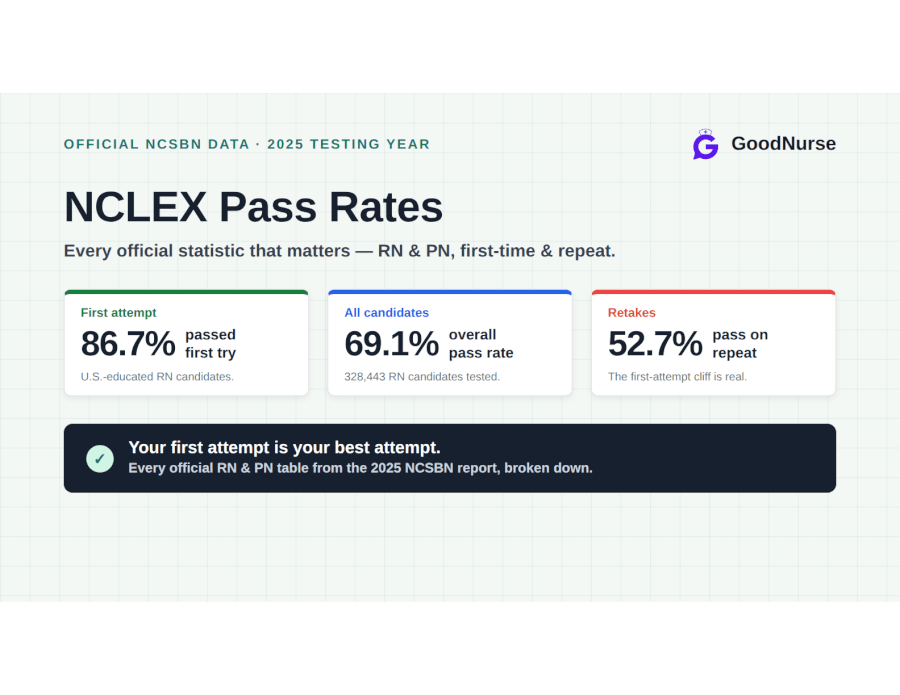
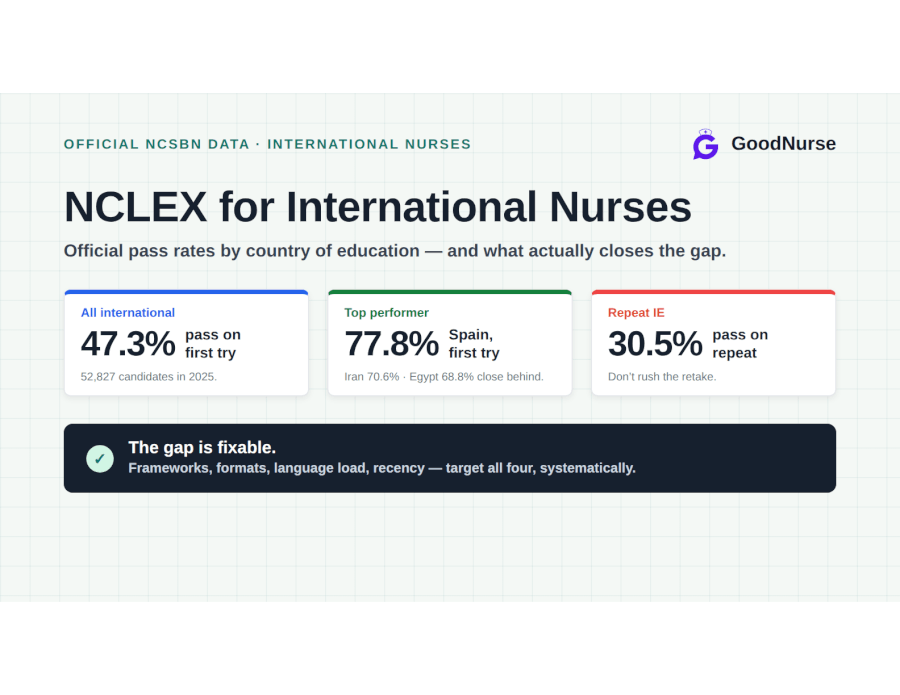
47.3% of first-time, internationally educated candidates passed the NCLEX-RN in 2025 — compared to 86.7% of U.S.-educated first-timers.
And behind that average is a 50-point spread between countries. Nurses educated in some countries pass at rates above 68%; others, below 26%.
If you were educated outside the U.S. — or you recruit and support nurses who were — this is the complete, official picture: pass rates by country of education, why the gap exists, and what actually closes it.
📊 Studying for the NCLEX in your second language?
GoodNurse's AI tutor explains rationales in 10+ languages, then drills you in exam-style English — so you build clinical judgment and test-language fluency at once. Start free.
Try GoodNurse Free — No Card Needed →The Big Picture: Internationally Educated NCLEX-RN Candidates (2025)
| Group | Tested | Passed | Pass Rate |
|---|---|---|---|
| First-time, internationally educated | 52,827 | 24,999 | 47.3% |
| Repeat, internationally educated | 40,187 | 12,271 | 30.5% |
| (For comparison: first-time U.S.-educated) | 192,916 | 167,272 | 86.7% |
Internationally educated candidates now account for 28% of all NCLEX-RN testing volume for U.S. licensure (93,014 of 328,443 candidates). This isn't a side story in U.S. nursing — it's nearly a third of the pipeline.
NCLEX Pass Rates by Country of Education (2025)
Official first-time NCLEX-RN pass rates by country of education, for every country with at least 100 candidates (sorted by testing volume):
| Country of Education | Tested | Passed | Pass Rate |
|---|---|---|---|
| Philippines | 22,793 | 10,433 | 45.8% |
| India | 4,866 | 1,622 | 33.3% |
| Kenya | 4,096 | 2,383 | 58.2% |
| South Korea | 2,485 | 1,450 | 58.4% |
| Nepal | 2,407 | 1,262 | 52.4% |
| Ghana | 2,236 | 1,222 | 54.7% |
| Nigeria | 1,983 | 1,079 | 54.4% |
| Puerto Rico | 1,709 | 700 | 41.0% |
| Haiti | 724 | 244 | 33.7% |
| Pakistan | 692 | 336 | 48.6% |
| Brazil | 574 | 211 | 36.8% |
| Jamaica | 506 | 254 | 50.2% |
| Mexico | 464 | 165 | 35.6% |
| China | 451 | 214 | 47.5% |
| Thailand | 363 | 130 | 35.8% |
| Taiwan | 360 | 225 | 62.5% |
| Iran | 357 | 252 | 70.6% |
| Zambia | 307 | 150 | 48.9% |
| Zimbabwe | 297 | 143 | 48.1% |
| Cameroon | 296 | 76 | 25.7% |
| Colombia | 283 | 130 | 45.9% |
| Canada | 279 | 236 | 84.6% |
| Jordan | 259 | 163 | 62.9% |
| Ethiopia | 255 | 107 | 42.0% |
| United Kingdom | 240 | 112 | 46.7% |
| Israel | 184 | 126 | 68.5% |
| Egypt | 173 | 119 | 68.8% |
| South Africa | 125 | 34 | 27.2% |
| Uganda | 119 | 75 | 63.0% |
| Australia | 116 | 60 | 51.7% |
| Bangladesh | 114 | 74 | 64.9% |
| Turkey | 112 | 46 | 41.1% |
| Cuba | 111 | 31 | 27.9% |
| Spain | 108 | 84 | 77.8% |
| Ukraine | 102 | 41 | 40.2% |
| Gambia | 100 | 57 | 57.0% |
A few patterns worth naming:
The Philippines dominates volume, not pass rate. Filipino-educated nurses are 43% of all internationally educated first-timers (22,793 candidates) but pass at 45.8% — right around the international average.
India's numbers deserve attention. At 4,866 candidates and a 33.3% pass rate, Indian-educated nurses are the second-largest group and among the lowest passing. Two out of three don't pass on the first attempt. (Considering Canada instead? See our guide for Indian students taking the NCLEX in Canada.)
African nursing programs are quietly outperforming. Kenya (58.2%), Ghana (54.7%), Nigeria (54.4%), and Uganda (63.0%) all beat the international average — Kenya alone sent 4,096 candidates, making it the third-largest source country.
Small-volume, high-pass countries cluster together. Spain (77.8%), Iran (70.6%), Egypt (68.8%), and Israel (68.5%) top the table — countries whose candidates are often experienced nurses who self-select into U.S. licensure.
Why the International Pass Rate Gap Exists
The gap is not about clinical skill. Internationally educated candidates are often experienced practicing nurses. Four specific factors do the damage:
1. The exam tests U.S. nursing frameworks
The NCLEX is built on U.S. scope of practice, delegation rules, and care prioritization frameworks (like least-restrictive-first and nurse-patient assignment logic) that differ from how nursing is practiced — and taught — elsewhere.
2. NGN question formats are unfamiliar
Bow-tie items, matrix grids, and case studies are new even to U.S. students. Candidates who trained abroad, often years ago, usually meet these formats for the first time in prep — with less time to adapt.
3. Testing in a second language adds cognitive load
Even fluent English speakers process complex clinical vignettes more slowly in a second language. On a timed, adaptive exam, that tax compounds question after question.
4. Long gaps between school and exam
Credentialing, visa processing, and CGFNS verification can put years between nursing school and test day. Content decay is real — and it shows up hardest in pharmacology and maternal/pediatric content that experienced med-surg nurses haven't used clinically.
The Retake Trap: 30.5%
Repeat internationally educated candidates passed at just 30.5% in 2025 — 40,187 candidates, many stuck in a fail-retake-fail cycle that costs $200+ per attempt plus rescheduling fees.
The data's message: don't rush the retake. The same second-attempt principles apply — CPR-driven diagnosis, format-specific practice, and a structured 6–8 week rebuild — but with one addition: dedicated practice reading and answering NGN-style questions in English, under time pressure.
For the NCLEX-PN, international volumes are small (397 first-time candidates in 2025, passing at 53.7%), but the same pattern holds.
🧠 Built for nurses studying in their second language
GoodNurse explains every rationale in your language — Tagalog, Hindi, Spanish, Arabic, and more — then trains you on exam-style English questions. It's like having a bilingual NCLEX tutor for $9.99/mo.
Start Practicing Free →What Actually Closes the Gap: 5 Evidence-Based Moves
1. Train on U.S. frameworks explicitly. Don't just review content — study how the NCLEX thinks: prioritization (ABC, Maslow, acute-over-chronic), delegation rules, and therapeutic communication conventions.
2. Make NGN formats automatic before test day. Set a target: 300+ NGN-style items (bow-tie, matrix, cloze, case studies) before you book. Format familiarity is the cheapest points you'll ever earn.
3. Practice in English, learn in your language. Understanding a rationale deeply in your first language, then re-encountering the concept in English questions, builds both the knowledge and the test-language fluency.
4. Close the recency gap deliberately. If it's been 2+ years since nursing school, start with a diagnostic, not a review course — your gaps are personal, and generic review wastes your prep window.
5. Time your attempt around your credentialing. Don't let your ATT window force an underprepared attempt. A planned 8-week prep beats a rushed 3-week one — the first-attempt pass rate cliff is too steep to gamble.
FAQs
What is the NCLEX pass rate for foreign-educated nurses? 47.3% for first-time internationally educated candidates in 2025 (NCLEX-RN, U.S. licensure), per official NCSBN data. Repeat candidates passed at 30.5%.
Which country has the highest NCLEX pass rate? Among countries with 100+ candidates in 2025: Spain (77.8%), then Iran (70.6%), Egypt (68.8%), and Israel (68.5%). Canada-educated candidates passed at 84.6% — essentially matching U.S.-educated rates.
What is the NCLEX pass rate for nurses from the Philippines? 45.8% for first-time candidates in 2025 (22,793 tested — by far the largest international group).
What is the NCLEX pass rate for Indian nurses? 33.3% for first-time candidates educated in India in 2025 (4,866 tested).
Why do internationally educated nurses fail the NCLEX more often? Not clinical ability — the main drivers are unfamiliar U.S. practice frameworks, new NGN question formats, second-language cognitive load, and long credentialing delays between school and exam.
The Bottom Line
The 47.3% international pass rate is an average of preparation strategies, not a verdict on international nurses. Candidates educated in the same schools, from the same countries, land on both sides of it every day. The gap is made of four specific, fixable things — frameworks, formats, language load, and recency. Fix them systematically, and your odds look nothing like the average.
Related Resources
- NCLEX Pass Rates 2026: Every Official NCSBN Statistic (RN & PN)
- NCLEX Second Attempt Pass Rate (2026): The Real Numbers & How to Beat Them
- Can Indian Students Take the NCLEX in Canada? Guide for International Nurses
- NCLEX Pass Rates Are Falling in 2026: What the Data Means for You
Join thousands of international nurses prepping smarter.
2,500+ NGN-style questions, AI rationales in 10+ languages, and adaptive practice that finds your gaps — for $9.99/mo instead of $400+.
Try GoodNurse Free — No Card Needed →Source: NCSBN, 2025 NCLEX Examination Statistics (Research Brief Vol. 96, June 2026), Table 9.