

On June 2, 2026, NCSBN sent an email reminding candidates of the NCLEX retake policy. The message was short, but it touched the exact question many students search for the moment they get a disappointing result: "How soon can I take the NCLEX again?"
The answer is simple at the national level and more complicated at the state-board level.
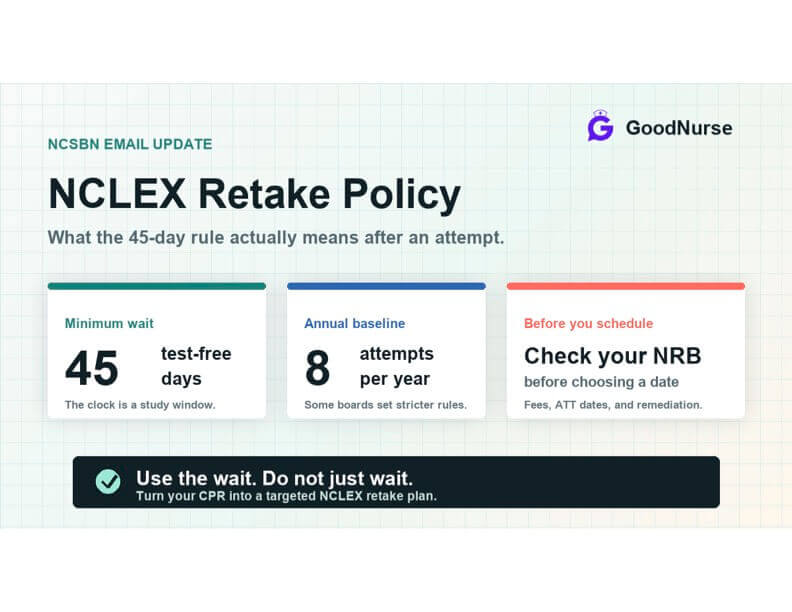
NCSBN's baseline policy allows candidates to begin the reregistration process after receiving their results. Candidates must notify their nursing regulatory body (NRB), complete any required materials, register again with Pearson, and wait at least 45 test-free days between exam administrations. NCSBN also says candidates may take the NCLEX up to eight times per year, but some jurisdictions have stricter annual limits, extra forms, fees, or remediation requirements.
That is the policy. The strategy is different.
If you did not pass, the 45-day window is not just a countdown to the next available seat. It is your first structured retake plan. Used well, it can help you fix the exact clinical judgment pattern that cost you the first attempt. Used poorly, it becomes five or six anxious weeks of rereading notes, retaking random quizzes, and hoping the next exam feels easier.
GoodNurse take: The email is not saying "rush back in 45 days." It is saying "45 days is the earliest national retest window." Your goal is not the fastest retake. Your goal is the best-prepared retake.
The Short Version
If you need the answer fast, here it is:
- The national NCLEX retake wait is 45 test-free days between exam attempts.
- NCSBN says candidates may attempt the NCLEX up to eight times per year.
- You can start the retake registration process after you receive official results.
- You must work through your NRB, not only Pearson VUE.
- Some states or jurisdictions require stricter limits, additional fees, background steps, or remediation after multiple attempts.
- Your Candidate Performance Report (CPR) should drive your next study plan.
For a state-by-state overview, start with GoodNurse's existing guide: NCLEX Retake Rules by State (2026): Wait Times, Attempt Limits & What to Do Next. For broader exam updates, bookmark the 2026 NCLEX Changes Hub.
What NCSBN Actually Clarified
The email in the screenshot lines up with NCSBN's published retake guidance. In its help center, NCSBN explains that candidates who need to retake the NCLEX should contact their NRB, reregister with Pearson, receive a new Authorization to Test (ATT) after the NRB makes them eligible, and then schedule an exam date. NCSBN also states that candidates must wait a minimum of 45 test-free days between examinations, and that the new ATT dates will reflect that window.
That matters because students often mix up four different dates:
- The date you took the NCLEX.
- The date you saw unofficial results.
- The date your official result or CPR arrives.
- The date your new ATT becomes valid.
The 45-day minimum is tied to exam administrations, not to when you emotionally feel ready, not to when your classmate got their result, and not to when you first log back into Pearson. Your new ATT should make the scheduling window clear.
NCSBN also clarifies a helpful exception: if you missed your appointment or your ATT expired without you sitting for the exam, the 45-day retake wait does not apply in the same way because you did not actually take the exam. You may still need to reregister, pay fees, or work with your NRB, but that is different from a failed exam retake.
Important: If there is one action item from the NCSBN email, it is this: contact the NRB in the jurisdiction where you are seeking licensure. Your board controls eligibility. Pearson administers the test appointment. NCSBN owns the exam program. Those roles overlap in your experience, but they are not the same office.
Why "Some Jurisdictions Are Stricter" Is Not Fine Print
The phrase "some jurisdictions have stricter limits" sounds like a footnote until it becomes your problem.
NCSBN's national baseline is broad because nursing licensure is handled by state and territorial boards. Your NRB may require a repeat application, a new fee, updated background documentation, a remediation plan, or a board-approved course after multiple failures. The exact requirement depends on your jurisdiction and sometimes on how many attempts you have already made.
California is a good example of why candidates should not rely only on a screenshot or a social media comment. The California Board of Registered Nursing has a dedicated Repeat/Reapply for Examination page that tells RN candidates to apply online through BreEZe, select the RN repeat/reapply application, pay fees, and check the status of their application. That is a state-specific process layered on top of the national NCLEX process.
Florida shows a different kind of state-level requirement. The Florida Board of Nursing explains that applicants who do not pass must submit a re-examination application, and after three failures of the same exam level, the applicant must complete a Florida Board of Nursing-approved remedial training program before the fourth attempt. That is not a small detail. It changes your timeline, your budget, and your study plan.
Do not assume your friend's rule is your rule. Same NCLEX, different NRB. A classmate testing for licensure in another jurisdiction may have a different repeat application, fee, remediation requirement, or processing timeline.
If you are not sure where to start, use NCSBN's member nursing regulatory body directory to find your board, then look specifically for "reapply," "repeat examination," "re-examination," "NCLEX retake," or "remediation" on the board website.
The 45-Day Window Is a Clinical Judgment Reset
The biggest mistake after a failed NCLEX attempt is treating the next 45 days like a punishment. It is not. It is a diagnostic window.
Your first job is not to do more questions immediately. Your first job is to understand what the exam told you. If you did not pass, your Candidate Performance Report identifies how you performed across the NCLEX client needs categories. It does not give you the exact questions, and it does not tell you every reasoning mistake you made. But it does show where the exam found your performance above, near, or below the passing standard.
That report should decide your plan.
Most retakers do the opposite. They feel embarrassed, so they study everything. They feel panicked, so they buy another resource. They feel behind, so they start doing 150 questions a day without reviewing the rationales deeply. That approach feels productive because it is busy. It is not always effective.
A stronger retake plan asks:
- Which content areas were below the passing standard?
- Did I miss content because I did not know the disease process?
- Did I know the content but choose the wrong priority?
- Did I struggle with NGN formats like matrix, bow-tie, trend, or case-study items?
- Did anxiety, fatigue, or pacing affect my judgment near the end?
- Did I review rationales actively, or did I just read them and move on?
GoodNurse was built for exactly this kind of reasoning work. On How GoodNurse Works, we describe the study loop as ask, practice, pass: ask the exact question you are stuck on, practice with guided quizzes, then focus review before exam day. For a retaker, that loop becomes even more valuable because your next attempt should be targeted, not generic.
What to Do in the First 72 Hours After a Failed Attempt
The first 72 hours are emotionally loud. Give yourself room to be disappointed. Then move from emotion to logistics.
Start by confirming whether you have official results. Unofficial quick results may be available in some jurisdictions, but official results and the CPR are what you need for planning. Do not schedule a retake plan around rumors, unofficial screenshots, or the Pearson VUE trick. Your board and official result documents matter more.
Next, find your NRB's retake instructions. Look for the exact application name, fee, documents, processing time, and whether there are rules after a second, third, or fourth attempt. Save that page. If you have a question, contact the board directly.
Then, reregister only when you understand the board process. In many cases, you will need Pearson registration and board eligibility to line up before a new ATT is issued. If you pay one part but miss a board requirement, you can lose time.
Finally, create a CPR-based study plan. Not a "study everything" plan. A CPR-based plan.
Retaker rule: Before you open a new quiz bank, write one sentence that explains why you think you failed. Then prove or revise that sentence using your CPR and your missed-question patterns. "I am bad at NCLEX" is not a diagnosis. "I miss priority questions when infection control and airway cues appear together" is a diagnosis.
A Practical 45-Day Retake Plan
Here is a realistic structure if your board allows you to retest at the earliest window. Adjust the timeline if your NRB takes longer or if your CPR shows multiple below-standard categories.
Days 1-3: Stabilize and gather documents
Confirm your result, locate the CPR, find your board's repeat application instructions, and write down every required fee or form. Do not make the study plan in your head. Put it in a document or calendar.
This is also where you should decide whether 45 days is actually enough. If your CPR shows several below-standard categories, or if you have already failed more than once, a 60- to 90-day plan may be safer.
Days 4-10: Diagnose your failure pattern
Review your CPR and run a focused baseline set in weak areas. Do not chase a score yet. You are looking for patterns.
For every missed question, label the reason:
- Content gap.
- Priority framework error.
- Safety/infection control miss.
- Delegation/scope confusion.
- Misread stem.
- NGN format confusion.
- Anxiety or rushing.
By the end of this week, you should know the two or three failure patterns that matter most.
Days 11-25: Rebuild weak areas with active retrieval
This is where the work gets less dramatic and more powerful. Use short daily study blocks, practice questions, and rationale review. The University of Minnesota's Center for Educational Innovation summarizes the learning-science idea well: spaced practice and interleaving help students revisit material over time and mix related skills instead of cramming one topic in a single block.
For NCLEX, that means you should not spend five straight days only rereading cardiac notes. Mix cardiac, respiratory, renal, safety, prioritization, and pharmacology questions so your brain has to choose the right framework. The exam will not label the question for you. Your practice should not always label it either.
GoodNurse's AI tutor can help here because you can ask follow-up questions after a rationale: "Why is airway not the priority here?" or "Explain why this is delegation and not assignment." That is the part most static question banks cannot do. You can read more in the GoodNurse FAQ.
Days 26-35: Drill NGN formats and clinical judgment
The 2026 NCLEX is not just testing whether you recognize facts. It asks you to notice cues, analyze them, prioritize hypotheses, take action, and evaluate outcomes. That is why retakers should practice NGN formats deliberately.
Use the 2026 NCLEX Changes Hub to review which format skills matter: bow-tie, matrix/grid, cloze/drop-down, trend items, and case-study reasoning. Then practice them under timed conditions.
When you review an NGN item, do not stop at "correct" or "incorrect." Ask which cue should have changed your mind. Ask which distractor looked tempting. Ask what made the safest nursing action safer than the answer you chose.
Days 36-42: Build test stamina
At this point, your study should feel closer to the real exam. Do longer mixed sets. Review rationales the same day. Practice breaks. Practice pacing. Practice sitting with uncertainty without clicking too fast.
If test anxiety affected your first attempt, treat it as a real variable, not a personality flaw. Harvard's Academic Resource Center notes that preparation, organization, and practice can help students focus on what they can control, and it recommends strategies before, during, and after exams. For NCLEX retakers, that means a plan for breathing, pacing, breaks, and self-talk is part of preparation.
Days 43-45: Taper, do not panic-cram
Your last three days should not be a desperate content dump. Review high-yield notes, common safety frameworks, medication red flags, lab values, and the specific mistakes you have already identified. Sleep. Eat normally. Pack documents. Confirm your testing appointment and ID requirements.
If you are still missing the same pattern repeatedly, that may be a sign to delay if your ATT allows it. A later pass is better than a faster repeat failure.
When 45 Days Is Not Enough
NCSBN's email gives the minimum national wait. It does not say every student should retest on day 46.
You may need more time if:
- Your CPR shows multiple below-standard areas.
- You failed more than once.
- You have not practiced NGN case-study formats.
- Your state board requires remediation.
- You are working full time and can only study a few hours per week.
- Test anxiety or fatigue clearly affected your performance.
- You cannot explain why your last prep plan failed.
This is where honesty helps more than optimism. You do not need to punish yourself with a long delay. But you also do not need to prove anything by taking the earliest possible date.
GoodNurse retake check: If your plan is just "do more questions," it is not specific enough. If your plan says "four mixed sets per week, every missed question labeled by reasoning error, two NGN case studies every other day, one weekly weak-area review," now you have something the next attempt can build on.
For students who are truly short on time, use NCLEX in 2 Weeks: The Emergency Study Plan That Actually Works (2026) as a compression plan. But treat that as a last-mile sprint, not the whole retake strategy.
Fees, ATT Dates, and the Annoying Admin Details
Retaking the NCLEX is not only an academic plan. It is also an administrative process.
Expect to deal with some combination of:
- Pearson registration fees.
- NRB repeat application fees.
- Board processing time.
- Background or fingerprinting requirements in some jurisdictions.
- A new ATT.
- A new scheduling window.
- Possible remediation documentation after multiple failures.
Your new ATT matters because it tells you when you can schedule. If you ignore the dates, you can lose time or fees. If you wait too long to act, you may compress your prep window. If you rush too quickly, you may get a seat before you have fixed the actual problem.
That is why GoodNurse recommends building your retake plan in two tracks:
- Admin track: board application, Pearson registration, ATT, appointment, ID, fees.
- Study track: CPR review, weak areas, NGN formats, stamina, anxiety plan.
Both tracks matter. A perfect study plan does not help if your board application is incomplete. A perfect ATT does not help if you walk back into the exam with the same reasoning gaps.
What This Means for First-Time Testers
If you have not taken the NCLEX yet, this email still matters.
The retake policy tells you what happens if the first attempt does not go your way, but it also tells you what to avoid. The 45-day wait is manageable, but it is expensive, stressful, and disruptive. You do not want to learn about your weak areas only after a failed attempt.
Before your first exam, practice like a retaker:
- Track missed questions by reason, not just topic.
- Mix client needs categories instead of studying one subject at a time.
- Practice NGN formats until the layout feels normal.
- Review rationales out loud.
- Ask follow-up questions when an explanation does not click.
- Build stamina with longer mixed sets.
GoodNurse's NCLEX-RN exam prep page explains the broader approach: realistic NCLEX-style questions plus an AI tutor that can clarify rationales in real time. That matters because students rarely fail only because they never saw a topic. They fail because they could not apply the topic safely under exam pressure.
Bottom Line
NCSBN's June 2 email is useful because it removes one layer of uncertainty: the national retake baseline is 45 test-free days, up to eight attempts per year, with retake registration beginning after results. But the email also points students back to the part they cannot skip: the NRB.
So if you need to retake, do three things today:
- Find your official result and CPR.
- Read your NRB's repeat examination instructions.
- Turn the 45-day minimum into a targeted clinical judgment plan.
Failing the NCLEX is painful, but it is not the end of your nursing path. The next attempt should not be a repeat of the last one with more anxiety attached. It should be a cleaner plan, built from better evidence.
Use the wait. Do not just wait.
Sources and Further Reading
- NCSBN: What is the process to retake the NCLEX?
- NCSBN: How many times can I take the NCLEX?
- NCSBN: 2026 NCLEX Candidate Bulletin
- California Board of Registered Nursing: Repeat/Reapply for Examination
- Florida Board of Nursing: Nursing (RN & LPN) licensing by examination and re-examination requirements
- University of Minnesota Center for Educational Innovation: Spaced and interleaved practice improves recall
- Harvard Academic Resource Center: Test Anxiety