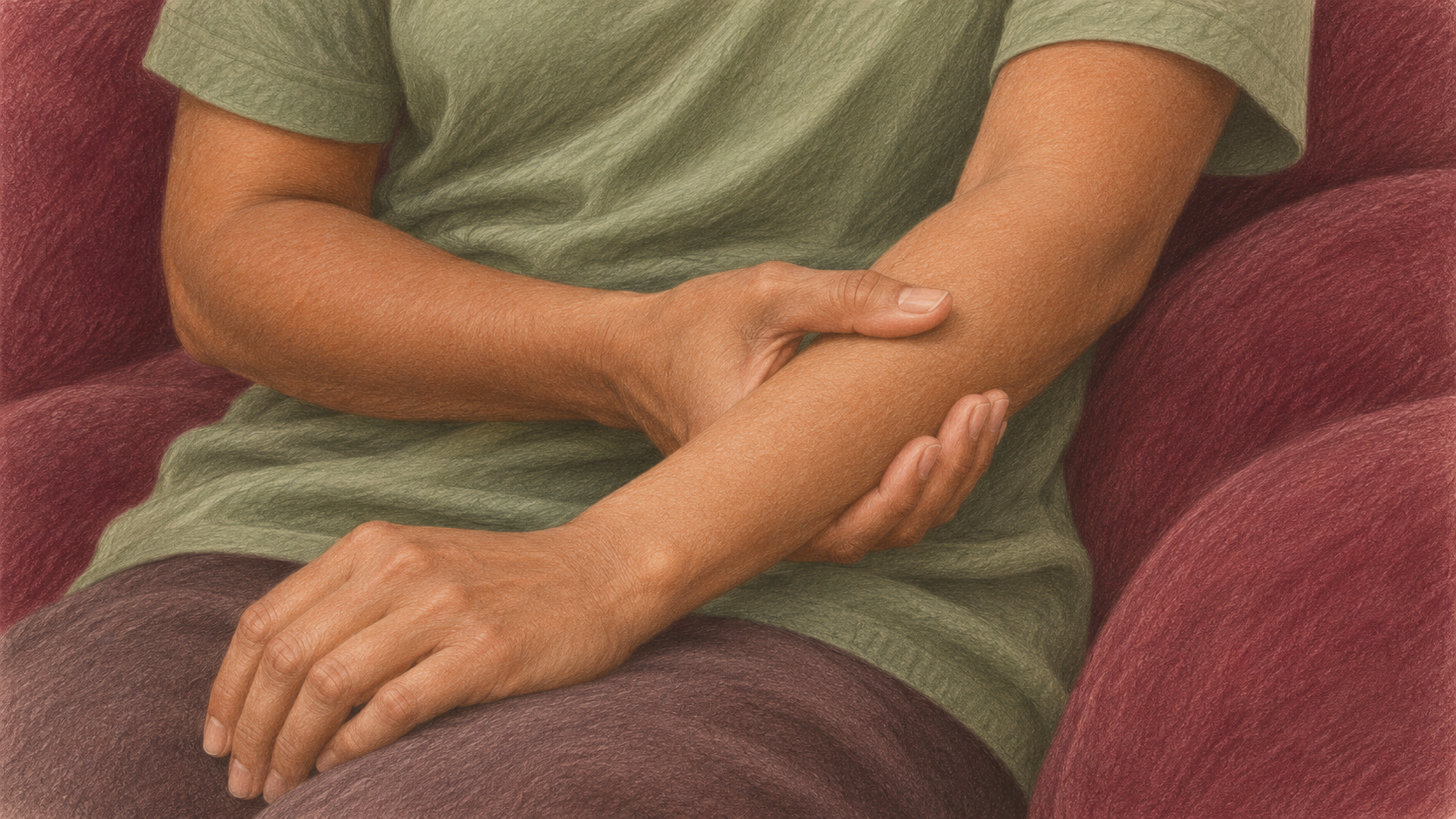


Nociceptive pain involves activation of nociceptors by actual or threatened damage to tissues other than nerves. Neuropathic pain results from a lesion or disease affecting the somatosensory nervous system. The distinction concerns the mechanism of pain; a descriptive word such as “burning” cannot establish that mechanism by itself. Scottish Government: pain mechanisms.
For a nursing student, the useful skill is to gather a clear description, connect it with the known history, and recognize what still needs evaluation. This guide explains the concepts and offers fictional classroom examples. It does not provide an individual diagnosis or treatment plan.
Nociceptive pain: a response to tissue threat or injury
Nociceptors are sensory receptors that respond to potentially damaging stimuli. With nociceptive pain, the initiating problem concerns non-neural tissue, rather than a lesion or disease of the sensory nervous system itself. IASP: nociceptive pain and nociceptors.
Two useful subdivisions are somatic and visceral. Somatic pain involves tissues such as skin, muscles or bones and is often easier to locate. Visceral pain involves internal organs and can be harder to localize. A person pointing to a broad area has still given useful information; a precise point is not required for pain to matter. National Cancer Institute (NCI): pain mechanisms.
When studying a case, ask what tissue process is described before selecting a label. “The arm hurts” identifies a location. It does not yet explain why it hurts.
Neuropathic pain: a problem in the sensory nervous system
Neuropathic pain can involve peripheral nerves or the central nervous system. NCI: pain mechanisms. The word somatosensory refers to the system that processes sensations from the body. If you need a pathway refresher, see afferent and efferent neurons.
The International Association for the Study of Pain (IASP) emphasizes that symptoms alone do not justify calling pain neuropathic. The history, examination and relevant evidence of a lesion or disease matter. IASP: neuropathic pain.
Diabetes-related peripheral neuropathy provides one example. It can produce burning, tingling, numbness or pain, commonly affecting the feet and legs. Some people experience pain with light touch; others have difficulty detecting pain or temperature. Neuropathy therefore does not mean that every affected area is always painful. NIDDK: peripheral neuropathy symptoms.
Compare the mechanism without turning clues into diagnoses
| Question | Nociceptive pain | Neuropathic pain |
|---|---|---|
| What is the defining process? | Nociceptor activation related to threatened or actual non-neural tissue damage | A lesion or disease of the somatosensory nervous system |
| What should the learner investigate? | The described tissue problem and its context | The relevant sensory-system history and clinical findings |
| Does one adjective settle the classification? | No | No |
These distinctions are also described in the Scottish Government's pain guidance. Use the table to organize questions, rather than as a diagnostic scoring tool.
Another distinction answers a different question: acute versus chronic describes the time course. Mechanism and duration are separate dimensions of pain assessment. A long duration alone does not establish nerve damage. NCI: pain classification.
The two-column comparison is also incomplete as a classification of all pain. The Scottish Government guidance describes nociplastic pain, involving altered nociception without clear evidence of the tissue damage or sensory-system lesion that would explain it through the other mechanisms. Avoid forcing every case into just two boxes. Scottish Government: mechanistic categories.
What to include in a nursing assessment discussion
Pain assessment includes location, intensity, quality and effects on function. The NCI's cancer-pain guidance also considers the broader impact on the person and response to treatment. NCI: assessment overview.
For classroom practice, organize your report into four short lines:
- Description: Where is the discomfort, what does it feel like, and when did it begin? Preserve the person's wording rather than translating it immediately into a mechanism.
- Context: What relevant conditions, recent events or prior assessments are actually documented? Separate confirmed information from possibilities you want to discuss.
- Impact: Which activity has become difficult? Make the description specific enough that another learner can understand the concern.
- Unanswered question: What needs clarification with the supervising nurse or instructor? Do not fill an assessment gap with an assumed finding.
This is an original learning organizer, not a validated assessment instrument. Use your course and facility's assessment and escalation procedures in clinical placement. Our guide to subjective versus objective nursing data can help keep reports and observations distinct.
Three original learning examples
These fictional exercises are not official NCLEX items or accounts of real patients.
1. The description becomes a diagnosis
A practice note says, “The patient reports burning forearm pain.” A classmate rewrites it as “neuropathic pain confirmed.”
Reasoning: The revised note claims more than the example establishes. Keep the reported location and quality. Ask what history, examination and clinical evaluation are available before assigning a mechanism. A more careful classroom response is, “Burning is reported; the cause remains to be evaluated.”
2. A time label replaces a mechanism
A case describes pain that has continued for months. A learner concludes that the duration proves neuropathic pain.
Reasoning: The case has supplied timing, not sufficient evidence of a sensory-system lesion or disease. Put duration on one line and the proposed mechanism on another. Then list which facts support each statement. If the mechanism line has no supporting information, leave the uncertainty visible.
3. Numbness is treated as reassurance
A fictional adult with documented diabetes-related peripheral neuropathy says that the feet feel numb. A learner writes, “No foot pain, so no sensory concern.”
Reasoning: Numbness itself is relevant sensory information. NIDDK explains that reduced sensation can make pressure or injuries harder to notice. Record the report and discuss the established assessment plan with the supervising nurse. Do not interpret an absence of reported pain as proof that sensation is intact. NIDDK: neuropathy and foot problems.
A useful final self-check
Before finishing a practice report, underline the observed or reported facts once and your interpretation twice. Can a reader tell which is which? Explain the possible mechanism, identify the evidence still needed, and leave individual diagnosis and treatment decisions with the responsible clinical team.
AI-assistance note: This educational article was prepared with AI assistance, and its cover illustration is AI-generated. It has not received independent human clinical review.


