Fundamentals Videos
Browse videos in the Fundamentals category.
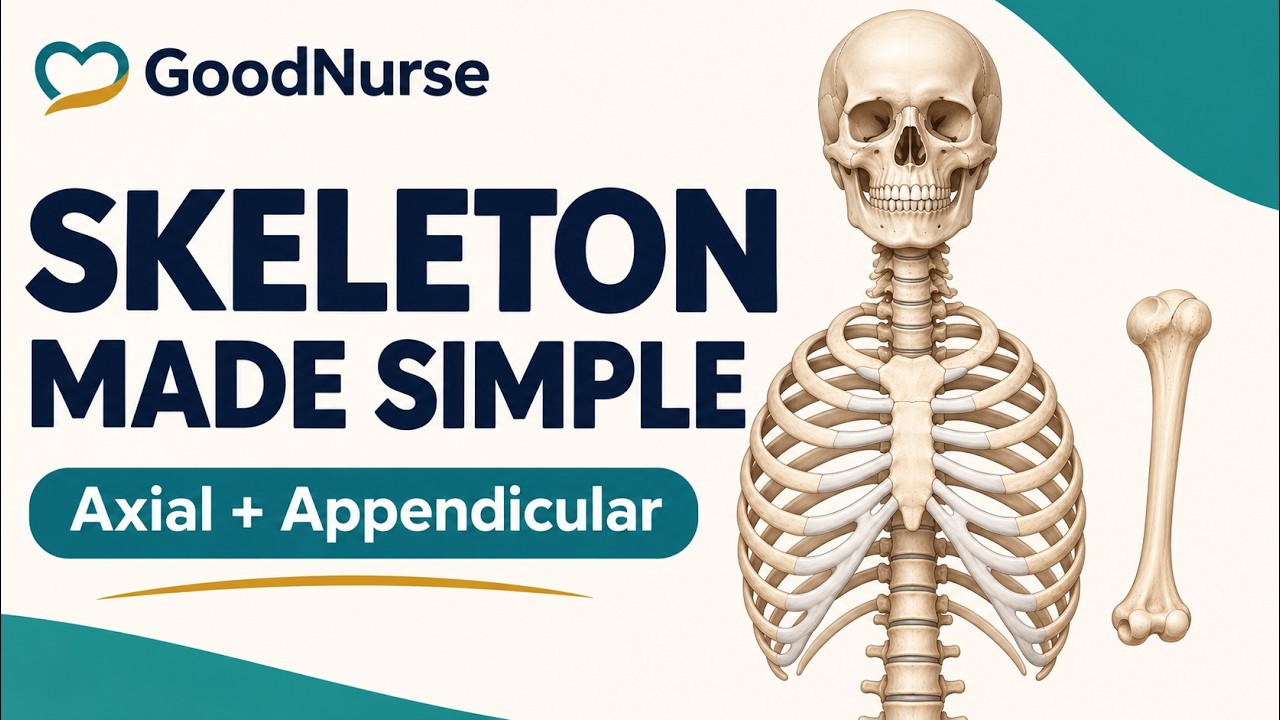
Skeleton Foundations: Axial, Appendicular and Major Bones
Build a practical map of the skeleton. Distinguish the central axial skeleton from the limbs and their shoulder and pelvic girdles, locate major upper- and lower-limb bone groups, and connect skeletal functions with respectful nursing observation. A fictional forearm-pain example and two retrieval questions practice clear location words and supervised reporting. Follow your assigned role, RN or instructor supervision, and local procedures.
Pediatric Dehydration: Notice Change, Assess and Escalate
Follow a fictional four-year-old case with vomiting, diarrhea, reduced drinking and less urine. Combine caregiver observations with current responsiveness, breathing, circulation, reliable weight trends and the supervising RN’s assessment. Contrast initial findings with urgent deterioration, practice a focused report, and use caregiver teach-back. Follow your assigned role, supervision, orders and local pediatric escalation procedures.

Urinary Catheter Care: Keep the System Closed and Flowing
An adult with an indwelling urinary catheter feels discomfort and notices less drainage after moving to a chair. Use this fictional case to check bag position and external tubing, distinguish a kink from a compromised connection, reassess the patient and give a focused report to the supervising nurse. Practice plain-language teach-back and follow your assigned role, supervision and facility protocols.

Adult Shock: Recognize Poor Perfusion and Escalate
Compare hypovolemic, cardiogenic, obstructive and distributive shock. In a fictional adult case, practice recognizing a concerning change in perfusion, calling for immediate help and giving a focused SBAR. The lesson connects bedside assessment to action within supervised nursing-student scope and your facility’s escalation pathway.
Pressure Injury Prevention: Risk, Skin Changes and Reassessment
Connect pressure-injury risk with an individualized prevention plan in supervised adult nursing care. Practise noticing and reporting changes in skin and tissue across skin tones, supporting safe pressure relief and gentle skin care, and reassessing the patient’s response. A fictional heel-soreness scenario illustrates why intact skin, a risk score or a recorded turn is not an all-clear. Follow the established plan, trained assistance, supervising RN and local protocols. This overview does not teach wound staging or a positioning procedure.

TB Treatment: Plan Understanding, Support and Warning Symptoms
Learn how nursing students can support an adult with an established TB treatment plan. Distinguish inactive infection from active disease at a teaching level, explain why feeling better does not prove treatment is complete, and check the actual medicine schedule, monitoring and contact instructions. Practise respectful barrier assessment, teach-back and TB-team support, then recognize warning symptoms that need immediate medical attention. The lesson does not select a regimen or replace the supervising RN, treating clinician or local protocols.
Prenatal Genetic Tests: Screening, Diagnosis and Informed Choice
Distinguish prenatal genetic screening from diagnostic testing for specific conditions. Practise explaining the limits of positive, negative and nonreportable screening results, respond to two fictional patient questions, and support voluntary informed choice with respectful teach-back and qualified prenatal-team follow-up. Designed for nursing students working with a supervising RN; it does not interpret an individual patient’s result or choose testing for them.
Adult NG Decompression: Assessment, Monitoring and Reporting
Learn how to monitor an adult patient with an NG tube for ordered gastric decompression. Connect patient symptoms, the documented tube plan and drainage trends; recognise placement concerns and deterioration; and practise a factual report to the RN. Includes comfort measures and a bedside scenario, with student supervision, orders and local protocols kept explicit.

Depression: Therapeutic Responses, Listening and Safety Escalation
Practice choosing an empathic response to an adult experiencing depression, allowing time to answer and clarifying without judgment. Compare supportive statements with false reassurance and rehearse a response to a fictional inpatient scenario using the original LISTEN / CLARIFY / CONNECT study cues. Recognize when concerning words require prompt supervising-RN assessment and when current suicidal thoughts or immediate danger require immediate clinical help, remaining with the patient and following the local safety pathway. This focused communication lesson supports supervised student practice; it does not authorize independent risk assessment, psychotherapy, diagnosis, treatment or discharge decisions.
Reported Penicillin Reaction: History, Uncertainty and Team Review
Practice gathering a focused adult penicillin-reaction history using what happened, when, and what followed. Ask about actual symptoms, timing relative to doses, treatment and outcome, and later antibiotic exposure. Preserve unknowns and distinguish the patient report from verified details in a clear handoff to the supervising RN for clinician/pharmacist review. Apply the history questions to a fictional stable-patient scenario, then contrast a new emergency concern. Current airway, breathing or circulation compromise takes priority over an interview or documentation and may occur without a rash. Follow RN/preceptor guidance and current local protocols. These original study cues are not a validated risk score; the lesson does not authorize independent allergy classification, label removal, drug clearance, challenge testing or medication changes.

Adult Osteoarthritis: Pain, Function and Supported Activity
Connect established adult knee osteoarthritis with assessed pain, stiffness and meaningful daily function. Practice using PAIN / FUNCTION / CHANGE to compare current symptoms with baseline, support the individualized clinician/PT plan alongside the supervising RN, and communicate observations and response. Work through a fictional daily-activity goal, respectful teach-back and a changed-symptom scenario. Recognize a newly hot swollen joint, sudden severe pain or major loss of movement as concerns needing prompt assessment rather than an assumed OA flare; fever may be absent. Follow current local pathways, orders, assistance and RN/preceptor guidance. This original study organizer is not a validated or complete clinical protocol, exercise prescription or competency assessment.

Choosing PPE for the Task and Anticipated Exposure
Practice connecting a planned adult-care task with anticipated exposure of the hands, skin/clothing and eyes, nose and mouth. Use TASK / EXPOSURE / PLAN to explain appropriate PPE, hand hygiene and equipment needs while preserving required Transmission-Based Precautions and current facility policies. Compare two qualified fictional scenarios, work through a soiled-to-clean-task practice question, and rehearse a respectful patient explanation and supervised plan. Follow RN/preceptor guidance and local training. This study organizer is not a validated clinical protocol or a substitute for procedural and PPE competency assessment.