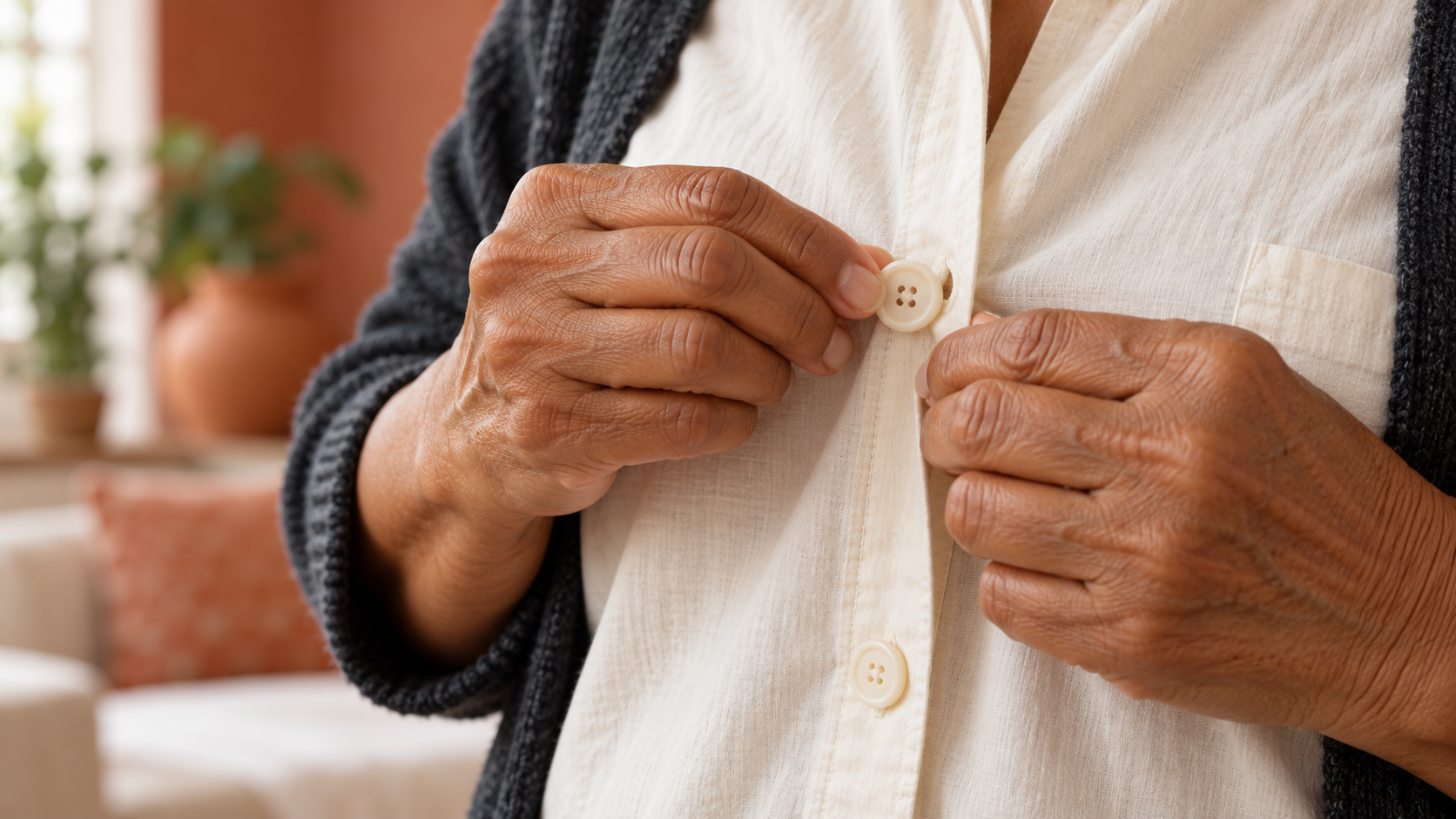


Osteoarthritis (OA) and rheumatoid arthritis (RA) can both cause painful, stiff joints, but their underlying processes differ. OA involves changes and breakdown in joint tissues. RA is an autoimmune disease in which the immune system attacks the body's own tissues, especially the joint lining. For nursing students, the useful comparison connects those processes with symptom timing, joint distribution, and daily function. NIAMS: osteoarthritis, NIAMS: rheumatoid arthritis.
A pattern can guide questions; it cannot establish a diagnosis. This explanation is for nursing education, with fictional learning examples rather than an individual care plan.
What changes inside the joint?
Osteoarthritis involves more than cartilage
Cartilage covers the ends of bones where they meet in a joint. In OA, cartilage and other joint tissues can change, including bone, the joint lining, and supporting structures. Calling OA simple “wear and tear” leaves out that broader process. It also risks making pain and disability sound like an unavoidable consequence of getting older. Younger people can develop OA, including after a joint injury. NIAMS: what happens in osteoarthritis.
The learning connection is joint structure → movement → function. Instead of stopping at “the knee hurts,” ask which movements and activities have become difficult.
Rheumatoid arthritis involves immune-driven inflammation
The synovium is the tissue lining the joint. In RA, persistent inflammation can thicken this lining and damage cartilage and bone. RA can also affect tissues outside joints, so a joint-only explanation is incomplete. NIAMS: what happens in rheumatoid arthritis.
The World Health Organization's RA overview describes possible effects on multiple body systems and difficulties with activities such as holding objects, writing, walking, and climbing stairs. This is why a useful nursing discussion includes both joint findings and the person's broader experience.
Compare patterns without turning them into rules
| Feature to explore | Osteoarthritis pattern | Rheumatoid arthritis pattern |
|---|---|---|
| Pain and activity | Often painful with joint use; rest may help | Pain may occur with movement and at rest |
| Stiffness after waking or resting | Usually relatively brief, often under 30 minutes | Often more prolonged, commonly over 30 minutes |
| Joint distribution | Frequently knees, hips, and particular hand joints | Frequently hands, wrists, and feet; often both sides |
| Swelling | Can occur | Can occur with warmth and tenderness |
These are typical features, not a scoring system. The OA and RA descriptions from NIAMS and NIAMS's RA symptom guide support the comparison.
Three qualifications prevent common mistakes:
- OA can hurt at rest. More advanced symptoms can include night pain. OA can also cause stiffness after inactivity. “Pain at rest means RA” is too absolute. NIAMS: OA symptoms.
- Both sides does not automatically mean RA. RA commonly has a symmetrical pattern, but not always; OA may affect both knees over time. NHS: RA symptoms, NHS: OA symptoms.
- Thirty minutes is a clue, not a diagnostic boundary. Ask how long stiffness actually lasts, what improves it, and how it has changed. The NHS describes shorter morning stiffness as typical of OA and longer stiffness as common in RA; it does not make a stopwatch a stand-alone diagnostic test. NHS: stiffness patterns.
Hand location also helps make a description more precise. OA commonly affects the thumb base and finger joints nearer the fingertips or in the middle of the fingers. Avoid documenting only “hand arthritis” when you can describe the actual location and task affected. NHS: hand osteoarthritis.
What should a nursing student clarify?
Use these questions to organize a classroom assessment discussion with your instructor:
- Timing: When did the problem begin? Is it new, longstanding, or changing? How long does morning stiffness last?
- Location: Which specific joints are involved? Is the pattern similar on both sides?
- Function: What has become harder—fastening buttons, holding a cup, climbing steps, or getting out of a chair? What assistance does the person want?
- Associated changes: Are there new symptoms beyond the joints? Keep reported symptoms separate from what you actually observe or measure.
- Existing evaluation: What diagnosis and care plan are documented? What remains uncertain?
These questions translate the symptom and functional descriptions into a learning framework; they are not a validated diagnostic checklist. For documentation practice, use our explanation of subjective and objective nursing data.
A new hot, swollen joint, especially with fever or feeling unwell, needs prompt assessment rather than an assumption that an existing arthritis diagnosis explains it. Infection is among the possible causes. In clinical placement, report such findings promptly through your supervising nurse and local escalation process. NHS: joint pain and urgent assessment.
Why the distinction matters for evaluation and treatment goals
Neither condition is diagnosed by one symptom. RA evaluation combines the history, examination, laboratory findings, and sometimes imaging. Rheumatoid factor is not decisive by itself: some people with RA have a negative result, while some people with a positive result do not have RA. NIAMS: RA diagnosis.
OA evaluation also uses the history and examination, with imaging or other tests when needed. Tests may help assess joint changes or investigate another explanation for symptoms. NIAMS: OA diagnosis.
For OA, care commonly addresses pain, mobility, and participation in daily life through an individualized combination of approaches. For RA, controlling the disease process and limiting joint or organ damage are central goals as well as symptom relief. Disease-modifying antirheumatic drugs, or DMARDs, are one treatment category used to influence RA progression. NIAMS: OA treatment, NIAMS: RA treatment.
For a student, recognizing that difference explains why “pain is better today” does not answer every question about an RA treatment plan. Medication selection, monitoring, and changes require the responsible clinical team; this comparison supplies no dosing or treatment instructions.
Three original learning checks
These fictional exercises are teaching examples, not official NCLEX questions.
1. A person with documented knee OA reports that both knees hurt when climbing stairs. A classmate says bilateral symptoms rule out OA. What needs correcting?
Bilateral involvement does not rule out OA. Identify the location, timing, and effect on mobility, and review the documented assessment rather than replacing it with a symmetry shortcut.
2. A person describes prolonged morning hand stiffness and difficulty fastening buttons. Can you label the condition RA from this information?
No. Those details are useful for further evaluation, but the diagnosis is still unestablished. A stronger learning response names what is known—reported timing and functional difficulty—and what remains missing, including examination findings and the clinician's evaluation.
3. A learner writes, “Negative rheumatoid factor means no rheumatoid arthritis.” Is that supported?
No. The test is one part of an evaluation. The next discussion should explain how history, examination, other results, and imaging contribute, rather than treating a single result as the whole diagnosis.
When reviewing either condition, practice describing what changed, where it changed, and how it affects the person's life before naming an explanation.
AI-assistance note: This educational article was created with AI assistance and automated checks against the linked public sources. Its cover is AI-generated. These checks are not a human or clinical review.