

The HESI Exit Exam is one of the most important assessments you will take in nursing school.
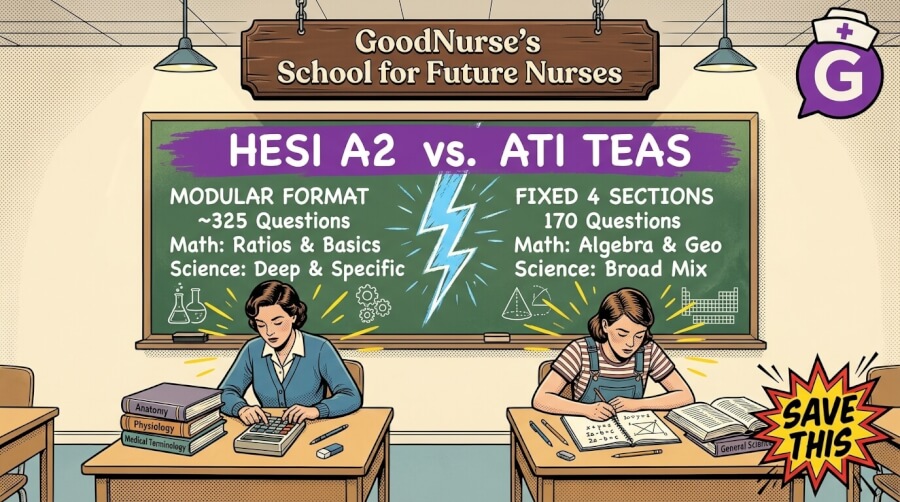
Unlike the HESI A2 — which evaluates academic readiness before admission — the HESI Exit exam measures your clinical knowledge and predicts your readiness for the NCLEX.
If you’re unfamiliar with the admissions version of HESI, review the full breakdown here: https://goodnurse.com/article/241/hesi-a2-breakdown-every-section-explained-2026-complete-guide
This guide will explain:
- What the HESI Exit exam is
- How it is scored
- What counts as a good HESI Exit score
- How it predicts NCLEX success
- What happens if you don’t meet the required benchmark
- How to raise your score strategically
Preparing for the HESI Exit Exam?
Join 5,000+ nursing students using GoodNurse for AI-powered HESI Exit practice, detailed rationales, prioritization drills, and targeted remediation support designed to strengthen weak clinical areas before graduation.
What Is the HESI Exit Exam?
The HESI Exit Exam is a comprehensive, standardized assessment taken near the end of a nursing program.
Its purpose is to:
- Evaluate overall nursing knowledge
- Predict NCLEX success
- Identify weak content areas
- Guide remediation before graduation
Many nursing programs require a minimum HESI Exit score before:
- Allowing students to graduate
- Clearing students to register for the NCLEX
- Approving progression in capstone courses
In other words, this exam carries real academic consequences.
How Many Questions Are on the HESI Exit Exam?
The number of questions varies slightly by program version, but most students encounter:
- 150–160 scored questions
- Multiple-choice format
- Integrated clinical judgment questions
- Prioritization and delegation items
Testing time is typically between 3 and 4 hours.
The Exit exam is designed to simulate the cognitive demands of the NCLEX — not just content recall.
What Content Areas Are Tested on the HESI Exit Exam?
The Exit exam reflects major NCLEX domains, including:
- Medical-Surgical Nursing
- Pharmacology
- Maternal-Newborn
- Pediatrics
- Mental Health
- Leadership and Management
- Delegation and Prioritization
- Infection Control
- Safety and Risk Reduction
- Health Promotion
High-frequency question types include:
- Which patient should the nurse see first?
- Which finding requires immediate intervention?
- Which medication order is unsafe?
- Which task can be delegated to a UAP?
This is not a memorization test — it is a clinical decision-making assessment.
How Is the HESI Exit Exam Scored?
Unlike the HESI A2 (which uses percentage scores), the HESI Exit uses a scaled scoring system.
Most programs interpret scores as follows:
| Scaled Score | Interpretation |
|---|---|
| 900+ | Strong NCLEX readiness |
| 850–899 | Meets common program benchmarks |
| 800–849 | Borderline; remediation likely |
| Below 800 | High risk; intensive remediation required |
Many schools set minimum benchmarks of:
- 850 for progression
- 900 for graduation clearance
For additional score benchmark details: https://goodnurse.com/article/243/what-is-a-good-hesi-score-a2-exit-benchmarks
What Is Considered a “Good” HESI Exit Score?
A good HESI Exit score is one that:
- Meets your program’s required benchmark
- Reflects readiness for NCLEX-level decision-making
In general:
- 850 is acceptable in many programs
- 900+ is considered strong
- 950+ indicates very strong predictive performance
However, always verify your specific school’s requirement.
Does the HESI Exit Exam Predict NCLEX Success?
Many nursing programs use the HESI Exit exam as a predictive indicator for NCLEX readiness.
While it is not a guarantee, research and institutional reporting show that higher Exit scores often correlate with stronger NCLEX pass rates.
The Exit exam focuses on:
- Clinical reasoning
- Safety prioritization
- Risk reduction
- Integrated knowledge
This predictive design is why programs take Exit scores seriously.
HESI Exit vs HESI A2: Understanding the Difference
| Feature | HESI A2 | HESI Exit |
|---|---|---|
| Timing | Before nursing school | End of nursing school |
| Purpose | Admissions | NCLEX readiness |
| Score Type | Percentage | Scaled score |
| Focus | Academic fundamentals | Clinical integration |
They serve different stages of your nursing journey.
What Happens If You Don’t Reach the Required Score?
Schools typically implement structured remediation, including:
- Required review modules
- Mandatory practice exams
- Faculty-guided study plans
- Retesting windows
- Delayed clearance to test for NCLEX
Failing to meet the benchmark does not mean you will fail the NCLEX — but it does signal areas needing improvement.
Analyze your lowest scoring content category first. Raising one weak domain by 10–15% can significantly increase your scaled score.
3-Week HESI Exit Score Improvement Plan
Week 1: Diagnostic Focus
- Review detailed score report
- Identify bottom two categories
- Practice 50–75 questions daily in those domains
Week 2: Clinical Decision-Making Emphasis
- Prioritization drills
- Delegation scenarios
- Rapid safety questions
Week 3: Full Simulation Practice
- Take 2–3 full-length timed practice sets
- Simulate testing conditions
- Review rationales carefully
For structured adaptive review: https://goodnurse.com/hesi-exam-prep
Focusing only on memorizing content. The Exit exam evaluates clinical reasoning and prioritization under time pressure.
How Much Can You Improve Your HESI Exit Score?
Students commonly improve:
- 50–100 scaled points in 2–4 weeks
- Even more if pacing or anxiety was limiting performance
Improvement is realistic with structured practice.
Frequently Asked Questions
Is 850 a good HESI Exit score?
Yes, in many programs 850 meets the minimum benchmark. However, some require 900+.
Is 900 on the HESI Exit strong?
Yes. A 900+ score generally indicates strong NCLEX readiness.
Is the HESI Exit harder than NCLEX?
The structure differs. Many students find the Exit intense because it compresses broad content into one predictive score.
Can you retake the HESI Exit exam?
Most programs allow retakes with remediation requirements. Policies vary.
How long should you study for the HESI Exit?
Most students benefit from 2–4 weeks of focused, structured review before retesting.
Final Takeaway
The HESI Exit exam is a readiness checkpoint.
- 850–900 is a common benchmark
- Higher scores correlate with stronger NCLEX readiness
- Targeted remediation can significantly improve results
If your Exit exam is approaching, begin structured preparation early: https://goodnurse.com/hesi-exam-prep
What Comes After the HESI Exit: Your NCLEX Roadmap
The HESI Exit exam is designed to predict your NCLEX readiness — which means passing it is not the finish line. It's the starting gun for NCLEX prep.
Here's how to translate your HESI results into a targeted NCLEX study plan:
If you scored 900+: You have a strong foundation. Your NCLEX prep should focus on question volume and NGN (Next Generation NCLEX) format fluency — especially bow-tie and matrix items that test clinical reasoning, not just knowledge recall. A focused 2–4 week sprint is typically enough.
If you scored 800–899: You're on track but have identifiable weak areas from your HESI content breakdown. Use those scores to build a targeted study plan around your lowest content categories. A 4-week structured plan lets you shore up gaps without burning out.
If you scored below 800: Treat this as a gift — you now know exactly where to focus before you sit for the NCLEX. Plan for 6–8 weeks of structured prep, prioritizing your two or three weakest content areas daily rather than studying everything equally.
What Changed in the 2026 NCLEX
The 2026 NCLEX test plan took effect April 1st and shifted content area weights. If your HESI prep materials are from 2024 or earlier, review the updated test plan before you start — some content areas gained weight and others were reduced.
Emergency Timeline: NCLEX in Under 2 Weeks
If your NCLEX date is close, the NCLEX Emergency 2-Week Study Plan walks through a day-by-day schedule designed specifically for students in this situation — including the 90-minute triage method that identifies your highest-priority content areas before you spend a single hour studying.
More Time Available: The 4-Week Plan
If you have 3–4 weeks before your NCLEX, the 4-Week NCLEX Study Plan for Working Students builds in the schedule flexibility that most traditional study guides ignore — including how to study effectively in 60–90 minute blocks rather than marathon sessions.
📋 From HESI Exit to NCLEX pass — GoodNurse bridges the gap
GoodNurse adapts to your HESI weak areas and generates NCLEX-style practice questions — including all Next Gen NGN formats — with detailed AI explanations. It's the fastest way to convert your HESI score into NCLEX readiness.
Start NCLEX prep with GoodNurse →