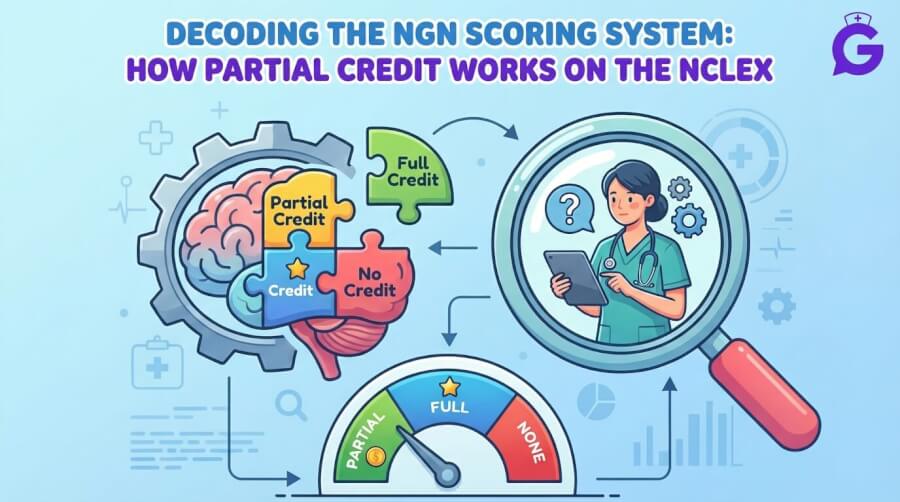


For decades, the NCLEX used a rigid all-or-nothing scoring model.
If you answered a Select All That Apply (SATA) question and missed just one correct option - or selected one extra incorrect answer - you earned zero points.
That changed in April 2023 with the launch of the Next Generation NCLEX (NGN).
The National Council of State Boards of Nursing (NCSBN) introduced polytomous (partial credit) scoring, fundamentally changing how points are awarded.
This shift aligns directly with the updated 2026 NCLEX-RN and NCLEX-PN Test Plans, which emphasize measurable clinical judgment rather than memorization.
If you have not reviewed the blueprint changes yet, start with the
👉 2026 NCLEX-RN & PN Test Plan Breakdown
so you understand how scoring connects to the exam structure.
👉 Start an NGN practice session inside GoodNurse and see how the scoring works before exam day.
What Is Polytomous Scoring?
To understand NGN scoring, you must understand the difference between:
Dichotomous Scoring (Old NCLEX)
- Correct = 1 point
- Incorrect = 0 points
No middle ground.
Polytomous Scoring (NGN Model)
- Points awarded for correct components
- Points deducted for incorrect selections (in certain formats)
- Minimum score per item = 0
This change reflects the NCSBN Clinical Judgment Measurement Model (NCJMM) — the same framework driving new NGN item types like:
- NGN Bow-Tie Items: Format & 10 Strategy Examples
- NGN Matrix/Grid Items Explained (Format + Examples)
- How to Read NGN Case Stems (Clinical Judgment Strategy Guide)
These formats rely heavily on partial credit logic.
The Three NGN Scoring Models
Not all NGN questions are scored the same way.
Understanding the scoring model protects your points.
1. The 0/1 Scoring Model
Used for:
- Traditional multiple-choice
- Some single-response drag-and-drop
Rule:
- Correct = 1
- Incorrect = 0
This remains straightforward.
2. The Plus-Minus (+/−) Model
Used for:
- NGN SATA
- Certain grouping items
- Some matrix questions
Rule:
- Select a correct option → +1
- Select an incorrect option → −1
- Lowest possible score per item = 0
You cannot go negative.
Why This Matters for SATA
Under the old NCLEX, guessing carried no penalty beyond zero.
Under NGN:
Selecting one incorrect answer cancels out one correct answer.
This means over-selecting is dangerous.
If you’re unsure about SATA logic, review the structured breakdown in:
👉 NGN Case Study Strategy Guide
Over-selecting options on SATA questions. A wrong guess subtracts a point from a correct answer.
3. The Rationale Scoring Model (Dyads & Triads)
Used for:
- Case studies
- Drop-down cloze
- Matrix/grid reasoning chains
This model requires linked reasoning.
Example dyad:
Condition → Cause
Both must be correct to earn credit.
Triads require three correct linked elements.
You’ll encounter this most frequently in:
- NGN Pharmacology Case Studies (2025 Edition)
- Multi-layered matrix items
- Extended case-based scenarios
How Partial Credit Changes Strategy
NGN scoring rewards layered reasoning.
This changes how you approach:
Select All That Apply
- Only select options you can justify clinically
- Avoid “maybe” answers
- Protect earned points
Matrix/Grid Items
Each row is often scored independently.
If a matrix contains 5 rows, it may be worth 5 total points.
Even if you miss one, you can bank the others.
For a deeper structural breakdown, study:
👉 NGN Matrix/Grid Items Explained
Bow-Tie Items
Bow-tie items integrate:
- Condition recognition
- Intervention selection
- Outcome prediction
They frequently combine scoring models.
Practice format familiarity here:
👉 NGN Bow-Tie Items Strategy Guide
Why the NCSBN Changed NCLEX Scoring
The goal was improved measurement validity.
The NGN now aligns scoring with:
- Clinical judgment
- Safety prioritization
- Real-world decision-making
This change also aligns with findings published in the Journal of Nursing Regulation validating polytomous scoring and improved outcome measurement.
For broader NCLEX preparation strategy, revisit:
👉 The Complete NCLEX Study Mega Guide (2026 Edition)
How to Maximize Your NGN Score
1. Study the Blueprint
Understand how scoring aligns with:
👉 2026 NCLEX-RN/PN Test Plan Changes
2. Practice Linked Reasoning
Use structured prompts from:
👉 AI Prompt Library for Nursing Students (NGN-Focused)
This strengthens dyad/triad thinking.
3. Train Under Real NGN Conditions
Exposure reduces anxiety.
Practice:
- Case stems
- Matrix logic
- SATA risk control
- Bow-tie reasoning
Inside GoodNurse before exam day.
Protect your points before test day.
If you want the complete, up-to-date breakdown of AI for NCLEX prep + nursing school—with independent university study metrics—use this master guide: The Ultimate Guide to AI for NCLEX Preparation and Nursing School.
Final Takeaway
NGN partial credit scoring is not harder.
It is more precise.
When you understand:
- The 0/1 model
- The +/- model
- The dyad/triad rationale model
You gain strategic control.
The Next Generation NCLEX rewards safe, structured clinical reasoning.
Understand the scoring - and protect your points.