Educational Videos
Learn with our comprehensive video library covering NCLEX prep, nursing fundamentals, and clinical skills.

Adult Vital Signs: Accurate Measurement, Trends, and Escalation
Practice interpreting adult vital signs as part of a patient assessment. Review practical measurement checks for temperature, pulse, respirations, blood pressure, and oxygen saturation, then connect findings with symptoms, baseline, and trends. A short case helps you reason through a reassuring monitor reading alongside concerning clinical changes. Use this lesson to prepare for supervised clinical practice and nursing assessment questions. Work with your RN/preceptor, follow current orders and facility procedures, and seek urgent help promptly when a patient deteriorates. Educational content with AI-generated visuals and synthetic narration.

Pharmacology Foundations: Medication Safety and Nursing Judgment
Practice a structured approach to medication safety before, during, and after administration. Connect the medication and indication with a focused assessment, verify the order and patient identifiers, recognize when to pause and clarify a concern, and reassess the response. This lesson includes a fictional patient scenario, high-alert medication concepts, respectful communication, documentation, and teach-back. The before/during/after organizer supports studying; assessment remains continuous and urgent deterioration needs immediate escalation. For nursing-student learning under RN/preceptor supervision. Use current orders, approved medication references, and local protocols. Created with AI-assisted visuals and synthetic narration; source comparison does not constitute qualified clinician sign-off.

Labor & Delivery: Assessment and Nursing Priorities
Practice organizing maternal and fetal assessment during labor and connecting your findings with nursing priorities. This focused lesson covers assessment after suspected membrane rupture, labor stages, introductory fetal heart-rate assessment, concerning changes, prompt team communication, and reassessment during supervised care. It also emphasizes listening to the patient's concerns and providing respectful support. Designed for nursing students preparing for maternity clinicals and NCLEX review. Based on OpenStax Maternal Newborn Nursing, ACOG's 2024 labor-management and 2025 fetal heart-rate monitoring guidelines, and CDC HEAR HER maternal warning signs. This AI-assisted explainer uses synthetic narration. Apply what you learn within your scope of practice, facility protocols, provider orders, and supervised clinical training.
Adult Sepsis: Recognition, Escalation, and Nursing Priorities
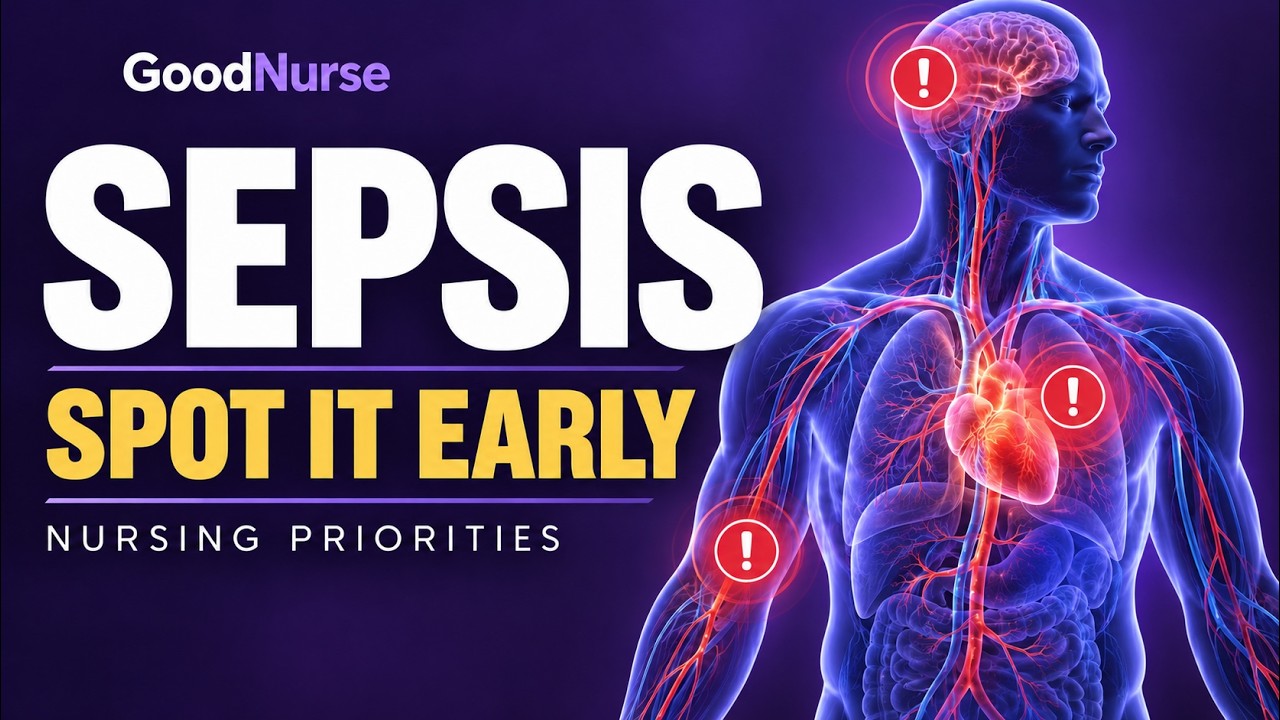
Practice recognizing possible sepsis and organizing your response when an adult patient deteriorates. Clinical clarification (3:41–4:11): The three-hour window applies only to possible sepsis without shock; it is not a reason to delay indicated antibiotics. Perform rapid evaluation and give antimicrobials within three hours if infection concern persists. Shock or probable/definite sepsis calls for immediate treatment, ideally within one hour. The phrase “no exceptions” is too absolute: apply clinical judgment, patient-specific factors, and local protocols. In the recap case, the findings suggest possible shock and require immediate assessment; the brief scenario alone does not confirm shock. After watching, you should be able to identify concerning changes in mental status, breathing, circulation, and temperature; communicate findings promptly; explain the purpose and limitations of blood cultures and lactate; and describe nursing responsibilities during ordered antimicrobial therapy, fluid resuscitation, and reassessment. The lesson emphasizes clinical context, individualized care, and ongoing communication. Based on CDC resources and the 2026 Surviving Sepsis Campaign adult guidelines. This AI-assisted explainer uses synthetic narration. Apply what you learn within your scope of practice, facility protocols, provider orders, and supervised clinical training.

Blood Transfusions: Compatibility, Administration & Reaction Management
A focused review of blood transfusion nursing care, covering blood type compatibility, pre-transfusion verification, infusion time limits, IV fluid compatibility, and how to recognize and respond to febrile, allergic, and hemolytic reactions, as well as TACO and TRALI. Includes step-by-step priority actions for managing a suspected transfusion reaction.

GI System NCLEX Review: Pancreatitis, SBO, TPN, Labs & Prioritization
This GI NCLEX review covers high-yield gastrointestinal nursing topics, including TPN safety, acute pancreatitis, small bowel obstruction, GI medications, potassium imbalances, and prioritization/delegation strategies. You’ll review key NCLEX clues such as LUQ pain radiating to the back in pancreatitis, Cullen’s sign, Turner’s sign, NPO status, NG tube decompression, SBO vs LBO symptoms, and when to prioritize unexpected complications in GI patients. The lesson also reinforces the “EAT” delegation rule: do not delegate evaluation, assessment, or teaching.

Appendicitis: Pathophysiology, Assessment & Peri-Operative Nursing Care
A focused review of acute appendicitis for NCLEX and med-surg preparation. Covers the pathophysiology of obstruction-to-rupture, the APPENDIX mnemonic, and the four key assessment signs (McBurney's, Rovsing's, psoas, obturator). Also reviews diagnostic labs (WBC, left shift, CRP), pre-op do's and don'ts, post-op care for laparoscopic vs. open appendectomy, and how to recognize peritonitis.
Extrapyramidal Symptoms: EPS Timeline, Assessment, and NCLEX Traps
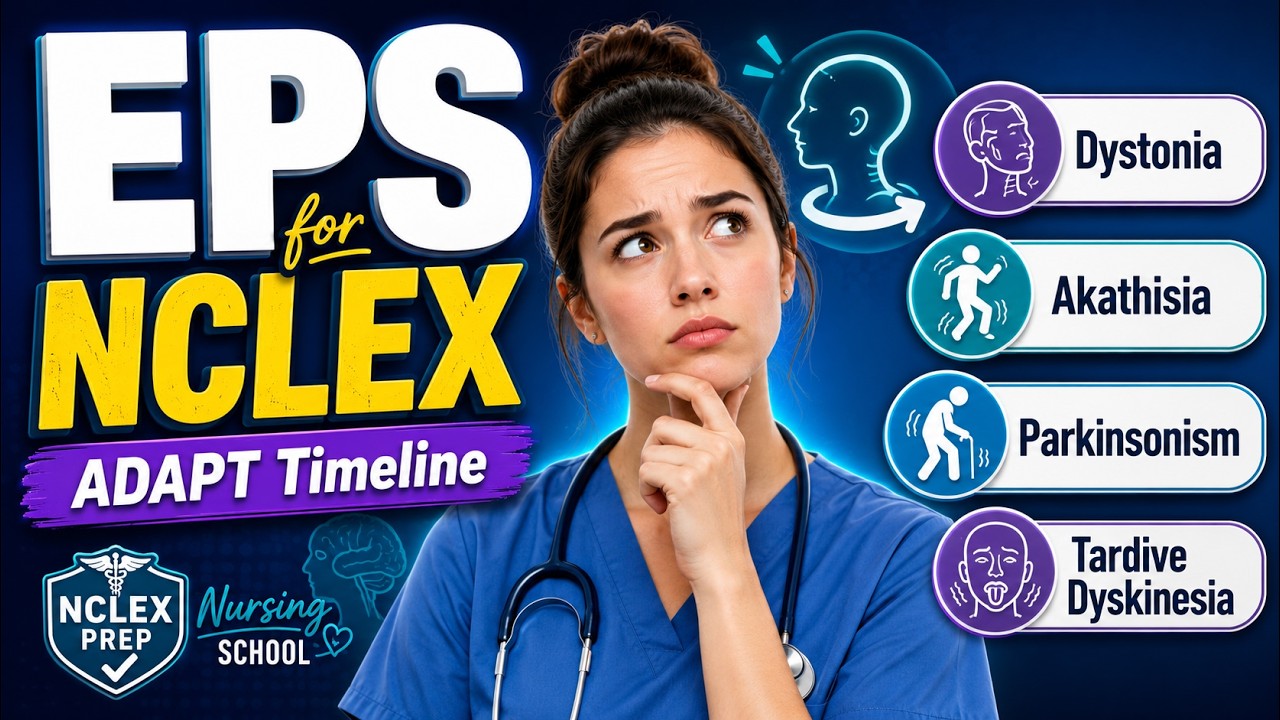
Learn how to recognize and manage extrapyramidal symptoms caused by dopamine-blocking medications, including antipsychotics and antiemetics. This lesson covers the ADAPT timeline for acute dystonia, akathisia, pseudoparkinsonism, and tardive dyskinesia, along with AIMS assessment steps, anticholinergic treatment, and key NCLEX comparisons such as EPS vs neuroleptic malignant syndrome, malignant hyperthermia, and serotonin syndrome.

Cardiac Assessment NCLEX Review: Auscultation, JVD, Troponin, Angina & Nitro Protocol
This lesson reviews high-yield cardiac assessment concepts for NCLEX prep, including heart auscultation landmarks, normal and abnormal heart sounds, jugular vein distension assessment, troponin interpretation, stable vs. unstable angina, and the step-by-step nitroglycerin protocol. Designed to help nursing students connect memorized facts with safe clinical decision-making.

Pediatric NCLEX Review: Prioritization, Emergencies, Milestones & Med Safety
This pediatric NCLEX review covers the key concepts nursing students need to recognize high-priority pediatric patients and answer safety-based exam questions. Topics include NCLEX prioritization rules, pediatric vital sign trends, developmental milestones and regression, croup vs. epiglottitis, signs of abuse and neglect, mandated reporting, and high-yield pediatric pharmacology. Students will review essential medication safety points including kilogram-based dosing, ibuprofen and aspirin precautions, IM injection site selection, digoxin toxicity signs, amoxicillin teaching, and pancreatic enzyme administration for cystic fibrosis.

Electrolyte Imbalances & Fluid Shifts: NCLEX Priority Actions
A focused review of the five core electrolytes (sodium, potassium, calcium, magnesium, chloride) with normal ranges, ECG changes, and priority nursing interventions. Includes high-yield mnemonics (SALT LOSS, MURDER, CATS, BACME), a breakdown of isotonic, hypotonic, and hypertonic IV fluids, and key NCLEX traps covering lithium toxicity, IV potassium safety rules, and magnesium toxicity reversal with calcium gluconate. Ends with a Next Gen NCLEX clinical judgment scenario.
Multiple Sclerosis (MS) — High-Yield NCLEX Review
## 1. YouTube Title & Description **Title:** Multiple Sclerosis (MS) NCLEX Review | Pathophysiology, Signs & Symptoms, Nursing Interventions & Pharmacology --- **Description:** Struggling with the neuro section of the NCLEX? This high-yield Multiple Sclerosis review covers everything nursing students need to know to confidently answer MS questions on the boards — from pathophysiology to pharmacology, all broken down in a clear, memorable way. In this video, you'll master: - The core pathophysiology of MS and how demyelination disrupts nerve transmission - How to instantly tell MS apart from Myasthenia Gravis (a classic NCLEX trick!) - Must-know signs and symptoms: Charcot's triad, Uhthoff's sign, Lhermitte's sign, optic neuritis, and Romberg's sign - Priority nursing interventions and how to teach patients to avoid exacerbation triggers - Bowel and bladder management strategies, including the step-by-step constipation algorithm - Key MS medications mapped to the symptoms they treat — exactly how the NCLEX tests pharmacology Whether you're in nursing school, deep in NCLEX prep, or brushing up on neurological nursing, this structured breakdown will help you retain the concepts that matter most on test day. 🔍 Topics Covered: MS Pathophysiology | Myelin Sheath | MS vs Myasthenia Gravis | Charcot's Triad | Uhthoff's Sign | Lhermitte's Sign | Romberg Sign | Optic Neuritis | Nursing Interventions | Urinary Incontinence vs Retention | Clean Intermittent Catheterization | Beta Interferon | Corticosteroids | Baclofen | Oxybutynin | Bethanechol | Modafinil | NCLEX Neuro Review #NCLEX #NursingSchool #MultipleSclerosis #NCLEXReview #NursingStudy #NeuroNursing #NCLEXPrep #NursingExam #MSNursing #HighYieldNursing --- ## 2. Members-Only Library Title & Description **Title:** Multiple Sclerosis (MS) — High-Yield NCLEX Review --- **Description:** This video provides a comprehensive, board-focused breakdown of Multiple Sclerosis for NCLEX preparation. Topics include the autoimmune pathophysiology of CNS demyelination, key distinguishing features between MS and Myasthenia Gravis, and high-yield clinical findings such as Charcot's triad, Uhthoff's sign, Lhermitte's sign, and optic neuritis. Also covered: priority nursing interventions, environmental trigger education, bowel and bladder management protocols, and essential pharmacology including immunomodulators, corticosteroids, muscle relaxants, and bladder medications.