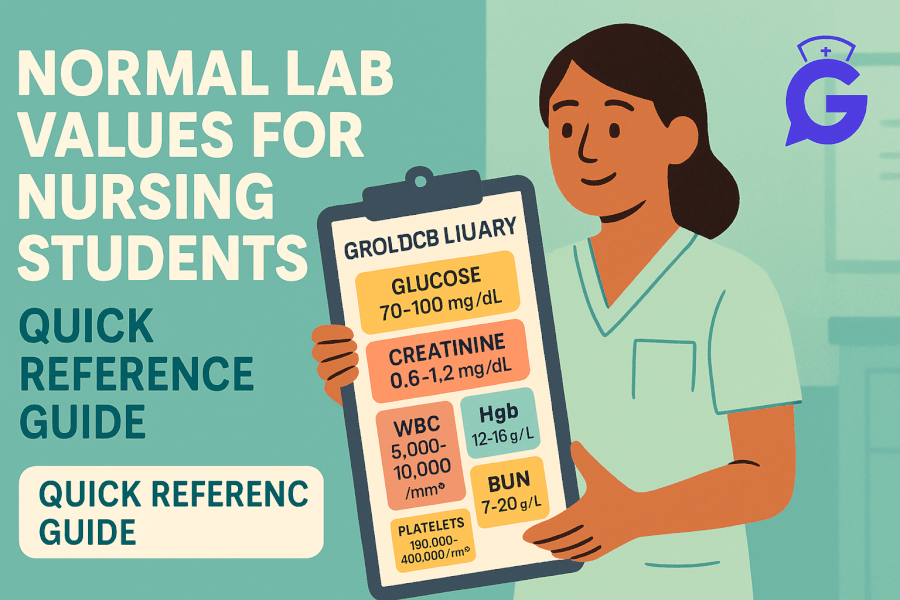


This lab values cheat sheet gives nursing students every reference range, interpretation shortcut, and clinical pattern you need for clinicals, exams, and the NCLEX. Instead of memorizing hundreds of isolated numbers, you will learn to read labs the way working nurses do: spot the abnormal value, name the pattern, and connect it to the two or three actions that fix the problem.
Use the master table below for rapid review, then scroll to any panel section for deeper context. At the bottom you will find mnemonics, NGN action–parameter pairs, and three NCLEX-style practice questions.
Important: Ranges vary by lab, assay, and population. Always compare against your hospital’s or course’s reference ranges.
Download a free printable PDF version of this Lab Values cheat sheet. Enter your email below and we'll send it right over.
Table of Contents
- Master Quick-Reference Table
- How to Use This Cheat Sheet
- CBC (Complete Blood Count)
- Basic Metabolic Panel / Electrolytes
- Comprehensive Metabolic Panel (LFTs, Proteins)
- Renal Markers and Urine Basics
- Cardiac Markers and Lactate
- Coagulation Studies
- ABG: Arterial Blood Gas Reference
- Fast Patterns and Mnemonics
- NGN Tie-Ins: Action → Parameter Pairs
- NCLEX Practice Questions
- FAQs
- Further Reading
Test your knowledge—new quizzes added weekly!
Our dedicated page of free NCLEX Practice Quizzes. Adaptive, updated, and filled with NCLEX-style questions →
Master Quick-Reference Table
Scan this single table before any exam or clinical shift. Every lab you are most likely to see on the NCLEX is here with its normal range and the one-line clinical flag that matters most.
| Lab Test | Normal Adult Range* | Panel | Key Clinical Flag |
|---|---|---|---|
| WBC | 4.0–11.0 ×10³/µL | CBC | ↑ infection/inflammation; ↓ immunosuppression |
| Hemoglobin | F: 12–16 g/dL; M: 13.5–17.5 solid #e0e0e0;">F: 12–16 g/dL; M: 13.5–17.5 | CBC | ↓ anemia/bleeding; ↑ dehydration or polycythemia |
| Hematocrit | F: 36–46%; M: 41–53% | CBC | Tracks Hgb; hemodilution vs. concentration |
| Platelets | 150–400 ×10³/µL | CBC | ↓ bleeding risk (HIT alert); ↑ clot risk |
| Na¹ | 135–145 mEq/L | BMP | Fluid/neuro status; correct slowly to avoid CPM |
| K¹ | 3.5–5.0 mEq/L | BMP | Cardiac conduction; watch with diuretics/insulin |
| Cl¹ | 96–106 mEq/L | BMP | Acid–base partner with bicarb |
| CO&sub2; / HCO&sub3;¹ | 22–29 mEq/L | BMP | Metabolic acid–base component |
| BUN | 7–20 mg/dL | BMP | Hydration and renal perfusion trends |
| Creatinine | ~0.6–1.3 mg/dL | BMP | Renal filtration; always compare to baseline |
| Glucose (fasting) | 70–99 mg/dL | BMP | DM therapy, sepsis, steroids, DKA |
| Ca²¹ | 8.6–10.2 mg/dL | BMP | Correct for albumin; neuromuscular excitability |
| Mg²¹ | 1.7–2.2 mg/dL | BMP | Arrhythmias, preeclampsia therapy, torsades |
| Phosphorus | 2.5–4.5 mg/dL | BMP | Refeeding syndrome, bone/renal issues |
| AST | ~10–40 U/L | CMP | Hepatocellular injury (with ALT) |
| ALT | ~7–56 U/L | CMP | More liver-specific than AST |
| ALP | ~40–129 U/L | CMP | Cholestasis, bone turnover |
| Total Bilirubin | ~0.2–1.2 mg/dL | CMP | Hemolysis vs. cholestasis patterns |
| Albumin | 3.5–5.0 g/dL | CMP | Nutrition, oncotic pressure, corrected Ca²¹ |
| Troponin | Assay-specific; 99th %ile | Cardiac | Serial trends + symptoms + ECG drive decisions |
| BNP | Often <100 pg/mL | Cardiac | Heart failure marker; adjust for age/renal |
| Lactate | ~0.5–2.2 mmol/L | Cardiac | Perfusion/O&sub2; debt; sepsis target: trend down |
| PT | ~11–13.5 s | Coags | Warfarin monitoring with INR |
| INR | ~0.8–1.2 | Coags | Therapeutic 2.0–3.0 for most indications |
| aPTT | ~25–35 s | Coags | Heparin effect; therapeutic per protocol |
| pH | 7.35–7.45 | ABG | <7.35 acidosis; >7.45 alkalosis |
| PaCO&sub2; | 35–45 mmHg | ABG | Respiratory component (inverse with pH) |
| PaO&sub2; | 80–100 mmHg | ABG | Age/altitude dependent; pair with SpO&sub2; |
Ranges are approximate adult values. Always verify with your facility’s reference ranges.
How to Use This Cheat Sheet
Skim the tables before clinical or exams to refresh anchors. When a lab is off, name the likely problem pattern and pick the two fastest ways to improve physiology. For NGN, pair every action with a parameter you will recheck soon (10–30 minutes when appropriate).
If case stems feel dense, warm up with How to Read NGN Case Stems (2026) and then drill category practice in NGN Case Studies (2026).
CBC (Complete Blood Count)
| Test | Typical Adult Range* | What to Watch |
|---|---|---|
| WBC | 4.0–11.0 ×10³/µL | ↑ infection/inflammation; ↓ immunosuppression or marrow issue |
| Hemoglobin (Hgb) | F: 12–16 g/dL; M: 13.5–17.5 g/dL | ↓ anemia/bleeding; ↑ dehydration |
| Hematocrit (Hct) | F: 36–46%; M: 41–53% | Tracks with Hgb; hemodilution vs. concentration |
| Platelets | 150–400 ×10³/µL | ↓ bleeding risk (HIT); ↑ inflammation/clot risk |
| RBC | F: 3.8–5.2; M: 4.3–5.7 ×10⁶/µL | Trend with indices for anemia types |
| MCV | 80–100 fL | Microcytic vs. macrocytic anemia clues |
Ranges vary by lab; use your facility’s references.
Basic Metabolic Panel / Electrolytes
| Test | Typical Adult Range* | Notes |
|---|---|---|
| Sodium (Na¹) | 135–145 mEq/L | Fluid/neurologic status; rapid shifts are risky |
| Potassium (K¹) | 3.5–5.0 mEq/L | Cardiac conduction; watch with diuretics/insulin |
| Chloride (Cl¹) | 96–106 mEq/L | Acid–base partner with bicarbonate |
| CO&sub2; (HCO&sub3;¹) | 22–29 mEq/L | Metabolic component of acid–base balance |
| BUN | 7–20 mg/dL | Hydration and renal perfusion trends |
| Creatinine | ~0.6–1.3 mg/dL | Renal filtration; compare to baseline |
| Glucose (fasting) | 70–99 mg/dL | Context: DM therapy, sepsis, steroids |
| Calcium (total) | 8.6–10.2 mg/dL | Correct for albumin; neuromuscular excitability |
| Magnesium | 1.7–2.2 mg/dL | Arrhythmias, preeclampsia therapy, torsades |
| Phosphorus | 2.5–4.5 mg/dL | Refeeding, bone/renal issues |
Comprehensive Metabolic Panel (LFTs, Proteins)
| Test | Typical Adult Range* | Notes |
|---|---|---|
| AST | ~10–40 U/L | Hepatocellular injury (with ALT) |
| ALT | ~7–56 U/L | More liver-specific than AST |
| Alkaline Phosphatase (ALP) | ~40–129 U/L | Cholestasis, bone turnover |
| Total Bilirubin | ~0.2–1.2 mg/dL | Hemolysis vs. cholestasis patterns |
| Albumin | 3.5–5.0 g/dL | Nutrition, oncotic pressure, corrected Ca²¹ |
| Total Protein | 6.0–8.3 g/dL | Globulins, hydration |
Renal Markers and Urine Basics
| Measure | Typical Range / Goal | Notes |
|---|---|---|
| eGFR | >60 mL/min/1.73m² | Trend over time; dose meds renally |
| Urine Output | ≥0.5 mL/kg/hr | Perfusion check; Foley only if indicated |
| Urinalysis Highlights | Negative nitrites/LE/protein/glucose | Infection, kidney disease, DM clues |
Cardiac Markers and Lactate
| Marker | Reference Point | Notes |
|---|---|---|
| Troponin (high-sensitivity) | Assay-specific; abnormal at 99th %ile | Use serial trends and clinical picture |
| BNP / NT-proBNP | Often <100 pg/mL (BNP) in non-HF | Interpret with age, renal function, obesity |
| Lactate | ~0.5–2.2 mmol/L | Perfusion/oxygen debt; sepsis target: trend down |
| CK-MB (legacy) | Declining use | Troponin preferred |
Coagulation Studies
| Test | Typical Range* | Notes |
|---|---|---|
| PT | ~11–13.5 s | Warfarin monitoring with INR |
| INR | ~0.8–1.2 (non-anticoagulated) | Therapeutic often 2.0–3.0 depending on indication |
| aPTT | ~25–35 s | Heparin effect; therapeutic range per protocol |
| Fibrinogen | ~200–400 mg/dL | Low in DIC, massive hemorrhage |
| D-dimer | Assay-specific; often <0.5 mg/L FEU | Rule-out tool; many false positives |
ABG: Arterial Blood Gas Reference
| Component | Typical Range* | Interpretation Hints |
|---|---|---|
| pH | 7.35–7.45 | <7.35 acidosis; >7.45 alkalosis |
| PaCO&sub2; | 35–45 mmHg | Respiratory component (inverse with pH) |
| HCO&sub3;¹ | 22–26 mEq/L | Metabolic component (direct with pH) |
| PaO&sub2; | 80–100 mmHg (room air, adult) | Age/altitude dependent; interpret with SpO&sub2; |
| SaO&sub2; | 95–100% | Check perfusion/hemoglobin factors |
| Anion Gap | ~8–12 mEq/L (lab dependent) | High gap metabolic acidosis patterns (MUDPILES) |
For hands-on ABG practice, try the ABG Interpretation NCLEX Practice Quiz.
Fast Patterns and Mnemonics
Electrolyte emergencies — the “3 Hs” check: Hyponatremia (neuro changes → correct slowly to avoid CPM), Hyperkalemia (ECG changes → stabilize myocardium first), Hypocalcemia (Trousseau/Chvostek signs → replace calcium, check magnesium).
Renal red flag: Rising creatinine after contrast → remove nephrotoxins, hydrate per protocol, trend output.
Liver pattern shortcut: AST + ALT both up → hepatocellular process. ALP + bilirubin up → cholestasis pattern. Use the mnemonic “HALT”: Hepatocellular = ALT leads; ALP = cholestasis; Lactate = perfusion; Troponin = cardiac.
Coag pairing: PT/INR → warfarin (extrinsic pathway). aPTT → heparin (intrinsic pathway). Remember: PT = Pill (warfarin is oral), aPTT = Parenteral (heparin is IV/SubQ).
ABG quick start: pH tells acidosis vs. alkalosis. PaCO&sub2; and HCO&sub3;¹ tell respiratory vs. metabolic. Decide compensation and whether oxygenation is adequate.
Lactate trending up in infection → suspect worsening perfusion; fluids/pressors per protocol and re-check.
For more clinical mnemonics, see the Pharmacology Mnemonics Cheat Sheet.
NGN Tie-Ins: Action → Parameter Pairs
To score consistently on NGN, pick actions that change physiology and parameters that prove it worked soon.
Hypoxia pattern → actions: oxygen, position; parameters: SpO&sub2;, respiratory rate/work of breathing.
Hypovolemia/bleed → actions: large-bore IVs, fluids; parameters: MAP/BP, urine output.
DKA → actions: fluids then insulin; parameters: potassium, anion gap, glucose trend.
Hepatic cholestasis → actions: trend LFTs, evaluate obstruction, manage symptoms; parameters: bilirubin, ALP, pruritus relief.
Anticoagulation change → actions: manage dose/antidote per protocol; parameters: INR/aPTT, bleeding signs.
Sepsis / elevated lactate → actions: blood cultures, antibiotics within 1 hr, 30 mL/kg crystalloid; parameters: lactate clearance, MAP ≥65, urine output.
For full NGN walk-throughs, see 25 Free Case Studies and category sets in Pediatrics & Psych and Maternal–Newborn.
NCLEX Practice Questions
Question 1. A nurse reviews morning labs for a client receiving IV heparin. The aPTT is 120 seconds (therapeutic range: 60–80 s for this protocol). Which action should the nurse take first?
Show Answer
Question 2. A client admitted with vomiting and diarrhea has the following labs: Na¹ 128 mEq/L, K¹ 3.1 mEq/L, Cl¹ 90 mEq/L. Which assessment finding should the nurse report immediately?
Show Answer
Question 3. A nurse is caring for a post-operative client whose morning labs show: Hgb 7.2 g/dL (pre-op baseline 12.8), Hct 22%, and urine output of 20 mL over the last hour (weight 80 kg). What is the priority nursing action?
Show Answer
Want more practice? Try our free NCLEX practice quizzes with adaptive questions updated weekly.
FAQs
Are these ranges the same everywhere? No. Use your facility’s or course’s ranges. This lab values cheat sheet is for orientation and exam practice.
How should I memorize lab values? Group by pattern: electrolytes together, renal pair (BUN/Cr), LFT set (AST/ALT/ALP/bili), coags, and ABG trio. Turn tables into flashcards and review them in short daily sets. If you use AI, convert this page into a two-page study guide with quiz questions using the AI Prompt Library.
What’s the difference for pediatrics or pregnancy? Ranges and normal physiology shift. For example, newborn bilirubin runs higher early on; pregnancy alters proteins and volume. Always use population-specific references. For OB-specific practice, see Maternal–Newborn Case Studies (2026).
How do I connect labs to actions on NGN? Name the single priority first, then pick two actions that change physiology and two parameters that will show improvement soon. Practice with Bow-Tie Items and Matrix/Grid Items.
Do I need to memorize troponin cutoffs? Know that positivity is defined by your lab’s assay-specific 99th percentile and that trends plus symptoms/ECG drive decisions.
What labs should I know for the NCLEX specifically? Focus on the values that drive immediate nursing actions: potassium (cardiac risk), sodium (neuro risk), INR/aPTT (bleeding risk), glucose (hypo/hyperglycemia), and lactate (perfusion). These appear most frequently in NCLEX-style scenarios.
2,500+ NCLEX-style questions with detailed rationales, adaptive difficulty, and AI-powered explanations that break down why each answer is right or wrong. Available in 10+ languages.
Under $10/month — no card needed to start.
Start Free Today →
Further Reading
Recommended next reads from the GoodNurse library:
- Heart Rhythm Strips Cheat Sheet (2026) — pair cardiac markers with rhythm recognition
- NGN Case Studies (2026): 25 Free Examples with Answers
- How to Read NGN Case Stems (2026): Strategy Guide
- Med-Surg / Physiological Adaptation Case Studies (2026)
- Maternal–Newborn Case Studies (2026)
- Pediatrics & Psych Case Studies (2026)
- Pharmacology Mnemonics Cheat Sheet
- AI Prompt Library for Nursing Students (2026)
- Best AI Apps for Nursing Students (2026): Honest Comparison