

If you’re wondering how to study for the HESI in a structured, realistic way - this guide is for you.
Whether you’re preparing for the admissions-focused A2 or the graduation-level Exit exam, the key to success is consistency, targeted practice, and strategic review.
If you haven’t reviewed the structure of the exam yet, begin with our complete HESI A2 exam breakdown and section guide so you understand exactly what will be tested.
This 30-day HESI study plan works for:
- First-time test takers
- Students retaking the HESI
- Nursing students preparing for the Exit benchmark
- Applicants aiming for competitive admission scores
Want a Smarter Way to Study for HESI?
Join 5,000+ nursing and pre-nursing students using GoodNurse for AI-powered HESI study plans, personalized math drills, prioritization practice, and adaptive remediation support.
How This 30-Day HESI Study Plan Is Structured
The schedule is divided into four phases:
- Week 1: Foundation building
- Week 2: Section mastery
- Week 3: Weak-area repair and integration
- Week 4: Full simulation and confidence
You’ll study:
- 45–60 minutes per day
- 5–6 days per week
- With one lighter review day
Consistency beats cramming.
Week 1: Build the Foundation
Goal: Strengthen high-impact core areas.
Day 1–2: Math Mastery
Math is one of the most common weak points — and the most fixable.
Focus on:
- Metric conversions
- Dimensional analysis
- Percentages
- Ratios
- Word problems
If math is below 80%, work through our detailed HESI math practice guide with step-by-step solutions before moving on.
Accuracy matters more than speed this week.
Day 3–4: Anatomy & Physiology Systems
Study by systems, not scattered facts.
Prioritize:
- Cardiovascular
- Respiratory
- Renal
- Endocrine
Understand why each system functions the way it does. Many HESI questions test cause-and-effect reasoning.
Day 5: Reading & Vocabulary
Focus on:
- Main idea identification
- Inference questions
- Medical prefixes and suffixes
- Context-based vocabulary
Admissions students often underestimate this section.
Day 6: Mixed Practice Block
Combine:
- 15 math questions
- 15 A&P questions
- 10 reading questions
Simulate light timing but focus on understanding patterns.
During Week 1, prioritize understanding question structure. Don’t rush. Strong foundations reduce careless mistakes later.
Week 2: Section Mastery
Goal: Raise your lowest-performing section.
If you’re unsure what score you should be aiming for, review our guide explaining what counts as a competitive HESI score for A2 and Exit exams.
Knowing your target helps you structure your effort.
Day 8–9: Target Your Weakest Area
Identify your lowest-performing section.
- If math is weak → revisit conversions and word problems
- If A&P is weak → review system interactions
- If reading is weak → practice timed comprehension
Improving a 70% to 85% impacts your composite score significantly.
Day 10–11: Timed Question Sets
Now begin timing yourself.
- 30–40 question blocks
- Strict time tracking
- Immediate error analysis
The review phase is where growth happens.
Day 12–13 (Exit Students): Clinical Decision-Making
If you’re preparing for graduation benchmarks, shift focus to prioritization and delegation.
Review the full breakdown of scoring and readiness expectations in our HESI Exit exam explanation and passing score guide.
Exit students should practice:
- Which patient to see first
- Delegation rules
- Medication safety
- Recognizing unstable conditions
Week 3: Integration & Repair
Goal: Fix scoring gaps before simulation.
Day 15–17: Deep Dive Weak Areas
Select your two lowest domains and:
- Review content
- Complete 75–100 targeted questions
- Track mistake patterns
Ask:
- Was this knowledge-based?
- Did I misread the question?
- Was timing the issue?
Day 18–19: Mixed Clinical Integration
Blend:
- Pharmacology
- Prioritization
- Safety
- A&P
This builds cognitive flexibility — crucial for Exit students.
Day 20: Error Log Analysis
Review every missed question from the previous two weeks.
Improvement happens during analysis — not repetition.
Repeating practice questions without reviewing rationales. Real improvement comes from understanding why an answer was wrong.
Week 4: Simulation & Confidence Building
Goal: Build endurance and timing control.
Day 22–24: Full-Length Simulation
Simulate realistic testing conditions:
- No distractions
- Timed environment
- Limited breaks
This reduces anxiety on test day.
Day 25–26: Targeted Repair
Focus only on the lowest 20% of your performance areas.
Avoid reviewing strong areas excessively.
Day 27–28: Confidence Drills
Short 20–25 question timed sets.
Reinforce strengths.
Day 29: Light Review
Review:
- Conversion charts
- Lab value basics
- Prioritization rules
Day 30: Mental Reset
Light review only.
Sleep well.
Do not cram.
How to Adapt This Plan for HESI Exit
Exit preparation requires heavier focus on:
- Clinical judgment
- Safety
- Prioritization
- Pharmacology
If your Exit score is near 850 and your program requires 900, dedicate more time to integrated practice blocks.
Structured adaptive practice can accelerate this phase inside our HESI exam prep hub for A2 and Exit students.
How Many Hours Should You Study?
Over 30 days:
- 25–35 focused study hours total
Quality matters more than volume.
Frequently Asked Questions
Is 30 days enough to study for HESI?
Yes. Four consistent weeks is sufficient for most students.
How long should I study daily?
45–60 focused minutes is ideal.
Should I study every day?
Aim for 5–6 days weekly with one lighter day.
Is math the hardest section?
For many students, yes — but it is also the most improvable with repetition and dimensional analysis.
Final Takeaway
A strong HESI score is not about luck.
It is about structure.
- Identify weak areas
- Follow a plan
- Simulate testing conditions
- Review mistakes carefully
If you want adaptive guidance that adjusts automatically to your weak sections, begin inside our HESI prep platform built specifically for nursing students.
After HESI: Turning Your Score Into an NCLEX Game Plan
You've put 30 days into HESI prep. Now here's the move most students miss: your HESI score report is the best NCLEX diagnostic you'll ever get — if you actually use it.
Before you close the score report, pull up the content area breakdown. Every section where you scored below the 50th percentile is a priority zone for NCLEX prep. That list is your study plan.
The HESI → NCLEX Content Translation
HESI and NCLEX overlap significantly but aren't identical. Here's what carries over and what needs extra attention:
Carries over directly: Pharmacology, anatomy/physiology, medical-surgical content, maternity, pediatrics, mental health. Strong HESI performance in these sections translates closely to NCLEX readiness.
Needs NCLEX-specific work: Prioritization and delegation (a much larger share of the NCLEX than HESI), NGN (Next Generation) item formats (bow-ties, matrix items, cloze questions — these don't appear on HESI at all), and clinical reasoning under adaptive pressure.
The biggest adjustment most HESI → NCLEX students need to make is shifting from recall-based studying to application-based studying. HESI rewards knowing facts. The NCLEX rewards knowing what to do with them.
Know the 2026 NCLEX Test Plan
If you're heading into the NCLEX this year, review the 2026 NCLEX test plan changes before you start. Content area weights shifted effective April 1st — some sections you studied heavily for HESI are weighted differently on this year's NCLEX.
Choose the Right Timeline
- Under 2 weeks to your NCLEX date: Use the NCLEX Emergency 2-Week Study Plan. It starts with a 90-minute triage session that maps directly to your HESI weak areas, then gives you a day-by-day schedule.
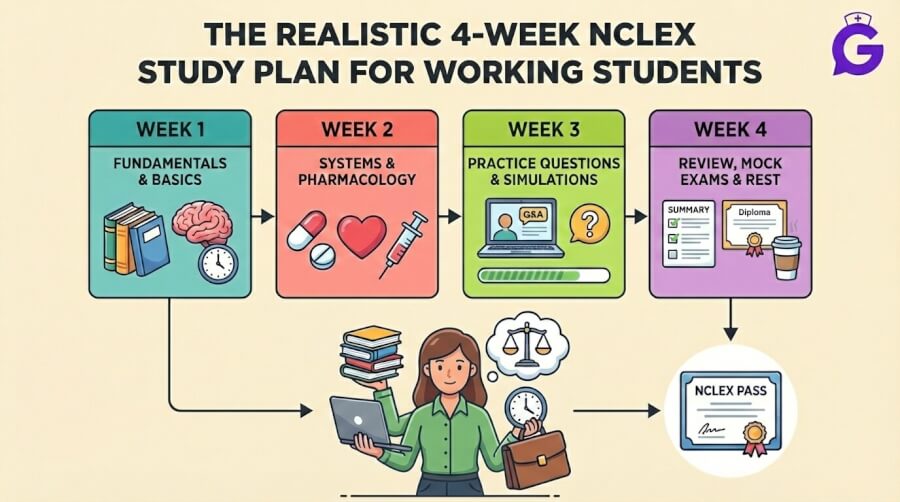
- 3–4 weeks available: The 4-Week NCLEX Study Plan for Working Students balances depth and sustainability — especially useful if you're working during your NCLEX prep window.
🎯 Ready to pivot from HESI to NCLEX prep?
GoodNurse picks up where your HESI prep left off. It generates adaptive NCLEX-style questions in all Next Gen NGN formats, focuses automatically on your weak content areas, and explains every answer with the clinical reasoning the NCLEX is actually testing. Most students see measurable improvement in their first 3 practice sessions.
Start NCLEX prep with GoodNurse →