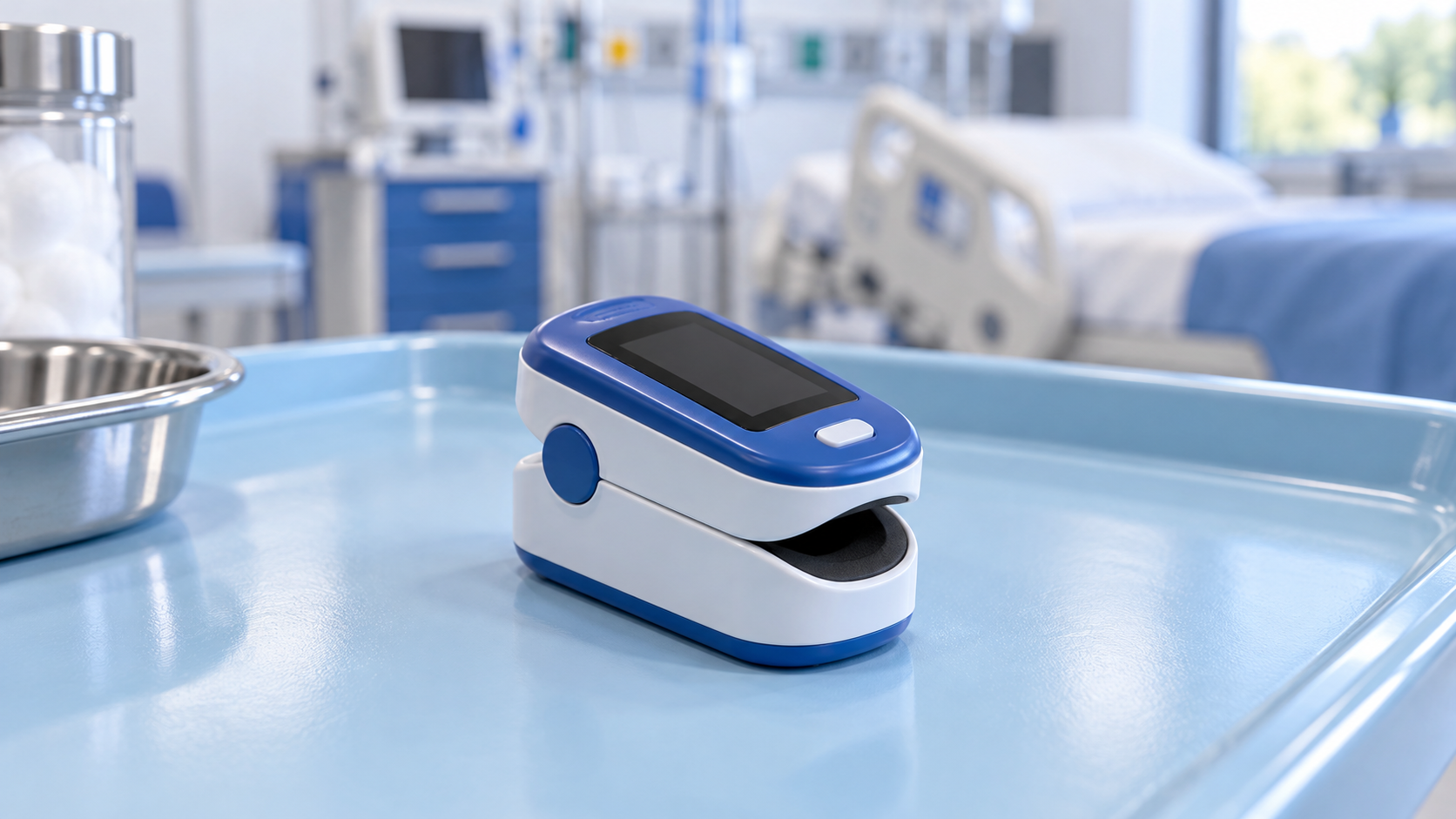


Pulse oximetry estimates the percentage of hemoglobin binding sites in arterial blood occupied by oxygen. The reading, called SpO2, helps assess oxygenation. It does not measure carbon dioxide, explain why a patient is breathless, or replace a respiratory assessment.
For a nursing student, the key question is broader than “What is the number?” Ask: What does this reading measure, how trustworthy is the signal, and does it fit the person in front of me?
OpenStax explains how hemoglobin saturation relates to oxygen transport.
This explanation is for nursing education and supervised learning. In clinical placement, follow your instructor, the patient's care plan, device instructions and facility escalation procedures.
What SpO2 actually measures
A fingertip pulse oximeter sends light through tissue and uses the detected signal to estimate arterial oxygen saturation. It also displays a pulse rate. This gives the team useful information without taking a blood sample, but it remains an estimate. See the FDA's explanation of pulse oximeters.
Keep three terms separate when reading a chart or case:
- SpO2: the oxygen-saturation estimate from a pulse oximeter.
- PaO2: the partial pressure of oxygen dissolved in arterial blood, reported in an arterial blood gas test.
- PaCO2: the partial pressure of carbon dioxide in arterial blood, also reported in an arterial blood gas test.
The two blood-gas measurements answer different questions from the percentage on the fingertip device. MedlinePlus explains the components of an arterial blood gas test.
A useful wording habit is “the oximeter estimates oxygen saturation,” rather than “the monitor proves the lungs are working normally.” The first describes the measurement; the second adds a conclusion the device cannot establish.
Oxygenation and ventilation are different
Oxygenation concerns oxygen entering the blood. Ventilation concerns moving air into and out of the lungs; effective ventilation helps remove carbon dioxide. NHLBI explains how breathing moves oxygen into the blood and carbon dioxide out. An SpO2 value does not reveal the patient's carbon dioxide level. The American Thoracic Society's pulse oximetry guide explicitly identifies that limitation.
That distinction matters when reading a simulated case. A display can show an apparently reassuring oxygen-saturation estimate while the case still contains concerning breathing or alertness findings. The number cannot settle a question about carbon dioxide that it never measured.
When an instructor asks what additional information you need, connect the information to the question:
- “I need the respiratory rate and pattern” addresses how the person is breathing.
- “I need to know whether supplemental oxygen is in use” adds context to the saturation reading.
- “I cannot infer PaCO2 from SpO2” identifies the limit of the measurement.
These are different statements. Avoid treating them as interchangeable evidence that everything is normal.
Why a pulse oximeter can give an inaccurate reading
The FDA lists poor circulation, skin pigmentation, skin thickness, skin temperature, tobacco use and fingernail polish among factors that can affect accuracy. MedlinePlus also identifies artificial nails. Movement can interfere with a reading, as the American Thoracic Society explains. These limitations are reasons to evaluate the measurement, rather than dismiss the patient or assume that every unusual value is equipment error. MedlinePlus pulse oximetry guidance.
Signal quality deserves its own check
In a skills lab, use the manufacturer's instructions to check sensor placement and the device's signal indicator, if provided. Consider movement and whether the extremity is cold. Allow the device to obtain a stable signal rather than recording the first changing digit. These checks align with the FDA's Pulse Oximeter Basics.
Comparing the displayed pulse with an independently assessed pulse can help evaluate signal quality; the ATS guide describes this check. Agreement is useful information, but it does not remove every source of saturation error.
Skin pigmentation is a patient-safety consideration
The FDA warns that pulse oximeters may be less accurate in people with darker skin pigmentation. The ATS guide notes that low oxygen saturation can be missed. A seemingly acceptable display therefore should not be used to dismiss concerning symptoms or assessment findings.
Do not invent a skin-tone correction by adding or subtracting a fixed percentage. These sources do not provide a universal correction formula. Recognize the limitation and communicate the full assessment to the supervising clinician.
Read the number in context
MedlinePlus describes 95%–100% as a usual normal saturation range, while noting that lung disease and higher elevation can change interpretation. That reference range is background knowledge, not a universal oxygen prescription or an instruction to manage every patient the same way.
For a supervised assessment or classroom case, organize the available information into four parts:
- The person: symptoms, respiratory rate and pattern, work of breathing and alertness.
- The measurement: the displayed saturation, pulse, signal quality and possible interference.
- The conditions: room air or the prescribed oxygen device and setting, plus rest or activity.
- The comparison: previous findings, the prescribed target and whether the current picture has changed.
If information is missing, label it missing. Do not fill in “room air,” “no distress” or “baseline” merely because the case does not mention them. For that distinction, review subjective and objective nursing data.
Concerning or worsening findings require prompt communication through the placement's escalation process. Troubleshooting a sensor should not delay getting help for a deteriorating patient.
Three short interpretation exercises
These are original fictional learning examples, not official NCLEX questions or treatment protocols.
A changing display during movement
During a skills demonstration, the volunteer moves their hand and the displayed saturation fluctuates. The learner writes, “The volunteer has a respiratory disease.”
What is the reasoning error? The learner has turned an uncertain measurement into a diagnosis. A better response identifies movement as a possible signal problem, follows the device instructions and reassesses the measurement alongside the volunteer's condition. The display alone does not establish a disease.
A reassuring number with missing information
A simulation handoff includes an SpO2 reading within the scenario's prescribed target. It also describes a new change in alertness. A learner says, “Carbon dioxide must be normal.”
What can you conclude? Carbon dioxide was not measured by the oximeter. The new finding still needs assessment and prompt communication. The learner should state what is known, what is concerning and what remains unknown, without choosing a treatment from the saturation value alone.
Two readings under different conditions
A worksheet gives one saturation reading at rest on room air and another during activity while prescribed oxygen is in use. A student compares the numbers without mentioning those conditions.
What is missing? The comparison needs its context. Record the conditions with each reading before interpreting a trend. A number separated from how and when it was obtained is an incomplete report.
For organizing a concise practice handoff, use GoodNurse's SBAR example. Keep the assessment findings and the request for help explicit.
A final check before you report SpO2
Be ready to explain the measurement, its limitations and the patient's current presentation. A sound student report communicates the reading and conditions, relevant changes, possible measurement problems and the assistance needed. It does not use one percentage to certify adequate ventilation or rule out deterioration.
AI-assistance note: This article was prepared with AI assistance using the linked sources, and its cover image is AI-generated. It has not received human clinical review.